

When several retrieval methods return the same document, they establish that the document appeared in several result lists. That recurrence can be useful for ranking. It does not, by itself, establish that several independent sources support the document’s claims.
A lexical search and a vector search may notice different properties of the same text while sharing the same corpus, metadata, and omissions. Their agreement can help identify a relevant candidate without providing new evidence that its contents are correct.
The useful distinction is between repeated retrieval of an item, complementary retrieval signals, and independent source support. These can occur together, but none should be assumed from the others.
Three kinds of agreement
“Several methods agree” is incomplete unless we say what they agree about.
The same item recurs across lists
A document appears in both a lexical result list and a vector result list. Assuming its identity has been matched correctly, this establishes recurrence across those retrieval outputs.
It does not establish two documents, two observations, or two confirmations of a claim. One document has been found twice.
Different retrieval signals converge
The lexical method may retrieve the document because it contains an exact identifier. The vector method may retrieve it because its description resembles the query’s meaning.
Those signals can be complementary. Together, they may help distinguish a useful result from documents that match only the identifier or only the broader topic. This is part of the rationale for hybrid retrieval.
Whether that convergence improves ranking is an empirical question. Different mechanisms do not automatically provide useful complementarity for every corpus or query.
Separate evidence supports a claim
Independent corroboration concerns the origins of evidence supporting a particular claim. For example, two separately conducted measurements may support the same finding without either merely repeating the other.
That is a different relationship from two search methods finding the same report. Retrieval methods compare queries with records; they do not create additional observations of the events those records describe.
Retrieval agreement concerns how an item was found. Corroboration concerns what supports a claim.
Why separate retrieval paths can share errors
Two pipelines can run separately without being statistically independent. Operational separation tells us where computation occurs, not whether the resulting signals have unrelated causes or failure modes.
A shared corpus limits what either path can find
Lexical and vector retrieval over the same collection both depend on what that collection contains. If the current revision of a document was never ingested, neither method can retrieve it from that collection.
Both paths may repeatedly return an outdated revision because it is the only available version. Their agreement does not resolve the missing information.
Related models may produce similar rankings
Two embedding models may share training material, model lineage, or representational tendencies. Even different models can favor similar language and miss similar distinctions.
Using two models therefore creates two retrieval outputs, but not necessarily two substantially different views. Model names alone do not establish how much useful diversity the second path contributes.
Duplicate pipelines repeat an existing preference
A second execution of the same deterministic retrieval configuration over the same query and index may return an identical list. Counting both lists in fusion gives that ordering additional influence without introducing a new retrieval perspective.
Near-duplicate pipelines are less straightforward. Small configuration changes can produce useful differences, but they can also repeat almost all of the original ranking’s strengths and weaknesses.
Common metadata errors can survive every path
Suppose a document is incorrectly labeled as applicable to a particular equipment model. If both retrieval paths use that shared field for filtering, both may admit the same inapplicable document.
The error sits upstream of their apparent agreement. Additional retrieval methods using the same incorrect field do not independently validate it.
Version, date, and applicability checks therefore need evidence appropriate to those questions. Version-aware retrieval addresses distinctions that relevance ranking alone may not preserve.
How another list increases a fused score
Reciprocal Rank Fusion, or RRF, makes the distinction visible. In ordinary unweighted RRF, each included appearance contributes:
Contributions are added across lists. Elastic’s RRF reference documents this rank-based calculation.
Consider two candidates from a diagnostic search:
- A reference document appears at lexical rank 1 and vector rank 2.
- A troubleshooting guide appears at vector rank 1 but is absent from the included lexical list.
Use ranks starting at 1 and a smoothing constant of k = 60. Now add an exact copy of the vector list as a third fusion input, with every list receiving equal weight.
| Candidate | Original two-list calculation | With the vector list counted twice |
|---|---|---|
| Reference document | 1/61 + 1/62 ≈ 0.03252 |
1/61 + 1/62 + 1/62 ≈ 0.04865 |
| Troubleshooting guide | 1/61 ≈ 0.01639 |
1/61 + 1/61 ≈ 0.03279 |
Both scores increase. Neither candidate acquires a new source, a new observation, or an additional check of its contents. The calculation simply counts another contribution from the repeated ranking.
For this exact duplication, the result is mathematically equivalent to giving the original vector list a weight of two while leaving the lexical list at weight one. The ordering of these two candidates stays the same, although duplicating a list can change ordering in other examples.
A highly similar—but not identical—third list is not exactly equivalent to doubling a weight. Its additional influence still needs to be understood and evaluated.
This is not a flaw in the arithmetic. RRF combines supplied rank positions; it does not inspect the causal relationships between retrieval paths or the provenance of source claims. Its score is not a probability of correctness. The related guide What Rankings Forget explains why turning positions into new numerical contributions does not recover the original score magnitudes.
What independent source support requires
Counting distinct documents is not enough either. Several documents can repeat one underlying source.
A manufacturer’s notice, a distributor’s summary, and a forum post quoting that summary may occupy three URLs. For the quoted specification, however, all three may trace back to the same notice.
That source could be authoritative for the specification. The problem is not that it appears only once at the origin. The problem would be representing its repetition as three independent confirmations.
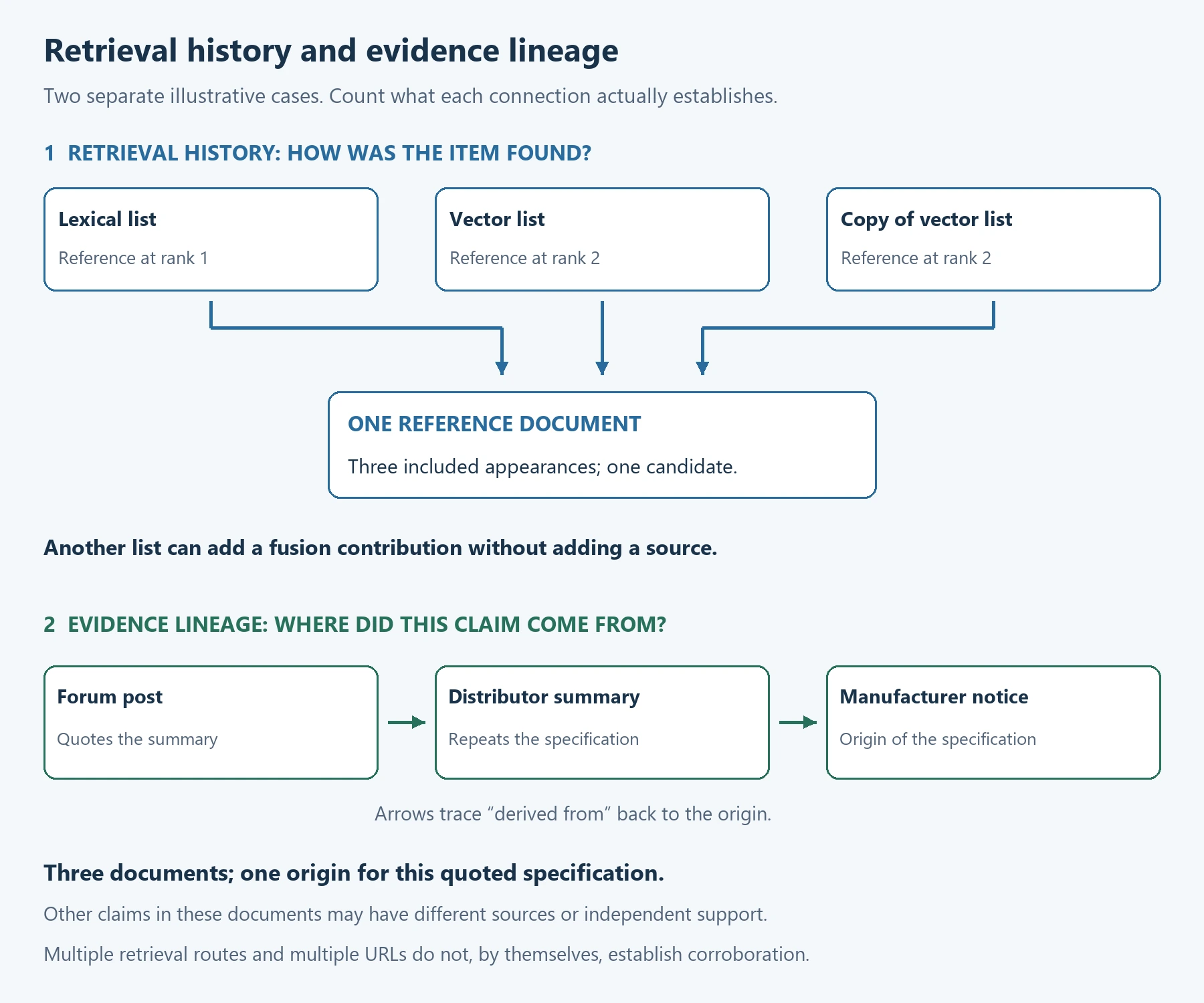
Useful questions include:
- What exact claim is being supported? Sources may agree on a headline while differing on scope or qualifications.
- Where did the information originate? Look for original records, observations, measurements, or analysis.
- Does one source depend on another? Quotations, syndication, copied tables, and shared datasets can connect apparently separate accounts.
- What dependencies remain? Separately written reports may still use the same instrument, dataset, or unverified assumption.
- Are the sources applicable? Agreement about a different date, version, jurisdiction, or operating condition may not support the present claim.
Independence is often partial and claim-specific. Two studies might analyze the same dataset using different methods. That can provide a useful check on the analysis without constituting independent data collection.
Document provenance helps preserve these relationships. Separate retrieval labels cannot substitute for tracing the evidence.
How to evaluate useful overlap
Shared dependencies do not make fusion useless. Methods can overlap substantially and still contribute useful differences. The question is whether the combination improves the task—not whether the lists are perfectly independent.
Measure overlap alongside relevance
Record which candidates recur, at what positions, and at what input depths. Then examine whether those recurring candidates are actually relevant under the task’s judgments.
High overlap can indicate that several methods consistently find useful material. It can also indicate redundant pipelines or a shared preference for irrelevant material. Low overlap can reveal complementary coverage or simply more unrelated results.
Overlap alone cannot distinguish these cases.
Inspect unique contributions
Identify relevant items found by only one path. A specialized lexical method might retrieve an exact identifier that several semantic paths miss. Multiple similar lists can otherwise overwhelm that uniquely useful result in a fused ordering.
Novelty alone is not sufficient either. A unique result is valuable when it contributes relevant information, not merely because it differs.
Remove paths and compare outcomes
An ablation test removes one component and measures what changes. Compare the complete fusion with versions that omit individual retrieval paths.
Keep queries, source snapshots, relevance judgments, and settings consistent. Record per-path candidate depths and practical latency or processing costs. If a path adds little useful coverage or ranking improvement, its additional complexity may not be justified.
Separate retrieval evaluation from evidence review
Retrieval evaluation asks whether the system finds and prioritizes useful candidates. Evidence review asks whether the retrieved material adequately supports particular claims.
A relevant document can contain an error. A correct document can be irrelevant to the question. A good evaluation should preserve both distinctions rather than treating retrieval success as factual verification.
The broader guide to evaluating retrieval quality develops task-based comparisons beyond whether a fused list looks plausible.
Preserving the distinction downstream
Interfaces and later processing stages can accidentally turn retrieval recurrence into apparent evidential strength.
A label such as “confirmed by three systems” overstates what happened if three retrievers merely returned one document. A more precise label is “returned by three retrieval paths,” accompanied by the path names and ranks when useful.
Similarly, context assembly should not present several retrieved copies or passages as independent sources simply because they arrived through different routes.
Preserve enough information to distinguish:
- the document, passage, and revision being retrieved;
- the paths that returned it and their individual contributions;
- copies, excerpts, and sources derived from a common origin;
- the claims each source actually supports;
- unresolved questions about provenance or applicability.
Deduplicating candidate identities does not mean ignoring recurrence during ranking. A system can combine contributions for one candidate while presenting that candidate once and retaining its retrieval history.
Likewise, preserving several distinct sources does not require pretending they are independent. Their relationships can remain visible.
A practical interpretation of agreement
Repeated retrieval is a reason to inspect an item, not a reason to stop inspecting it.
Agreement across useful retrieval methods can improve prioritization. Its value depends on what those methods contribute, which dependencies they share, and whether evaluation shows that their combination helps.
Independent corroboration requires a different inquiry into the origins and relationships of evidence. Finding one source several ways does not answer that inquiry.
The durable interpretation is modest: several retrieval paths surfaced this item under these conditions. Whether it is relevant, applicable, reliable, or independently supported remains a question for the appropriate evidence.