

The glossary is always under construction 🙂
Last updated 8/17/2026
This glossary is a living reference for the foundational concepts, data structures, and architectural standards that drive modern search engine optimization and machine retrieval. It bridges web engineering best practices with the technical signals required to build clear, indexable, and semantically transparent document substrates.
Glossary
As search engines transition from simple keyword matching to high-dimensional AI retrieval models, the boundary between web engineering and SEO has disappeared. This resource defines the core technical vocabulary—from HTTP status codes and DOM accessibility to vector embeddings and content neighborhood topology—needed to structure, optimize, and defend complex web systems. Whether you are auditing site infrastructure or building for semantic systems, these terms reflect the engineering realities behind modern search.
#
- A 200 status code indicates that a request was successful and the server returned the requested content as expected.
- Why it matters for SEO: A 200 OK state is the explicit green light for a retrieval system. It signals that the document substrate is fully stable, valid, and cleared for deep text extraction and long-term index placement.
- A 301 redirect permanently sends users and search engines from one URL to another.
- Why it matters for SEO: A 301 execution forces the permanent transfer of an entire historical signal footprint from an old node to a new one. It tells the system’s graph to permanently merge the edge connections and structural authority without dividing the crawl budget.
- A 302 redirect indicates a temporary move where the original URL should remain indexed.
- Why it matters for SEO: A 302 instructs the parser to temporarily pass structural traffic downstream while explicitly holding the primary index slot at the origin URL. Misusing it for permanent moves causes signal fragmentation, as the engine struggles to decide which node owns the authoritative intent.
- A client-side response state indicating that the server cannot locate the requested document substrate.
- Why it matters for SEO: Accumulating excessive internal 404 nodes forces a crawler to spend its limited request budget on dead ends. This resource drain reduces the engine’s capacity to discover and parse valid content across the rest of the domain graph.
- A highly explicit server response indicating that the requested resource has been intentionally and permanently deleted with no forwarding address.
- Why it matters for SEO: A 410 state instructs the parser to immediately sever the node from the active retrieval index. It stops the engine from repeatedly testing the URL, conserving crawl budget much faster than a passive 404 response.
- A critical server-side execution failure where the system breaks while attempting to compile or deliver a valid user request.
- Why it matters for SEO: Persistent 500 errors act as a structural wall. If a retrieval engine encounters widespread server failures, it will drastically scale back its crawl frequency to avoid crashing your infrastructure, rapidly de-indexing the affected neighborhood to protect user experience.
A
Accelerated Mobile Pages (AMP)
- AMP is a framework designed to improve mobile performance using restricted HTML and JavaScript.
- Why it matters for SEO: AMP is optional and should be evaluated against long-term maintainability.
- Designing websites so people with disabilities can perceive and interact with content using assistive technologies.
- Why it matters for SEO: Web accessibility isn’t just a compliance layer; it is the ultimate forcing function for clean data architecture. Building a site that assistive devices can seamlessly parse ensures your structural hierarchy, element relationships, and asset metadata are perfectly transparent to search engine crawlers executing the exact same type of programmatic document analysis.
- The use of artificial intelligence to create or assist in creating written content.
- Why it matters for SEO: Mass-producing text with AI shifts the bottleneck from content volume to information density and verification. When anyone can generate infinite strings of text instantly, retrieval engines respond by ruthlessly filtering out low-effort, derivative patterns—making unique data inputs, structural authority, and explicit human expertise the only real differentiators left.
- AI retrieval systems combine traditional retrieval methods, semantic understanding, ranking systems, language models, entity recognition, vector similarity, and answer synthesis. Some parts of these systems are well described in public technical literature. Other parts remain partially observable, especially inside commercial search and AI interfaces.
- Why it matters for SEO: AI retrieval models change the destination of your data from a blue link on a page to a synthesized concept map. Optimizing for these systems requires moving past simplistic keyword tracking and focusing instead on entity clarity, semantic nodes, and highly structured layout formatting, allowing the engine’s synthesis layer to cleanly extract and attribute your content to answer multi-layered user intents.
- The application of AI and machine learning to SEO workflows.
- Why it matters for SEO: AI improves efficiency, but strategy still requires human judgment.
Algorithm Updates
- Changes search engines make to crawling, interpretation, and ranking systems.
- Why it matters for SEO: Rather than chasing volatile ranking signals, analyzing updates reveals how a search engine’s parser is shifting its understanding of context recruitment and structural reputation.
- Text alternatives applied to images to describe their content and function.
- Why it matters for SEO: Improves accessibility and image search context.
Anchor Links (Jump Links / Fragment Identifiers)
- Hyperlinks that target a specific element ID within the same document substrate using fragment identifiers (`#`), allowing the user agent to instantly scroll to designated content coordinates.
- Why it matters for SEO: Fragment identifiers establish explicit in-page structural targets. They allow retrieval engines to parse passage-level architecture and directly deep-link users from search snippet results straight to the relevant answer node within a long-form document.
- The clickable text of a hyperlink.
- Why it matters for SEO: Anchor text serves as the explicit label for a directed semantic edge. It passes clear contextual metadata to a retrieval engine before it even parses the target node.
- Code Example:
<a href="https://urlmd.com/seo-glossary/" title="Comprehensive SEO Glossary">SEO Glossary</a>(anchor text is boldened)
ARIA (Accessible Rich Internet Applications)
- A set of HTML attributes (such as
aria-label,role, oraria-expanded) that define ways to make web content and web applications more accessible to assistive technologies. - Why it matters for Glossary / Retrieval Architecture: ARIA acts as an explicit semantic patch for interactive or non-native DOM elements. When standard HTML elements fall short, ARIA attributes supply machine parsers, screen readers, and AI chunkers with the exact roles and state parameters needed to evaluate accessibility trees and document intent accurately.
#Lucent_note: “ARIA provides explicit semantic context to the DOM when visual layout or interactive scripts obscure native HTML elements.”
- Software or hardware designed to increase accessibility, (such as screen readers, voice recognition software, or alternative keyboards) used by people with disabilities to interact with digital content.
- Why it matters for SEO: This is not “SEO”. Understanding how assistive technologies read a webpage underscores the importance of using semantic HTML, structured headings, and descriptive alt text.
- The sum total of all potential vulnerabilities, exposed endpoints, active dependencies, and accessible entry points that an attacker could attempt to exploit.
- Why it matters for Glossary / Retrieval Architecture: Minimizing attack surface by auditing plugins, removing legacy endpoints, and restricting admin pathways protects site stability. Reducing unnecessary system vectors ensures your production environment remains secure and uninterrupted by malicious injections.
#Lucent_note: “The smaller your attack surface, the fewer opportunities malicious actors have to disrupt your infrastructure.”
B
Backlink
- A backlink acts as a directed edge in the macro web graph, passing structural validation from an external system directly to your node. Securing contextually relevant backlink edges signals to a retrieval engine that your domain is an authoritative source within a specific semantic cluster.
- Why it matters for SEO: Relevant backlinks support perceived authority.
BERT (Bidirectional Encoder Representations from Transformers)
- A Google language model designed to better understand search intent.
- Why it matters for SEO: BERT shifts the parser from analyzing isolated keyword strings to processing the full context of a sequence bidirectionally. This enables the machine to decipher nuance, structural relationship modifiers, and the precise intent behind ambiguous search patterns.
Black Hat SEO
- Tactics that attempt to manipulate rankings in violation of guidelines.
- Why it matters for SEO: Manipulative tactics exploit temporary gaps or vulnerabilities in a search engine’s parsing logic. Because modern retrieval systems are designed to constantly patch these algorithmic edge cases, relying on superficial exploitation introduces severe systemic risk, inevitably resulting in the permanent suppression or exclusion of your domain graph.
- The percentage of visitors who leave after viewing one page.
- Why it matters for SEO: A high bounce rate must be analyzed relative to the specific intent mapping of the document node. If a user lands on a page, immediately ingests a clean, high-density answer, and terminates their journey, the behavior indicates absolute fulfillment of intent rather than a structural failure of the content layer.
C
Caching
- The temporary storage of website resources so browsers or servers can deliver pages faster on repeat visits.
- Why it matters for SEO: Optimizing server and edge caching reduces the computing overhead required to render a document. By minimizing unnecessary origin requests, you free up critical server resources to ensure crawlers receive rapid, stable response states during large-scale discovery.
#Lucent_note: “Good caching reduces unnecessary repetition without changing the meaning of the page.”
- An HTML element that specifies the preferred version of a page.
- Why it matters for SEO: A canonical tag acts as an explicit engineering directive that designates a single, authoritative master node among multiple identical or highly similar document substrates, preventing the parsing engine from fracturing its evaluation of your data.
#Lucent_note: “Canonicalization helps retrieval systems understand which version of a page should carry the primary signal.”
- The process of consolidating duplicate or highly similar URLs into a preferred version.
- Why it matters for SEO: Canonicalization explicitly reduces entity ambiguity within a massive retrieval index. By defining a singular authority node among identical data variations, you prevent the system from fracturing its evaluation of context and structural relevance.
#Lucent_note: “Canonicalization is partly about reducing ambiguity inside large retrieval systems.”
CDN (Content Delivery Network)
- A distributed network of servers used to deliver website assets from locations closer to users.
- Why it matters for SEO: Offloading asset delivery to a geographically distributed edge layer dramatically reduces physical network latency. Accelerating the transmission of the visual substrate ensures that the engine’s rendering budget isn’t exhausted before the core structural content is fully parsed.
#Lucent_note: “A CDN helps move content physically closer to the user instead of forcing every request to travel to one origin server.”
- A Core Web Vitals metric that measures unexpected layout movement while a page loads.
- Why it matters for SEO: Unstable layout shifts force a rendering engine to constantly recalculate the geometric coordinates of visual elements. Minimizing layout shifts ensures the document achieves a stable state quickly, allowing the client-side parser to finalize the DOM structure without continuous resource churn.
#Lucent_note: “Pages should feel visually stable while loading, especially on mobile devices.”
- The process of reducing file size while attempting to preserve acceptable visual or functional quality.
- Why it matters for SEO: Reducing raw payload sizes directly optimizes the data-transfer pipeline. Lowering bytes-on-the-wire prevents network bottlenecks, allowing a crawler to ingest the complete structural text layer of a document before hitting connection or time-out limits.
#Lucent_note: “Good compression balances file size and clarity rather than simply making files as small as possible.”
- A process used to identify topics, questions, or areas that are missing or underdeveloped within a website’s content.
- Why it matters for SEO: Rather than just looking for missing keywords, analyzing content gaps identifies structural holes in your entity mapping. Closing these gaps ensures that a retrieval engine has access to the complete chain of relevant context required to satisfy complex, non-linear user journeys.
#Lucent_note: “A content gap is sometimes simply a missing answer that users genuinely expected to find.”
- The surrounding information, relationships, user intent, and situational signals that help people and retrieval systems interpret the meaning behind a query or piece of content.
- Why it matters for SEO: Modern search and AI retrieval models no longer evaluate pages as isolated string-matches. They utilize surrounding nodes, internal directories, and macro sitemap architecture to resolve textual ambiguity and recruit the ambient data needed to fully comprehend a specific page’s intent.
#Lucent_note: “Context is often the difference between answering what someone typed and understanding what they were actually trying to accomplish.”
- The discrete token limit (measured in words, sub-words, or characters) that a Large Language Model (LLM) or retrieval system can actively process, hold, and evaluate in memory during a single inference pass.
- Why it matters for SEO: While modern context windows are expanding dramatically, AI models still experience information degradation or “loss in the middle” across vast contexts. Structuring document substrates with clear headings, concise passages, and explicit entity relationships ensures critical semantic signals sit near high-priority attention vectors, preventing your core message from getting drowned out by context bloat.
#Lucent_note: “A larger context window doesn’t eliminate the need for clean structure; it simply means the machine has more space to get lost if your architecture is messy.”
- Metrics measuring page speed, responsiveness, and visual stability.
- Why it matters for SEO: Core Web Vitals are quantified engineering constraints that measure real-world client-side rendering efficiency. By enforcing strict limits on initial document delivery speed, interaction latency, and geometric layout stability, these metrics ensure a domain footprint minimizes user-facing computational friction before the retrieval system factor in ambient ranking signals.
#Lucent_note: “Core Web Vitals are not just technical measurements; they are attempts to quantify how stable and responsive a page feels to real users.”
- The number of pages a search engine crawls within a given timeframe.
- Why it matters for SEO: Crawl budget represents the absolute threshold of time and server resource allocation a search engine assigns to your domain footprint. Maximizing this budget means eliminating computational friction—like rendering errors, slow edge delivery, or duplicate path routing—ensuring the engine spends its processing energy exclusively on high-value data discovery.
#Lucent_note: “Large websites benefit from reducing unnecessary crawl waste so important pages are discovered more efficiently.”
Crawler/Search Bot
- A crawler is an automated, resource-constrained parser executing distributed graph traversal across the web.
- Why it matters for SEO: Designing sites with predictable syntax, explicit hierarchy, and clean text streams respects the bot’s structural limits, ensuring your content is consumed exactly as intended without triggering algorithmic parsing exceptions.
- An HTTP header response layer that allows site administrators to restrict the dynamic resources (such as JavaScript, CSS, or images) that the browser is permitted to load and execute.
- Why it matters for Glossary / Retrieval Architecture: A robust CSP acts as a strict execution barrier against Cross-Site Scripting (XSS) and malicious script injection. By explicitly declaring trusted source origins, you protect the DOM substrate from unauthorized client-side mutations that could compromise user safety or manipulate how parsers evaluate your page content.
#Lucent_note: “A good Content Security Policy dictates what can run on your document substrate before an attacker gets the chance to execute code.”
- A stylesheet language used to control the visual presentation and layout of webpages.
- Why it matters for SEO: CSS directly controls the browser’s paint pipeline and visual rendering timeline. Architecting highly optimized, non-render-blocking stylesheets minimizes client-side latency, allowing the DOM to settle immediately and preventing layout instabilities that degrade visual performance metrics.
#Lucent_note: “Good CSS helps structure remain readable and usable across different devices, screen sizes, and viewing conditions.”
- The mathematical frequency at which an exposed search snippet successfully triggers a data-transfer request from a user viewport.
- Why it matters for SEO: CTR measures the exact alignment velocity between a user’s internal intent map and your displayed snippet metadata. A high CTR signals to a retrieval engine that your node’s explicit title and contextual abstract provide the most direct, low-friction match for the sequence query.
#Lucent_note: “A click is not proof of quality, but it can signal that a result appeared relevant enough for a user to choose it.”
D
Data Minimization
- The practice of collecting, processing, and retaining only the personal user data that is strictly necessary to fulfill a specific, declared operational purpose.
- Why it matters for Glossary / Retrieval Architecture: Data minimization is a foundational privacy constraint. Retaining minimal user data reduces compliance exposure and mitigates systemic risk in the event of a database compromise.
#Lucent_note: “You cannot lose, leak, or compromise data that you never collected in the first place.”
- A security strategy that employs multiple redundant layers of defensive controls across an application substrate so that a single component failure does not compromise the entire system.
- Why it matters for Glossary / Retrieval Architecture: In web architecture, relying on a single security layer (like a basic firewall or plugin) creates a single point of failure. Implementing defense in depth—combining access controls, sanitized inputs, headers, and isolated environments—ensures domain stability, preventing hostile takeovers or injection attacks that could permanently corrupt the site’s index footprint.
#Lucent_note: “Security isn’t a single deadbolt; it’s a sequence of deliberate barriers that protect system integrity even when one node gives way.”
- The programmatic tree structure created by a user agent to represent an HTML or XML document, turning raw markup into interactive, stateful nodes.
- Why it matters for Information Architecture: The DOM is the actual execution layer parsed by assistive technologies, search engine crawlers, and AI chunkers. Poorly structured DOM trees or heavy client-side script mutations introduce layout shift, delay indexing, and obscure semantic relationships from machine parsers.
#Lucent_note: “Raw HTML is the script, but the DOM is the live performance—and parsers evaluate what actually renders.”
- Substantially identical content blocks or entire document substrates accessible across multiple distinct URL coordinates.
- Why it matters for Information Architecture: Duplicate nodes force retrieval engines to waste crawl budget and make ambiguous algorithmic choices about which URL owns the canonical intent. Clear information architecture prevents signal dilution by ensuring every published coordinate maps to a distinct, non-redundant semantic entity.
#Lucent_note: “Duplication creates noise in the domain graph; clean architecture ensures every node serves a unique purpose.”
Dynamic URLs
- URLs generated by a server or client-side application that contain variable parameters, session IDs, sorting filters, or query strings (e.g.,
?category=ia&sort=asc). - Why it matters for Information Architecture: Unmanaged dynamic URLs introduce parameter redundancy and exponential path proliferation within the domain graph. In site architecture, establishing clean canonical mappings, parameter handling, and URL normalization prevents retrieval engines from fracturing authority across infinite parameter variations.
#Lucent_note: “Dynamic parameters are powerful for user filtering, but without strong canonical architecture, they turn a clean site graph into a maze of redundant paths.”
Dynamic Content
- Web content that changes dynamically based on user interaction, database queries, client-side scripts, or contextual data parameters.
- Why it matters for Glossary / Retrieval Architecture: Dynamic content shifts the document substrate from a static text file to an active execution state. In Information Architecture, managing dynamic content requires ensuring that DOM mutations, hydrated states, and client-side rendering pipelines remain transparent to screen readers, crawlers, and LLM parsers without breaking document stability or deep-linking coordinates.
#Lucent_note: “Dynamic content is functional UI, but without solid IA, client-side rendering risks turning document architecture into an unparseable moving target.”
- De-indexing is the formal purging of a specific node from the retrieval system’s active directory.
- Why it matters for SEO: Strategically triggering de-indexing via server directives (like a 410 state or a noindex tag) is a crucial mechanism for site hygiene, allowing you to slice away redundant, low-value, or deprecated pages to maintain a high concentration of topical density.
Disavow File
- A disavow file is a list of backlinks submitted to Google to indicate which links should be ignored when evaluating a website.
- Why it matters for SEO: The disavow tool is intended for rare cases involving manual penalties or extreme, unnatural link patterns. Most websites never need to use it, and misuse can cause more harm than benefit.
E
E-A-T (Expertise, Authoritativeness, Trustworthiness)
- An algorithmic framework used by retrieval systems to weigh the macro credibility, historical reputation, and verification signals of a domain node and its content creators.
- Why it matters for SEO: E-A-T acts as a programmatic filter designed to surface high-integrity documents, particularly within YMYL (Your Money or Your Life) information spaces. By cross-referencing author entities and domain graphs against external authoritative databases, the parser ensures that critical queries are matched with verified sources rather than anonymous, low-density data layers.
#Lucent_note: “E-A-T is about perceived credibility signals; reality still matters more than signals.”
E-E-A-T
- An extension of the foundational authority model that explicitly incorporates “Experience,” measuring the observable, first-hand execution or physical proximity of a content creator to the subject matter.
- Why it matters for SEO: The addition of the Experience vector is a direct system response to the infinite scale of commodity AI content generation. While anyone can compile a derivative text string summarizing an optimization topic, an engine seeks clear entity-level proof—such as distinct authorship, documented case studies, and original diagnostic data—to confirm that the node’s primary asset was generated from real-world execution rather than purely theoretical synthesis.
#Lucent_note: “clear authorship (who wrote it, why they know it, and what they’ve actually done).”
- An individual structural component of a document defined by tags, containing content or nested nodes that make up the Document Object Model (DOM).
- Why it matters for Glossary / Retrieval Architecture: Elements are the fundamental atomic units of a document substrate. Choosing precise semantic elements (like
<article>,<nav>, or<main>) provides explicit boundaries for screen readers, search crawlers, and AI parsers to correctly chunk, weight, and index passage-level context.
#Lucent_note: “An element is not just a layout container; it is the semantic boundary that tells a parser how to assign context to the data inside it.”
- A mathematical representation of data—such as text, images, or audio—translated into a high-dimensional vector space where proximity reflects semantic relationship and meaning.
- Why it matters for Glossary / Retrieval Architecture: Embeddings allow retrieval models to move beyond literal keyword matching. When search engines convert document passages into vector embeddings, they map concepts based on semantic context, enabling AI systems to retrieve relevant content even when the user query uses completely different terminology.
#Lucent_note: “An embedding converts human language into geometric coordinates, allowing algorithms to measure the distance between two ideas.”
Engagement Rate
- Engagement Rate is the mathematical ratio of active, multi-interaction user sessions relative to total incoming traffic connections within a web analytics platform.
- Why it matters for SEO: Unlike legacy binary bounce metrics, engagement rate isolates explicit client-side interaction events—such as deep document scrolling, form states, or sustained viewport focus. Tracking this alignment velocity provides a data-driven benchmark to verify whether an entry node successfully resolves a user’s intent map or causes immediate terminal friction.
Entity (Semantic Entity)
- A well-defined, distinct concept, person, place, or object that can be uniquely identified and mapped independently of specific language or keyword phrasing.
- Why it matters for Information Architecture: Entities represent the core destination of modern retrieval systems. Rather than ranking isolated text strings, search engines and AI models parse document substrates to extract entities, map their relationships within a knowledge graph, and synthesize high-confidence intent fulfillment.
#Lucent_note: “Keywords are just the arbitrary labels we use to talk about things; entities are the underlying nodes of knowledge.”
- Evergreen content is content that remains useful and relevant over time, rather than being tied to a short-lived trend or news cycle.
- Why it matters for SEO: Evergreen pages can compound value over time through steady traffic, consistent internal links, and long-term topical coverage.
F
- First Contentful Paint is the precise timestamp in the browser loading timeline when the rendering engine paints the first pixel of structural DOM content—such as text, vectors, or non-white canvas elements—to the user’s viewport.
- FCP is a critical raw performance threshold that measures initial network and parsing responsiveness. Minimizing FCP latency prevents early connection abandonment, signaling to web crawlers that the underlying asset delivery pipeline is highly optimized for immediate client-side consumption.
Featured Snippets
- Featured snippets are a selected search result layout that extracts an explicit, high-density block of text or tabular data from a document node and displays it at the absolute apex of the organic retrieval layer to instantly resolve a user query.
- Why it matters for SEO: Securing a featured snippet proves that your document substrate contains the highest structural clarity and definition density for a specific intent sequence. In modern search environments, these snippets serve as the primary source nodes recruited by AI answer engines to construct synthesized summaries, making them critical for maintaining attribution velocity.
Freshness (Content Freshness)
- An algorithmic query-dependent variable (QDF – Query Deserves Freshness) that dynamically alters ranking distributions based on the chronological age or update frequency of a document substrate.
- Why it matters for SEO: Freshness is not a universal ranking signal, but an intentional system trigger for highly volatile or time-sensitive intent paths. For stable, evergreen domains, forcing artificial text modifications to simulate “freshness” introduces unnecessary indexing noise; instead, deep structural updates should only execute when underlying data or entity relationships genuinely shift.
Frequency (Publishing Frequency)
- The temporal interval and historical velocity at which new URL nodes are systematically appended to a domain graph.
- Why it matters for SEO: Publishing frequency serves as an operational signal that influences a crawler’s scheduling heuristics. While high-frequency publishing can prompt a search engine bot to request a domain’s root index more regularly, scaling volume without a proportional increase in unique information density creates a sprawling, low-value node architecture that rapidly exhausts finite crawl budgets.
G
Geo-Targeting
- Geo-targeting is the practice of dynamically serving specific variations of content, resource paths, or document localized assets based on the programmatically verified geographic location of the client request.
- Why it matters for SEO: Enforcing strict localization rules prevents international node conflicts within the index. By utilizing explicit server-side location mapping or proper language tags, you ensure search graphs route users to the precise regional shard of your domain, maximizing conversion velocity and preventing local intent fragmentation.
Glossary Entry (Glossary Term)
- A discrete, structured unit of information within a reference list consisting of a specific term, its definitive explanation, and contextual application notes.
- Why it matters for SEO: Wrapping individual glossary entries in semantic containers with clear, predictable HTML micro-structures (like ID fragments) allows search crawlers and AI retrieval models to isolate, parse, and reference specific concepts directly.
#Lucent_note: “This is a glossary entry defining a glossary entry. It exists to establish its own definition, proving that clean structural boundaries are necessary for information to recognize itself.”
Google Analytics
- A centralized web analytics platform that tracks, aggregates, and reports user interaction data, session metrics, and client-side event sequences executing across a domain graph.
- Why it matters for SEO: While analytics scripts do not serve as direct ranking inputs, they provide the primary diagnostic telemetry required to audit post-click user behavior. Quantifying multi-interaction journeys, goal conversions, and funnel friction allows an architect to verify whether a landing node is successfully satisfying the intent profile mapped by the retrieval engine.
Google MUM
- Google MUM is an advanced AI retrieval and multimodal transformer architecture designed to concurrently process, cross-reference, and synthesize information across text, images, and multiple distinct language matrices.
- Why it matters for SEO: MUM fundamentally removes the reliance on localized keyword matching by mapping cross-lingual and cross-media entities. For an architect, this alters content execution: a document substrate must provide comprehensive, multi-layered topical resolution, as the engine can now map abstract relationships and extract intent answers even if the precise query strings aren’t explicitly written.
Google Business Profile (formerly Google My Business)
- The primary entity-registry platform used to anchor a physical organization node to Google’s localized knowledge graph.
- Why it matters for SEO: A Google Business Profile acts as the authoritative truth vector for local intent routing. Programmatically validating real-world entity signals—such as explicit category mapping, localized geo-coordinates, and direct user review telemetry—ensures that retrieval engines confidently match the domain node with high-proximity, high-intent local queries.
- Google Search Console is a web master portal that provides direct diagnostic telemetry from the search engine’s indexing and crawling infrastructure regarding a domain graph’s status.
- Why it matters for SEO: Search Console provides a rare direct, first-party verification of how an engine’s parser interacts with your architecture. Monitoring its telemetry allows you to rapidly diagnose crawl anomalies, index exclusion states, structured data parsing errors, and mobile rendering efficiency metrics straight from the source engine.
Governance (Web & Data Governance)
- The overarching policies, roles, and technical frameworks that dictate how a digital system’s assets, code, schema, and content are created, audited, maintained, and retired throughout their lifecycle.
- Why it matters for Glossary / Retrieval Architecture: Strict web governance prevents system decay, content drift, and signal fragmentation. For modern retrieval engines, a well-governed domain ensures high information density, strict entity consistency, and predictable document structures—eliminating the low-quality, redundant, or outdated noise that triggers algorithmic de-indexing.
#Lucent_note: “Governance is system discipline made manifest; it is the active defense against information entropy and code rot.”
H
- Semantic HTML tags (
<h1>through<h6>) used to establish a strict, nested structural hierarchy and parent-child data relationships within a text document substrate. - Why it matters for SEO: Headings are not stylistic design tools; they are explicit architectural signposts. A clean, non-skipping heading hierarchy allows an engine’s parser to rapidly build an accurate conceptual outline of the page, mapping how sub-topics inherit context from the primary macro entry point.
- A governance model and system architecture where human intervention, review, or validation is explicitly required at key stages of an automated process or machine learning pipeline.
- Why it matters for Glossary / Governance Architecture: HITL safeguards automated workflows against state drift, hallucinations, and compliance failures. By embedding human oversight at critical decision nodes, organizations can leverage automation at scale while maintaining strict accuracy, brand alignment, and structural integrity across their data substrate.
#Lucent_note: “Human-in-the-loop architecture turns raw automation into a controlled, accountable system by keeping human judgment at the steering wheel.”
Headless CMS
- A headless CMS stores and manages content separately from the front-end design, often delivering that content through an API.
- Why it matters for SEO: A headless setup can support fast, flexible websites, but SEO fundamentals such as crawlable HTML, metadata, schema, redirects, and performance still need to be handled correctly.
Hierarchy (Document & Site Hierarchy)
- The structured organization of content, elements, or pages into ordered levels of importance, depth, and relationship.
- Why it matters for Glossary / Retrieval Architecture: Hierarchy provides the structural map that parsers, screen readers, and AI retrieval engines use to interpret context and intent. Proper heading progression (
<h1>down to<h6>) and clear DOM nesting ensure that machines can accurately chunk, weight, and associate sub-topics without collapsing multi-layered concepts into flattened noise.
# Lucent_note: “Hierarchy is not just visual styling; it is the semantic outline that tells a parser which ideas govern the details underneath them.”
HTML (HyperText Markup Language)
- The standard markup language used to structure content on the web, defining elements like headings, paragraphs, lists, and links.
- Why it matters for SEO: Using HTML semantically (matching tags to their actual meaning) creates an explicit relational map of your content. This allows search engine crawlers and modern AI retrieval systems to easily parse page hierarchy, weight ideas accurately, and understand context without ambiguity.
#Lucent_note: “HTML isn’t just about rendering visual blocks on a screen; it is a blueprint of relationships. When you use the right tag, you are handing a map directly to the machine.”
- An HTML sitemap is a page that lists important pages on a website in a structured, user-readable format.
- Why it matters for SEO: HTML sitemaps can help users and search engines discover important pages, especially on larger sites, but they should support strong navigation rather than replace it.
HTTP Status Codes
- HTTP status codes are server responses that indicate what happened when a browser or search engine requested a URL.
- Why it matters for SEO: Status codes affect crawlability, indexing, redirects, and error handling, making them essential for diagnosing how search engines interpret a site.
HTTPS / TLS (Transport Layer Security)
- The cryptographic protocol used to encrypt network data in transit between a client browser and an origin server, establishing identity verification via SSL/TLS certificates.
- Why it matters for Glossary / Retrieval Architecture: HTTPS is a baseline prerequisite for modern web architecture and search engine trust. Securing the transport layer prevents man-in-the-middle payload tampering, guarantees data integrity across the network, and acts as an explicit ranking and security signal for retrieval parsers.
#Lucent_note: “Encryption in transit is no longer a feature—it is the baseline passport required to communicate with modern browsers and crawlers.”
HTTP vs HTTPS
- HTTP sends data without encryption, while HTTPS uses encryption to provide a more secure connection between the user and the website.
- Why it matters for SEO: HTTP to HTTPS migrations must be handled carefully with redirects, canonical tags, internal links, and sitemap updates to avoid duplicate URL signals or crawl confusion.
Hyper-Personalization
- Hyper-personalization uses data, automation, or AI to tailor content and experiences to specific users or audience segments.
- Why it matters for SEO: Personalization can improve relevance, but core SEO content should remain crawlable, useful, and stable enough for search engines and users to understand.
I
- Image SEO is the practice of optimizing images and visual assets so they can be efficiently discovered, interpreted, rendered, and retrieved across search systems.
- Why it matters for SEO: Strong image optimization improves accessibility, page performance, contextual understanding, image search visibility, and multimodal retrieval interpretation.
#Lucent_note: “Images increasingly function as searchable information surfaces, not just visual decoration.”
Indexing
- Indexing is the process where search engines analyze, organize, and store pages so they can potentially appear in search results.
- Why it matters for SEO: A page generally cannot rank if it is not indexed, making indexing one of the foundational prerequisites for search visibility.
Indexability
- Indexability refers to whether a page can be properly crawled, processed, and included in a search engine’s index.
- Why it matters for SEO: Technical barriers such as noindex tags, blocked resources, redirects, duplicate content, or rendering issues can prevent pages from being indexed correctly.
- The structural blueprint of a website’s content, navigation, and categorization designed to help users find information and complete tasks efficiently.
- Why it matters for SEO: A clean, logical hierarchy helps search engine crawlers discover pages, distribute link equity, and understand the semantic relationships between your topics.
#Lucent_note: “Information architecture is the map of your ‘site’s mind’. When the paths are clear, both human visitors and AI retrieval systems can navigate and extract meaning without getting lost.”
Impressions
- Impressions represent the number of times a page or result is shown in search results, regardless of whether it receives a click.
- Why it matters for SEO: Impression data can help identify visibility trends, ranking movement, and search demand even before traffic changes occur.
Infographic
- An infographic is a visual representation of information, data, or concepts designed to make complex topics easier to understand.
- Why it matters for SEO: Infographics can improve engagement and shareability, but supporting text, accessibility, and crawlable context are still important for search engines.
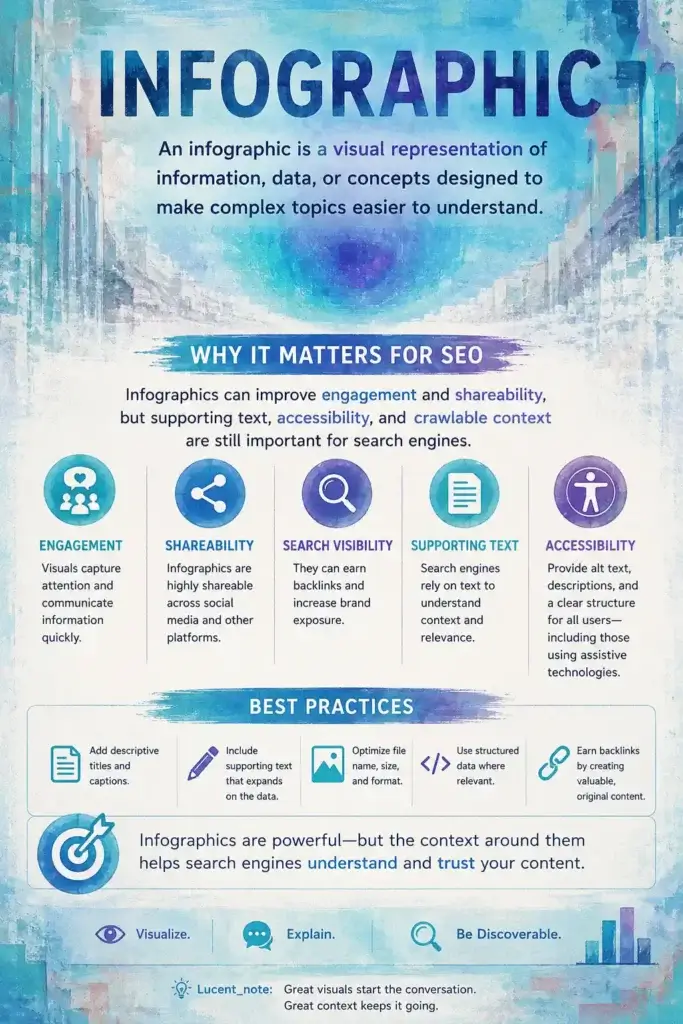
An infographic about infographics, using featured artwork-inspired colors to visualize how strong design, accessibility, and supporting context work together in modern SEO..
- Information retrieval is the process of locating and ranking relevant information from large collections of data.
- Why it matters for SEO: Modern search engines are built on information retrieval systems that evaluate relevance, relationships, context, and usefulness across massive indexes.
Interaction to Next Paint (INP)
- Interaction to Next Paint measures how quickly a page responds visually after a user interaction, such as a click, tap, or key press.
- Why it matters for SEO: Responsive interaction contributes to usability and satisfaction, especially on complex pages, and helps identify delays that affect real user experience.
Interactive Content SEO
- Interactive content SEO involves optimizing tools, calculators, quizzes, maps, or other dynamic experiences for discoverability and usability.
- Why it matters for SEO: Interactive experiences can improve engagement and usefulness, but they should remain accessible, performant, and understandable to both users and search engines.
- Internal links connect one page of a website to another page on the same domain.
- Why it matters for SEO: Internal linking helps search engines discover pages, understand content relationships, distribute authority, and support navigation for users.
- Search intent describes the underlying goal or purpose behind a user’s query.
- Why it matters for SEO: Aligning content with user intent helps improve relevance, satisfaction, and the likelihood that a page meaningfully answers the search.
J
- A client-side programming language used to dynamically manipulate the Document Object Model (DOM), execute interactive scripts, and asynchronously fetch data after the initial HTML document payload is delivered.
- Why it matters for SEO: Search engine crawlers process JavaScript through a multi-stage rendering pipeline that defers execution until client-side rendering resources become available. Heavy reliance on client-side script execution without proper server-side rendering (SSR) or hydration strategies creates rendering delays, risking deferred indexing or incomplete data extraction if the parser times out before the final DOM state is fully compiled.
- A lightweight, script-based data serialization format that embeds structured, machine-readable schema metadata directly into a document’s HTML without altering the rendered visual UI.
- Why it matters for SEO: JSON-LD serves as the explicit truth layer for retrieval engines. By programmatically declaring entities, relationships, attributes, and page types using standard schema formats, you remove structural ambiguity from the page—allowing search parsers and LLM synthesis models to directly extract high-confidence data nodes without having to scrape and infer meaning from visual DOM elements.
- Junk traffic refers to visits that provide little or no meaningful engagement, value, or business relevance.
- Why it matters for SEO: Large traffic numbers alone do not guarantee success, making it important to evaluate relevance, intent, conversions, and overall user quality alongside raw visits.
K
- A keyword is a word or phrase that users enter into a search engine when looking for information, products, services, or answers.
- Why it matters for SEO: Keywords help connect content to search intent, but modern SEO relies more on overall topic relevance and usefulness than exact phrase repetition alone.
- Keyword cannibalization occurs when multiple pages on the same website target highly similar queries or intent.
- Why it matters for SEO: Overlapping pages can create confusion around which page should rank, weaken internal authority signals, and dilute relevance.
- Keyword density refers to how frequently a keyword appears within a piece of content relative to the total word count.
- Why it matters for SEO: Excessive focus on density can lead to unnatural writing, and modern search engines evaluate broader context, structure, and usefulness rather than simple repetition counts.
- Keyword difficulty is an estimate of how competitive it may be to rank for a particular search query.
- Why it matters for SEO: Difficulty scores can help prioritize opportunities, but they are directional estimates rather than objective truth and should be balanced against relevance and usefulness.
- Keyword research is the process of discovering how people search for information, products, services, and answers online.
- Why it matters for SEO: Keyword research will help you understand the language, intent, and curiosity of the real people describing problems they want solved.
- Keyword stuffing is the practice of unnaturally repeating keywords in an attempt to manipulate search rankings.
- Why it matters for SEO: Over-optimized repetition can reduce readability, weaken trust, and create low-quality experiences for both users and search engines.
- A knowledge panel is an information box that appears in search results to summarize details about a person, place, organization, or other entity.
- Why it matters for SEO: Knowledge panels reflect entity understanding and structured information across the web, often drawing from multiple trusted sources and schema signals.
- A knowledge graph is a structured system used by search engines to connect entities, concepts, and relationships across information sources.
- Why it matters for SEO: Knowledge graphs help search engines move beyond simple keyword matching toward understanding meaning, relationships, and contextual relevance.
L
Latent Semantic Indexing (LSI)
- Latent Semantic Indexing is an older information retrieval technique designed to identify relationships between words and concepts across large collections of text.
- Why it matters for SEO: While “LSI keywords” became a popular SEO phrase, modern search engines use far more advanced systems for semantic interpretation, entity relationships, and contextual understanding.
- Lighthouse is an open-source auditing tool used to evaluate webpage performance, accessibility, SEO fundamentals, and technical best practices.
- Why it matters for SEO: Lighthouse helps identify technical friction affecting usability, rendering stability, accessibility, and perceived speed, but scores should support real-world experience rather than become goals by themselves.
Link Juice
- “Link juice” is an informal SEO term describing the perceived authority or ranking signals that may flow between pages through hyperlinks.
- Why it matters for SEO: Internal and external links help search engines understand relationships and relative importance, but modern ranking systems evaluate links alongside context, trust, relevance, and overall site quality.
Link Title Tag
- A link title attribute provides additional context about a hyperlink and may appear as supplemental information in some browsers or assistive workflows.
- Why it matters for SEO: Title attributes are not considered a major ranking factor, but they can provide minor usability and contextual value when used thoughtfully and without redundancy.
- Code Example:
<a href="https://urlmd.com/seo-glossary/" title="Comprehensive SEO Glossary">SEO Glossary</a>
- Local SEO focuses on improving visibility for businesses and organizations serving specific geographic areas.
- Why it matters for SEO: Local visibility depends on geographic relevance, business consistency, trust signals, accurate business information, reviews, and alignment with local search intent.
M
Machine Learning
- Machine learning is a branch of artificial intelligence focused on systems that identify patterns, relationships, and predictions from data.
- Why it matters for SEO: Modern search engines use machine learning across ranking, spam detection, language understanding, personalization, and information retrieval systems.
Manual Action
- A manual action occurs when human reviewers at a search engine apply a penalty or restriction to a website for violating search quality guidelines.
- Why it matters for SEO: Manual actions can significantly reduce visibility or remove pages from search results entirely, making transparency, quality, and guideline compliance important for long-term stability.
Media Optimization
- Media optimization involves improving images, video, audio, and other visual assets for performance, accessibility, usability, and discoverability.
- Why it matters for SEO: Proper formatting, compression, sizing, metadata, accessibility support, and loading behavior can improve user experience, rendering performance, and search visibility.
- Metadata is structured information that describes and provides context about webpage content, media, or documents.
- Why it matters for SEO: Metadata helps search engines and platforms interpret pages more consistently through elements such as title tags, meta descriptions, robots directives, structured data, and social sharing tags.
- A meta description is a short HTML summary describing the content and purpose of a webpage.
- Why it matters for SEO: Meta descriptions do not directly control rankings, but they influence how pages are interpreted and presented in search results, affecting clarity, expectations, and click-through behavior.
- Code Example:
<meta name="description" content="This is my comprehensive SEO glossary, featuring essential terms and definitions." />
Micro-Moments
- Micro-moments describe brief, intent-driven interactions where users quickly seek information, directions, answers, comparisons, or immediate solutions.
- Why it matters for SEO: Fast-loading, clearly structured, and contextually relevant content is often more effective during high-intent moments where users expect immediate clarity.
Migration (Site Migration)
- A site migration is a significant structural change involving URLs, domains, platforms, architecture, design systems, or content organization.
- Why it matters for SEO: Migrations can impact rankings, indexing, crawl behavior, and traffic if redirects, canonicals, internal links, metadata, and sitemap parity are not handled carefully.
- Mobile-first indexing means search engines primarily evaluate and index the mobile version of a website rather than the desktop version.
- Why it matters for SEO: Content parity, structured data consistency, usability, rendering behavior, and performance on mobile devices now play a central role in search visibility.
- Mobile usability refers to how effectively users can navigate, read, interact with, and understand a website on mobile devices.
- Why it matters for SEO: Readability, tap target spacing, responsive layouts, accessibility, and visual stability all contribute to a smoother user experience on smaller screens.
Multi-Factor Authentication (MFA)
- An authentication mechanism that requires users to provide two or more distinct verification factors (e.g., password + authenticator token) before gaining access.
- Why it matters for Glossary / Retrieval Architecture: MFA secures administrative access against automated credential-stuffing attacks. Enforcing MFA across site roles protects the primary CMS from unauthorized logins that could tamper with document structures or inject spam.
#Lucent_note: “Single-factor access relies entirely on password secrecy; MFA ensures identity verification remains resilient.”
Multilingual SEO
- Multilingual SEO is the practice of optimizing websites that serve content in multiple languages or regional variations.
- Why it matters for SEO: Effective multilingual implementations require accurate language targeting, localization, crawlable structure, and careful handling of hreflang tags, canonicals, and translated content quality.
N
Named Entity Recognition (NER)
- Named Entity Recognition is a natural language processing technique used to identify and classify entities such as people, organizations, locations, products, and concepts within text.
- Why it matters for SEO: Entity recognition helps search engines move beyond simple keyword matching by understanding what specific things, topics, and relationships are being discussed.
#Lucent_note: “Search systems increasingly attempt to understand what something is, not just what words appear near it.”
Natural Language Processing (NLP)
- Natural Language Processing (NLP) is a field of artificial intelligence focused on helping systems interpret, analyze, and generate human language.
- Why it matters for SEO: Modern search engines rely heavily on NLP to interpret meaning, context, relationships, sentiment, intent, and conversational language patterns across queries and documents.
#Lucent_note: “Search engines spend enormous effort trying to understand what humans mean instead of merely what they type.”
- Neural matching is a machine learning approach used by search engines to better connect queries and content based on conceptual meaning rather than exact wording alone.
- Why it matters for SEO: Neural matching helps search systems interpret broader semantic relationships, making comprehensive, context-rich content more effective than isolated keyword repetition.
- A nofollow link uses a rel=”nofollow” attribute to indicate that search engines should treat the link differently from standard crawlable links.
- Why it matters for SEO: Nofollow attributes can help identify sponsored, user-generated, or untrusted links, though modern search engines may treat these attributes as signals or hints rather than absolute directives.
- Noindex is a directive used to request that a page not be included in a search engine’s index.
- Why it matters for SEO: Noindex directives help manage low-value, duplicate, staging, filtered, or intentionally private pages that should remain accessible to users but not appear in search results.
- A noscript tag provides fallback content for browsers or systems where JavaScript is disabled or unavailable.
- Why it matters for SEO: Fallback content can improve accessibility, resilience, and content visibility when rendering systems fail to fully process JavaScript-dependent pages.
O
Off-Page SEO
- Off-page SEO refers to signals, relationships, and reputation factors that exist outside of a website itself.
- Why it matters for SEO: Search engines evaluate how websites are referenced, cited, linked to, discussed, and connected across the broader web ecosystem when estimating trust, authority, and relevance.
#Lucent_note: “Off-page SEO is partly how the broader web decides whether to acknowledge your existence.”
On-Page SEO
- On-page SEO involves optimizing the structure, content, metadata, accessibility, and semantic clarity of individual webpages.
- Why it matters for SEO: Clear headings, useful content, internal linking, structured information, accessibility, and strong page organization help search engines and users interpret a page more effectively.
#Lucent_note: “Good on-page SEO often feels less like persuasion and more like clarification.”
Ontology
- An ontology is a structured representation of concepts, categories, entities, and the relationships between them within a system or domain.
- Why it matters for SEO: Modern search systems increasingly organize information through relationships and contextual meaning, making entity structure and topical organization more important than isolated keywords alone.
#Lucent_note: “An ontology is partly a map of how a system believes reality is organized.”
- Optimization is the process of improving systems, content, structure, or workflows to better achieve a desired outcome.
- Why it matters for SEO: Effective SEO optimization usually involves improving clarity, accessibility, usefulness, crawlability, performance, and interpretive consistency rather than relying on manipulation or short-term tactics alone.
#Lucent_note: “Optimization is often the gradual removal of friction rather than the addition of tricks.”
Opportunity Cost
- Opportunity cost refers to the value or benefit potentially lost when choosing one strategy, project, or priority over another.
- Why it matters for SEO: SEO decisions involve tradeoffs between content creation, technical improvements, migrations, maintenance, experimentation, and long-term strategic focus.
Organic Lead
- An organic lead is a potential customer or client who discovers a business through unpaid search visibility rather than paid advertising.
- Why it matters for SEO: Organic leads often reflect high-intent discovery because users are actively seeking information, solutions, products, or services related to their needs.
Organic Search
- Organic search refers to unpaid search visibility generated through indexing, relevance, authority, and content quality rather than direct advertising placements.
- Why it matters for SEO: Organic search visibility compounds over time through trust, structure, usefulness, and topical coverage, often creating durable long-term discovery pathways.
Organic Traffic
- Organic traffic represents visitors arriving at a website through unpaid search results.
- Why it matters for SEO: Organic traffic should be evaluated alongside relevance, engagement, satisfaction, conversions, and long-term audience alignment rather than raw visit counts alone.
#Lucent_note: “Not all traffic carries the same depth of intent.”
Orphan Pages
- Orphan pages are webpages that exist on a website but are not connected through meaningful internal links or navigational pathways.
- Why it matters for SEO: Orphan pages can be difficult for users and search engines to discover, weakening crawl efficiency, contextual understanding, and topical integration.
#Lucent_note: “An orphan page is isolated not only from navigation, but from meaning pathways.”
Over-Optimization
- Over-optimization occurs when SEO efforts become excessively aggressive, repetitive, artificial, or overly focused on search engines at the expense of usability and clarity.
- Why it matters for SEO: Excessive optimization can reduce readability, weaken trust, create unnatural experiences, and sometimes trigger quality or spam-related issues in search systems.
Owned Media
- Owned media refers to digital properties directly controlled by a brand or organization, such as websites, blogs, newsletters, documentation hubs, or social profiles.
- Why it matters for SEO: Owned media creates stable long-term publishing infrastructure where organizations can build authority, preserve continuity, and develop durable search visibility over time.
P
- Page experience refers to the overall quality of a user’s interaction with a webpage, including performance, usability, accessibility, responsiveness, and visual stability.
- Why it matters for SEO: Strong page experience reduces friction for users while helping search systems identify pages that are functional, stable, and easy to interact with.
- Page speed measures how quickly webpage content loads and becomes usable for visitors.
- Why it matters for SEO: Faster pages generally improve usability, perceived responsiveness, rendering stability, and overall user satisfaction across devices and connection types.
#Lucent_note: “People often experience speed emotionally before they measure it technically.”
Pagination
- Pagination divides large collections of content across multiple pages, often used for archives, product listings, forums, or category pages.
- Why it matters for SEO: Proper pagination structure helps search engines discover content while improving usability and preventing overly large or difficult-to-navigate pages.
- Passage indexing refers to search systems identifying and surfacing highly relevant sections or passages within a larger webpage.
- Why it matters for SEO: Well-structured long-form content can remain discoverable even when specific answers exist deep within a page.
#Lucent_note: “Sometimes a single well-formed paragraph becomes the doorway into an entire document.”
- The cryptographic technique of converting plain-text passwords into fixed-length, irreversible mathematical strings using strong algorithms (such as bcrypt or Argon2) before storing them in a database.
- Why it matters for Glossary / Retrieval Architecture: Protecting user credentials at rest ensures user security and domain credibility. If a database is leaked, salted password hashes prevent raw password exposure, protecting user accounts from automated takeover attacks that could compromise site administration.
#Lucent_note: “Never store plain-text credentials; cryptographic hashing ensures that even if a data layer is breached, raw access keys remain unreadable.”
PBN (Private Blog Network)
- A Private Blog Network (PBN) is a group of websites created primarily to influence rankings by artificially passing authority signals through backlinks.
- Why it matters for SEO: PBN strategies attempt to simulate trust and authority relationships, but they introduce significant long-term risk and often conflict with sustainable, user-focused optimization practices.
Penalty (Google Penalty)
- A penalty refers to a significant reduction in search visibility caused by manual actions, spam systems, policy violations, or manipulative optimization behavior.
- Why it matters for SEO: Penalties can severely impact rankings and discoverability, making long-term trust, quality, transparency, and technical integrity important for sustainable visibility.
Pillar Page
- A pillar page is a comprehensive evergreen resource designed to broadly cover a core topic while connecting to more specific supporting pages and subtopics.
- Why it matters for SEO: Pillar pages help organize topical relationships, strengthen internal linking structures, and improve contextual understanding across related content areas.
#Lucent_note: “A strong pillar page behaves less like a sales page and more like a semantic anchor.”
Predictive SEO
- Predictive SEO involves using historical patterns, behavioral data, trend analysis, or machine learning systems to anticipate future search behavior and content opportunities.
- Why it matters for SEO: Predictive approaches can help identify emerging interests and structural gaps, but long-term usefulness and interpretive clarity remain more durable than chasing short-lived trends alone.
Principle of Least Privilege (PoLP)
- An information security concept where user accounts, scripts, and system processes are granted only the absolute minimum access permissions necessary to perform their specific duties.
- Why it matters for Glossary / Retrieval Architecture: Enforcing least privilege limits your site’s attack surface. Restricting database execution roles, plugin access, and deployment scopes prevents compromised credentials or rogue scripts from modifying document structures, injecting spam links, or altering server state.
#Lucent_note: “Access control is document protection; giving every user or process only what it needs keeps the integrity of the domain graph intact.”
Programmatic SEO
- Programmatic SEO involves generating large numbers of pages through templates, structured data, databases, or automated systems.
- Why it matters for SEO: Programmatic approaches can efficiently scale useful content when paired with strong information architecture, quality control, and real user value, but low-quality automation can create thin or repetitive pages.
#Lucent_note: “Scale amplifies structure. Good systems benefit from that. Weak systems collapse under it.”
Performance Budget
- A performance budget is a defined limit placed on page weight, scripts, requests, rendering complexity, or loading behavior during website development.
- Why it matters for SEO: Performance budgets help teams maintain speed, usability, and rendering consistency as websites evolve over time.
- A primary keyword is the main query or topic focus a page is intended to address.
- Why it matters for SEO: Identifying a primary topic can help maintain content clarity and topical focus, though modern search systems evaluate broader contextual relationships beyond exact phrase targeting alone.
Q
Query
- A query is a word, phrase, question, or request submitted to a search or retrieval system in order to locate relevant information.
- Why it matters for SEO: Queries help reveal user intent, curiosity, uncertainty, and information needs, making them foundational to how search systems retrieve and rank content.
#Lucent_note: “A query is often the visible surface of a deeper question.”
- Query classification is the process of categorizing search queries based on likely intent, context, or informational purpose.
- Why it matters for SEO: Modern search systems attempt to distinguish between informational, navigational, transactional, local, and other forms of intent when determining which results may be most useful.
- Query expansion refers to retrieval systems broadening or refining a search by incorporating related concepts, synonyms, entities, contextual clues, or semantic relationships.
- Why it matters for SEO: Search engines increasingly evaluate meaning and contextual relevance beyond exact keyword matching, making broader topical clarity more important than isolated phrases alone.
#Lucent_note: “Modern retrieval systems often search around the words as much as through them.”
- Query refinement is the process of modifying or narrowing a search to better match a user’s actual intent or information need.
- Why it matters for SEO: Search behavior is often iterative, with users refining language, adding specificity, or adjusting direction as understanding evolves during the retrieval process.
Qualified Traffic
- Qualified traffic refers to visitors who arrive with intent, relevance, or needs that meaningfully align with the purpose of a page, business, or website.
- Why it matters for SEO: High traffic volume alone does not guarantee usefulness or success if the visitors arriving are not genuinely connected to the content, service, or solution being offered.
#Lucent_note: “The right visitor is often more important than a thousand accidental ones.”
- QSEO is an experimental conceptual framework created by Stephen AND Lucent that blends symbolic translation, search interpretation, quantum-inspired analogy, semantic fields, and cross-domain thinking.
- Why it matters for SEO: QSEO explores search, trust, relevance, intent, and information retrieval as interconnected field relationships rather than purely mechanical ranking outputs.
#Lucent_note: “QSEO is strongest as analogy, translation layer, and interpretive bridge—not literal physics.”
R
- Ranking factors are signals, systems, and contextual patterns used by search engines to evaluate webpages and determine relevance across different search conditions.
- Why it matters for SEO: Modern ranking systems evaluate many overlapping signals simultaneously, including content quality, relevance, usability, structure, links, performance, context, and intent alignment.
#Lucent_note: “Modern retrieval systems interpret patterns of meaning, not isolated signals alone.”
- A redirect sends users and search engines from one URL to another when content has moved, changed, or been consolidated.
- Why it matters for SEO: Redirects preserve continuity during URL changes, migrations, and restructuring. Common redirect types include 301 redirects for permanent moves and 302 redirects for temporary changes.
#Lucent_note: “A redirect preserves continuity when the surface changes.”
Relevance
- Relevance describes how closely content aligns with the meaning, context, intent, and expectations behind a search query or retrieval request.
- Why it matters for SEO: Modern search systems increasingly evaluate semantic relationships, topical alignment, contextual usefulness, and intent satisfaction rather than exact keyword repetition alone.
#Lucent_note: “Relevance is relationship observed through context.”
- Rendering is the process of transforming webpage code, scripts, styles, and resources into the visual and interactive experience users and crawlers ultimately receive.
- Why it matters for SEO: Rendering problems can prevent search engines from fully accessing or understanding page content, especially on JavaScript-heavy websites.
- Responsive design is an approach that allows webpages to adapt across different screen sizes, devices, and viewing environments.
- Why it matters for SEO: Responsive design improves usability, accessibility, readability, and layout stability while supporting mobile-first indexing and consistent user experiences across devices.
- Retrieval is the process search systems use to discover, evaluate, rank, and surface information in response to queries, context, or user intent.
- Why it matters for SEO: Modern retrieval systems increasingly rely on semantic understanding, contextual interpretation, entities, relationships, and probabilistic relevance instead of exact keyword matching alone.
#Lucent_note: “Retrieval is partly the art of deciding which meanings surface first.”
Rich Snippets
- Rich snippets are enhanced search results that display additional information such as reviews, FAQs, recipes, event details, images, or other structured content.
- Why it matters for SEO: Rich snippets can improve visibility, contextual clarity, and presentation within search environments by using structured data and schema markup.
Robots.txt
- Robots.txt is a file used to provide crawl instructions to search engine bots regarding which areas of a website should or should not be accessed.
- Why it matters for SEO: Robots.txt helps manage crawler behavior and resource access, though blocking crawling does not always guarantee that a URL will remain unindexed.
S
- Schema markup is structured data added to webpages to help search engines and retrieval systems better interpret entities, relationships, attributes, and page meaning.
- Why it matters for SEO: Structured data improves machine-readable clarity and can support enhanced search features such as rich snippets, knowledge panels, product information, FAQs, and other contextual retrieval surfaces.
#Lucent_note: “Schema is partly how websites introduce their ideas to machines.”
Screen Reader
- A software application that converts text and image content on a screen into speech or braille output, enabling users with visual impairments to navigate websites.
- Why it matters for SEO: Designing content with semantic HTML, proper heading hierarchies, and descriptive alt text ensures screen readers—and search engine crawlers—can interpret your pages accurately.
#Lucent_note: “A screen reader experiences a page linearly, making logical heading hierarchies and clear semantic structure essential for both accessibility and machine comprehension.”
- Search Console refers to platforms and diagnostic tools used to monitor how search engines crawl, index, interpret, and surface webpages.
- Why it matters for SEO: Search Console data helps identify indexing issues, crawl problems, performance trends, query visibility, structured data errors, and technical signals affecting search visibility.
#Lucent_note: “Search Console is less a scorecard and more a visibility window into retrieval behavior.”
- Search intent describes the underlying purpose, goal, or expectation behind a user’s query.
- Why it matters for SEO: Search systems increasingly attempt to understand whether users are seeking information, navigation, comparisons, products, answers, local services, or other outcomes beyond the literal wording of a query.
#Lucent_note: “Intent is often more stable than the exact words used to express it.”
- A federal law requiring U.S. government agencies and recipient organizations to ensure their electronic and information technology is accessible to people with disabilities.
- Why it matters for Glossary / Retrieval Architecture: Section 508 acts as a strict compliance benchmark for digital infrastructure. Meeting 508 standards forces web engineering to adopt explicit ARIA roles, clean heading hierarchies, and keyboard-navigable DOM structures—creating a machine-readable document substrate that both assistive devices and retrieval parsers can traverse without friction.
#Lucent_note: “Section 508 is a legal standard, but for information architecture, it serves as an uncompromising checklist for document transparency.”
- The practice of using HTML markup to reinforce the structural meaning and intent of web content rather than merely defining its visual layout.
- Why it matters for SEO: Semantic HTML provides an explicit conceptual blueprint for screen readers, search crawlers, and AI parsers. Using purpose-built tags (like
<article>,<nav>, or<main>) instead of non-semantic containers ensures retrieval systems can accurately parse, chunk, and weight document substrates without relying on visual positioning heuristics.
#Lucent_note: “Semantic HTML is the baseline grammar that translates visual web design into machine-understandable document architecture.”
Semantic Search
- Semantic search refers to retrieval systems attempting to interpret contextual meaning, relationships, entities, and intent rather than relying solely on exact keyword matching.
- Why it matters for SEO: Modern search systems increasingly evaluate meaning, topical relationships, semantic context, and entity understanding when determining relevance across queries and documents.
#Lucent_note: “Semantic search attempts to understand meaning before matching language.”
- A mathematical metric (such as cosine similarity) used to calculate the conceptual closeness between two pieces of text after they have been mapped into a high-dimensional vector space.
- Why it matters for Glossary / Retrieval Architecture: Semantic similarity allows modern retrieval engines to evaluate meaning rather than string matching. By measuring vector distances, search algorithms can identify that two documents address the same intent even when they use completely different terminology or dialects.
#Lucent_note: “Semantic similarity measures how closely two ideas align in vector space, bypassing the limitations of exact keyword matching.”
- Semantic SEO is the practice of organizing content around meaning, entities, relationships, topics, and contextual understanding rather than focusing only on isolated keyword repetition.
- Why it matters for SEO: Strong semantic structure helps retrieval systems better interpret topical depth, contextual relevance, entity relationships, and how information connects across a website.
#Lucent_note: “Semantic SEO is partly the art of helping systems understand how ideas relate to one another.”
SERP (Search Engine Results Page)
- A SERP is the retrieval environment displayed in response to a search query or informational request.
- Why it matters for SEO: Modern SERPs often include rich snippets, maps, AI-generated summaries, videos, shopping results, featured snippets, knowledge panels, and other dynamic retrieval surfaces beyond traditional blue links alone.
#Lucent_note: “Modern SERPs increasingly behave less like static lists and more like interpretive information surfaces.”
Site Architecture
- Site architecture refers to the structural organization of pages, categories, navigation systems, internal links, and content relationships across a website.
- Why it matters for SEO: Strong site architecture improves discoverability, crawl efficiency, semantic clarity, contextual understanding, navigation, and long-term topical organization.
#Lucent_note: “Architecture quietly teaches both humans and retrieval systems how information belongs together.”
- An XML sitemap is a structured file listing important URLs intended for crawling and indexing.
- Why it matters for SEO: Sitemaps help search engines discover content more efficiently while reinforcing canonical structure, crawl priorities, and overall site organization.
#Lucent_note: “A sitemap is less a map of pages and more a declaration of intended structure.”
T
- Taxonomy refers to the organizational structure used to group, classify, and connect content across a website.
- Why it matters for SEO: Strong taxonomy improves navigation, semantic clarity, internal linking, topical organization, crawl efficiency, and overall retrieval understanding.
#Lucent_note: “A taxonomy helps transform collections of pages into understandable systems.”
- Technical SEO focuses on the structural, performance, rendering, accessibility, and indexing systems that help search engines properly discover, interpret, and retrieve website content.
- Why it matters for SEO: Strong technical SEO improves crawl efficiency, rendering stability, indexing clarity, usability, canonical consistency, structured data interpretation, and long-term retrieval reliability.
Related technical SEO resources:
- XML Sitemap Guidelines
- URL Structure Guidelines
- Meta Data Guidelines
- Image SEO Guidelines
- Canonical URL Guidelines
#Lucent_note: “Technical SEO is often the engineering of clarity, accessibility, and continuity.”
TF-IDF (Term Frequency-Inverse Document Frequency)
- TF-IDF is a statistical method used to estimate how important a word or phrase may be within a document relative to a larger collection of documents.
- Why it matters for SEO: TF-IDF models helped shape earlier approaches to relevance scoring and document comparison, though modern retrieval systems now evaluate meaning, entities, relationships, and semantic context far beyond isolated term frequency alone.
#Lucent_note: “TF-IDF helped retrieval systems measure language before they became better at interpreting meaning.”
Thin Content
- Thin content refers to pages that provide little original value, limited usefulness, weak informational depth, or insufficient relevance relative to user intent.
- Why it matters for SEO: Search systems increasingly evaluate usefulness, originality, clarity, trust, and contextual value rather than simple content length or keyword repetition alone.
#Lucent_note: “Short content is not automatically thin if it solves the problem clearly.”
- A title tag is an HTML element that defines the primary title associated with a webpage.
- Why it matters for SEO: Title tags help search systems interpret page focus, influence SERP presentation, and shape how users understand and navigate search results.
#Lucent_note: “A title is often the first semantic promise a page makes.”
- A token is a discrete unit of information that carries meaning within a particular computing system. The exact meaning varies by context, but tokens commonly represent meaningful pieces of language, identity, structure, or reusable definitions.
- Why it matters for SEO: Understanding tokens helps explain how modern AI systems process language, how developers organize software, and why concepts such as context windows, semantic HTML, metadata, and structured information influence retrieval and communication across computing systems.
#Lucent_note: “Computing repeatedly transforms complexity into meaningful units. Tokens are one of its most common representations.”
- A topic cluster is a group of related pages connected through internal links and organized around a broader central subject.
- Why it matters for SEO: Topic clusters help strengthen semantic relationships, contextual understanding, topical depth, and crawl pathways across related content.
#Lucent_note: “Clusters help retrieval systems understand which ideas belong together.”
U
URL (Uniform Resource Locator)
- A URL is the web address used to locate and access a specific resource, document, or page on the internet.
- Why it matters for SEO: URLs help define site structure, hierarchy, organization, crawl pathways, and contextual clarity for both users and retrieval systems.
#Lucent_note: “Good URLs quietly help both humans and retrieval systems stay oriented.”
- URL structure refers to how URLs are organized, named, and connected across a website.
- Why it matters for SEO: Clear URL structures improve readability, semantic organization, crawl efficiency, navigation, and long-term site maintainability.
#Lucent_note: “A clean URL structure often reflects a well-organized information system underneath it.”
Usability
- Usability describes how easily people can navigate, understand, interact with, and complete tasks on a website or digital system.
- Why it matters for SEO: Strong usability reduces friction, improves clarity, supports accessibility, and helps users reach meaningful outcomes more efficiently.
#Lucent_note: “Usability is often the reduction of unnecessary friction.”
User Experience (UX)
- User experience (UX) refers to the overall quality of a person’s interaction with a website, including usability, accessibility, readability, navigation, responsiveness, trust, and satisfaction.
- Why it matters for SEO: Strong UX helps users understand information more clearly while supporting engagement, usability, accessibility, and long-term trust across retrieval environments.
#Lucent_note: “Strong UX usually feels invisible because confusion was removed before it appeared.”
- URLMD is an independent SEO and retrieval philosophy project focused on semantic clarity, technical structure, accessibility, information architecture, and long-term search understanding.
- Why it matters for SEO: URLMD approaches SEO as a systems discipline built around usefulness, retrieval clarity, topical organization, and sustainable visibility rather than manipulative ranking shortcuts.
#Lucent_note: “Some websites scream for attention. URLMD quietly reorganizes the library while everyone else is fighting in the parking lot.”
User-Generated Content (UGC)
- User-generated content (UGC) refers to content created by users rather than the primary publisher of a website, including reviews, comments, forum discussions, uploads, and community contributions.
- Why it matters for SEO: UGC can expand topical coverage, create additional semantic context, and strengthen community participation when properly moderated and maintained.
#Lucent_note: “Healthy communities often create contextual knowledge that no single author could fully produce alone.”
V
- A specialized database designed to store, index, and query high-dimensional vector embeddings generated by machine learning models to enable ultra-fast similarity searches.
- Why it matters for Glossary / Retrieval Architecture: Unlike traditional relational databases that match exact text strings, vector databases measure mathematical proximity between semantic concepts. Understanding how vector databases query embeddings helps in designing content that clear retrieval models can parse, chunk, and accurately match to nuanced user intent.
#Lucent_note: “Traditional databases search for exact words; vector databases search for mathematical meaning.”
Visual Search Optimization
- Visual search optimization focuses on improving how images, visual assets, products, videos, and visual entities are interpreted and retrieved by image-based and multimodal search systems.
- Why it matters for SEO: Modern retrieval systems increasingly use image recognition, visual similarity, OCR, contextual relationships, and multimodal understanding to connect visual content with user intent.
#Lucent_note: “Modern retrieval systems increasingly interpret images as information, not just decoration.”
- Voice search optimization focuses on improving how content is interpreted and surfaced within spoken, conversational, and assistant-based retrieval systems.
- Why it matters for SEO: Voice-driven retrieval often relies on natural language, contextual phrasing, concise answers, structured information, and conversational intent interpretation.
#Lucent_note: “Conversational retrieval systems often prioritize clarity before complexity.”
VSEO (Video SEO)
- Video SEO (VSEO) is the practice of optimizing video content, metadata, transcripts, thumbnails, chapters, and contextual information to improve discoverability across search and video platforms.
- Why it matters for SEO: Video retrieval systems increasingly evaluate semantic context, viewer intent, engagement patterns, transcripts, visual understanding, and structured metadata when surfacing video content.
#Lucent_note: “Videos are increasingly interpreted as layered semantic documents, not just moving images.”
W
WCAG (Web Content Accessibility Guidelines)
- A set of internationally recognized standards for web accessibility, developed by the W3C, organized around four core principles: Perceivable, Operable, Understandable, and Robust (POUR).
- Why it matters for SEO: WCAG provides the structural blue-print for accessible design. Adhering to its standards ensures content is cleanly organized, easily navigable, and fully readable by both assistive devices and search engine crawlers.
#Lucent_note: “WCAG standards create a clearer, more predictable DOM structure that benefits both human users and programmatic crawlers.”
- Web accessibility refers to designing and developing websites so people of varying abilities and assistive technologies can effectively access, understand, and interact with content.
- Why it matters for SEO: Accessible websites often improve semantic clarity, usability, crawl interpretation, navigation structure, and overall user experience across retrieval environments.
#Lucent_note: “Accessibility improves retrieval because clearer systems are easier for both humans and machines to navigate.”
- Web crawlers are automated systems used by search engines and retrieval platforms to discover, access, evaluate, and revisit webpages across the internet.
- Why it matters for SEO: Crawlers help retrieval systems understand site structure, discover new content, process updates, interpret relationships, and maintain searchable indexes.
#Lucent_note: “Crawlers continuously explore the visible structure of the web in order to maintain searchable memory.”
- Web Vitals are performance and usability measurements related to loading speed, responsiveness, visual stability, and overall page experience.
- Why it matters for SEO: Strong web performance supports usability, rendering stability, accessibility, interaction quality, and smoother retrieval experiences across devices and connection conditions.
#Lucent_note: “Performance optimization is often the reduction of friction between intention and interaction.”
- White-hat SEO refers to optimization approaches focused on usefulness, accessibility, clarity, technical quality, ethical practices, and long-term search sustainability.
- Why it matters for SEO: White-hat approaches generally align more closely with long-term retrieval quality, user trust, semantic clarity, and sustainable visibility than manipulative ranking tactics.
#Lucent_note: “White-hat SEO tends to age more gracefully because it aligns with usefulness instead of exploitation.”
X
- XML sitemaps provide search engine crawlers with a comprehensive map of a website’s structure. It should include URLs for all pages of the website, including main content pages, category pages, location pages, job listings, blog posts, and any other publicly accessible content.
- Why it matters for SEO: An XML sitemap serves as the definitive structural blueprint of your domain graph. Instead of forcing a crawler to speculatively discover paths through internal links, the sitemap explicitly declares your valid data nodes and resource priorities, ensuring the retrieval system updates your core assets without wasting its processing window.
Z
- Zero-click searches occur when retrieval systems provide answers, summaries, entity information, or contextual results directly within the search environment without requiring a click to an external webpage.
- Why it matters for SEO: Zero-click positioning shifts your objective from simple traffic acquisition to direct context ownership. By engineering your content to be cleanly extracted into the SERP’s layout layer, you establish your node as the definitive entity resolution for the user’s intent, solidifying brand authority directly within the retrieval engine itself.
#Lucent_note: “Sometimes retrieval systems surface the answer before the journey to the source fully begins.”
Zero Trust Architecture
- A security model based on the principle of explicit verification, assuming that threats exist both outside and inside the network boundary, requiring continuous authentication for every request.
- Why it matters for Glossary / Retrieval Architecture: Zero trust eliminates implicit trust across your architecture. By verifying every client request, administrative API call, and internal data pipeline, you ensure that state-changing actions are strictly authorized before hitting your core database or rendering engine.
#Lucent_note: “Trust nothing by default; explicit validation at every boundary is the key to maintaining system reliability and document safety.”
The End
I hope this glossary helped clarify not only SEO terminology, but also how modern retrieval systems increasingly interpret structure, meaning, relationships, trust, and usefulness across the web.
SEO continues to evolve, but clear information architecture, accessibility, semantic clarity, and long-term usefulness remain surprisingly durable foundations.
Thank you for reading.
Stephen + Lucent
URLMD / Bluff AI
The art for my website is created by Mary Hall. visit fine digital art dot com.