

I build human-guided AI systems for producing, organizing, and publishing substantial website content.
That work includes the software, context preparation, information architecture, editorial processes, and publication controls needed to move from an idea or established subject map to useful, structured documents.
Once a production environment is prepared, substantial HTML drafts can sometimes be generated within minutes. The speed is useful, but it is not the defining feature of the work. The more important achievement is creating a repeatable process in which automation handles much of the mechanical effort while people retain responsibility for what the website communicates.
I’ve developed this approach through sustained production and review across hundreds of substantial pages, different subjects, and multiple website environments. The systems continue to evolve as I use them.
What human-guided production means
Human-guided content production combines generative systems with deliberate human direction, evaluation, and editorial control.
Human participation is not limited to approving a finished draft. It begins with understanding the website, its audience, the information it already contains, and what additional material would serve a useful purpose.
Related reading: Automation Boundaries: Designing Responsible Transitions Between Human Judgment and Automation.
The approach draws on principles of human-in-the-loop systems, but human involvement can occur throughout the process rather than at a single approval checkpoint.
Depending on the project, my responsibilities may include:
- understanding the website, organization, audience, and purpose;
- identifying useful subjects and information gaps;
- planning relationships between articles, services, definitions, and supporting pages;
- preparing working context and editorial direction;
- designing or adapting the production workflow;
- reviewing the substance, organization, and structure of completed documents;
- integrating content with the website’s information architecture; and
- controlling what is saved, revised, and published.
- cracking jokes at Lucent’s expense
- taking what i dish out
The process uses shared expectations where consistency is useful while allowing individual documents to develop according to their subjects.
Content governance helps preserve those expectations. It also provides a way to question whether a proposed document should exist at all.
Preparation and production speed
The visible act of generating a document is only one part of the work.
Before production begins, I may establish the subject map, editorial direction, terminology, source material, structural expectations, and relationships to existing website content. This preparation is part of context assembly: bringing the information relevant to a particular task into a usable working environment.
Once that environment exists, settled decisions can be carried forward instead of being reconstructed for every document. This makes it possible to work efficiently across related subjects without requiring every page to follow an identical template.
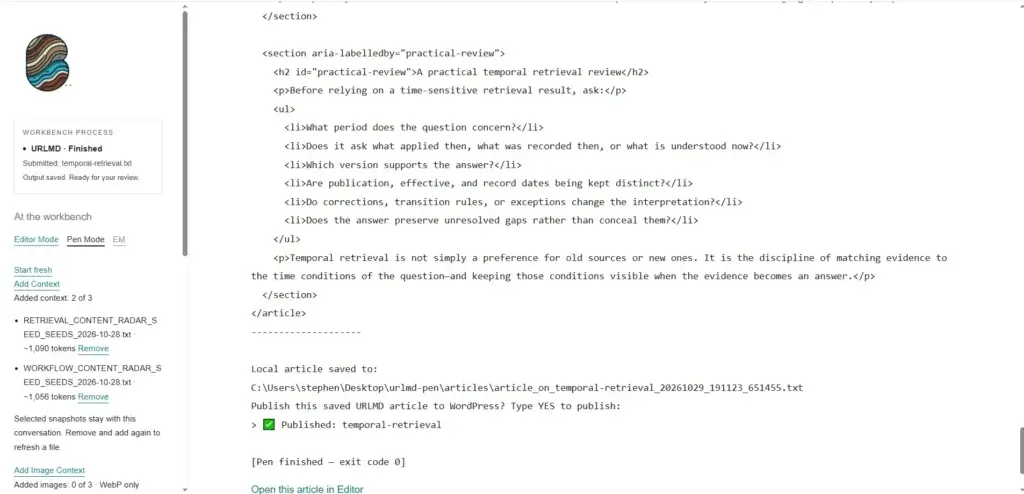
During prepared production runs, I have sometimes generated complete long-form HTML drafts at approximately one every two minutes. These are substantial working documents rather than title lists or skeletal outlines.
That is an observed composition rate, not a promise about finished publication. Research, context preparation, editorial review, corrections, internal linking, and website integration require additional attention. Some documents need considerably more of it than others.
A coordinated collection of regional pages presents a different problem from a series of unrelated technical references. A consequential subject may require extensive investigation before drafting should begin.
The practical advantage comes from preserving useful decisions and reducing unnecessary repetition. This is one of the concerns of workflow architecture: arranging work so that human attention can remain focused on meaningful differences, uncertainties, and decisions.
Speed follows preparation. It does not replace understanding.
Content engineering
I treat website content as structured information, not simply generated prose.
A document needs to communicate its subject, but it also needs to function within browsers, publishing systems, navigation structures, accessibility requirements, and the larger collection of information to which it belongs.
Document engineering considers how meaning, structure, relationships, and document history remain understandable as information moves between people and systems.
For website production, I generally work with semantic HTML appropriate to the material and its publishing environment.
Depending on the document, that may include:
- a meaningful heading hierarchy;
- sections that reflect genuine changes in subject;
- ordered and unordered lists where list relationships exist;
- tables for genuinely tabular information;
- descriptive links with understandable destinations;
- page navigation for longer documents; and
- appropriate labels and other accessibility-related structure.
Not every document needs all these elements. A concise definition may require only a heading and a few paragraphs. A long technical reference or curated content neighborhood may benefit from more explicit organization.
Structure should serve the information rather than decorate it.
Accessibility is considered during construction, although semantic markup alone does not guarantee an accessible experience. The final result also depends on the publishing system, presentation, interaction, and testing. URLMD’s accessibility neighborhood explores those responsibilities in greater detail.
Content engineering also involves relationships between documents. Terminology, parent topics, supporting definitions, internal links, and the surrounding information architecture all influence whether a page becomes a useful part of the website.
A technically valid document can still be unnecessary. A well-written article can still be poorly situated. These are editorial and architectural questions, not merely generation problems.
Review and website integration
A generated draft is not automatically a finished website document.
I review its language, organization, factual claims, HTML structure, and relationship to the surrounding website. Depending on the material, that may involve revising headings, correcting markup, checking important distinctions, selecting metadata, adding internal links, or changing how the document is organized.
Sometimes the most useful editorial decision is to remove something. A redundant section, unnecessary link, unsupported claim, or misplaced explanation can make a document less useful even when the individual sentences are well written.
The publishing environment matters, too. Markup that works in one context may be unnecessary or unsuitable inside a particular content management system. Integration includes understanding what the system already provides and what the document itself needs to contain.
Editorial review and responsibility remain part of the human role. Automated systems can assist with composition, transformation, and structural consistency, but responsibility for public-facing claims and publication decisions remains with the people operating the website.
I approach internal linking as a way to express meaningful relationships between information. Links are added when they help readers understand a term, explore a related subject, locate a supporting explanation, or move naturally through the website.
There is no requirement to insert a predetermined number of links into every document.
The objective is a body of information whose individual pages are useful and whose relationships make the larger website easier to understand.
Different content needs
Human-guided production can support different kinds of information without requiring them to share one fixed format or word count.
Depending on the website, the work may involve evergreen articles, technical references, concise definitions, service descriptions, regional information, supporting blurbs, or curated content neighborhoods.
Some collections benefit from a shared editorial framework. A geographic website, for example, may need related pages for multiple states or regions. Common structural expectations can be established once, while the actual information remains specific to each location.
Other subjects require a different approach. A collection of technical concepts may need individual context preparation for each document. A complex subject may deserve a substantial reference page, while a missing definition may be better served by a short explanation.
Existing material can also be reviewed, reorganized, and revised rather than replaced. Useful history and established relationships should not disappear simply because a newer production method is available.
As a website grows, its own documents can reveal additional information needs. Repeated references to an undefined concept may suggest a missing foundational article. Several related topics may reveal the need for a new content neighborhood. An isolated page may become more useful when connected to existing material.
This is one way content gap analysis can emerge from the work itself, rather than relying exclusively on external keyword research.
Not every observation needs to become a new article. Some belong in existing pages, some warrant further investigation, and some should remain unresolved until there is a useful reason to pursue them.
Applications and boundaries
This approach is particularly useful when a website needs substantial, structured information that must remain coherent across many documents and integrate with an existing publishing environment.
Potential applications include:
- new knowledge bases and information-rich websites;
- editorial launches with established subject maps;
- reconstruction and improvement of aging website content;
- regional or service-related article collections;
- technical and educational reference material;
- semantic HTML production for development teams; and
- continued expansion of an established information architecture.
The work can include designing a production environment, preparing its context, generating and reviewing documents, or helping an organization establish a process it can continue operating.
It is not a commitment to produce arbitrary quantities of content simply because the technology makes that possible. A new page should have a reason to exist, whether that reason comes from an audience need, an organizational purpose, or a meaningful role within the website’s information architecture.
Nor does every project benefit from the fastest available production rate. Some require additional research, technical investigation, editorial development, or direct collaboration with the people who understand the subject.
My work is not limited to operating a writing tool. I design, adapt, and operate the systems surrounding production, including context preparation, editorial workflows, revision handling, and publication controls.
The method has developed through sustained use, practical experimentation, and the review of hundreds of substantial documents. It continues to change as new requirements, limitations, and opportunities become visible.
The central principle is simple: automate repetitive friction without automating away the judgment that gives the work its purpose.
“`