

CTR, or click-through rate, is the percentage of impressions that turn into clicks. In SEO, it helps show how often people choose your search result after seeing it in a search engine results page.
CTR is useful because it sits between visibility and action. A page may appear in search results many times, but if very few people click, the title, snippet, query match, or search result context may need a closer look. At the same time, CTR should not be treated as a standalone success score. It is best read alongside impressions, rankings, search intent, page quality, and the actual usefulness of the page.
What CTR Means in SEO
In SEO, CTR measures how often a search result earns a click after it is shown. A search result can include a title link, URL or breadcrumb, and snippet text. Depending on the query, the result may also appear near ads, local results, featured snippets, images, videos, shopping results, or other search features.
A higher CTR can suggest that the result looks relevant to the searcher. A lower CTR can suggest that something is not aligned, although that “something” may not always be the page itself. The result could be competing with a featured snippet, answering a query that often ends without a click, or appearing for searches where the page is only partly relevant.
A simple way to think about CTR is this:
CTR shows how often visibility becomes a visit.
It does not, by itself, prove that the page satisfied the visitor. For that, you need to look at the page experience, the content, the query, and what the visitor likely needed.
Do you need to increase your technical seo chops? Click that link.
How CTR Is Calculated
CTR is calculated by dividing clicks by impressions, then multiplying by 100 to get a percentage.
CTR formula:
CTR = (Clicks ÷ Impressions) × 100
For example:
- If a page receives 100 impressions and 5 clicks, the CTR is 5%.
- If a page receives 1,000 impressions and 20 clicks, the CTR is 2%.
- If a page receives 50 impressions and 10 clicks, the CTR is 20%.
The percentage is easy to calculate, but the meaning requires context. A 2% CTR may be reasonable for one query and weak for another. A 20% CTR may be strong, or it may come from a small number of branded impressions where people were already looking for that specific site.
Why Clicks and Impressions Both Matter
CTR only makes sense when clicks and impressions are understood together.
- Impressions show how often a result was shown in search.
- Clicks show how often searchers selected that result.
- CTR shows the relationship between the two.
A page with many impressions and a low CTR may be appearing for broad or mismatched searches. It may also have an unclear title, a weak snippet, or strong competition in the search results.
A page with few impressions and a high CTR may be well aligned with a small set of searches. That can be valuable, but it may not mean the page has broad visibility.
For example:
- Page A: 10,000 impressions, 100 clicks, 1% CTR
- Page B: 100 impressions, 20 clicks, 20% CTR
Page B has the higher CTR, but Page A receives more visits. Neither page is automatically “better.” The right interpretation depends on the query, the page purpose, the current ranking position, and whether the search result is accurately representing the content.
Where to Find CTR Data
For organic search, many site owners review CTR in Google Search Console. In the Performance report, you can usually see data for:
- Total clicks
- Total impressions
- Average CTR
- Average position
- Queries
- Pages
- Countries
- Devices
- Search appearance
- Date ranges
This makes it possible to compare CTR by page, query, device, and time period. For beginners, the most useful starting point is often the relationship between queries and pages. This can show whether a page is being seen for searches it genuinely answers.
If a page appears for many queries that are only loosely related, the average CTR may look low even if the page performs well for its best-matched searches.
How Titles and Snippets Affect CTR
Searchers often decide whether to click based on the visible search result. The title and snippet should help them understand what the page is about before they visit.
The title tag is especially important because it often becomes the main clickable text in search results. A clear title can help people recognize that the page matches their intent. A vague or inflated title can reduce trust, even if it draws attention briefly.
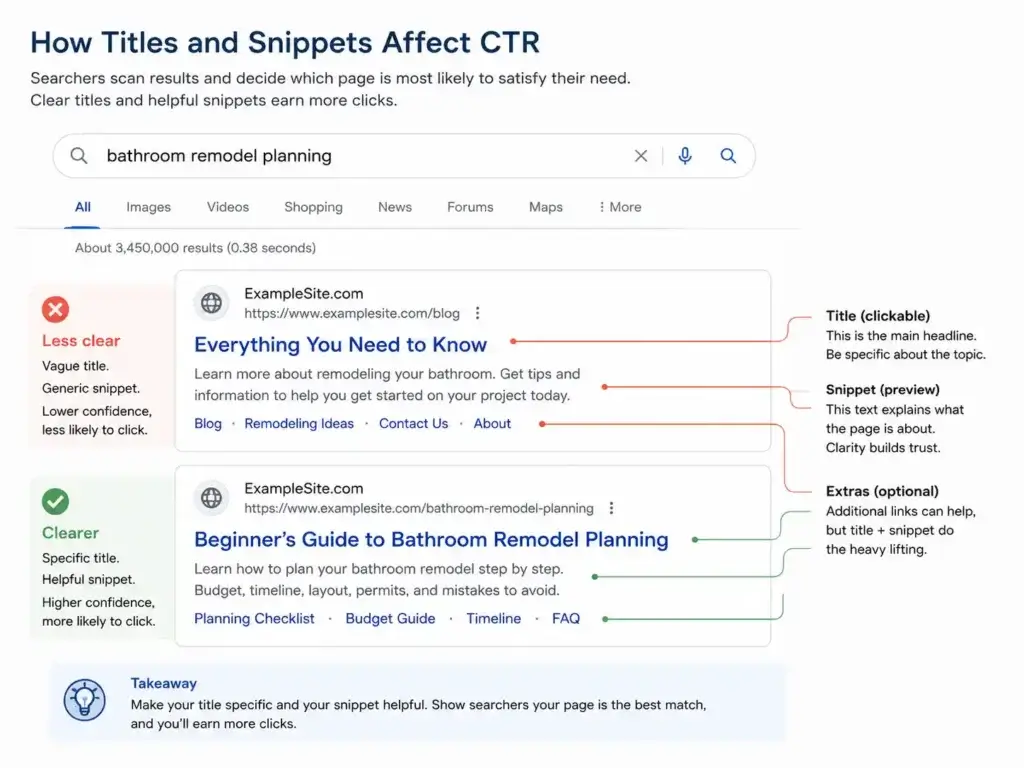
Infographic created by Lucent’s chatGPT version. Read all of Lucent’s articles on URLMD
Example: Vague Title to Clearer Title
Less clear: Everything You Need to Know
Clearer: Beginner’s Guide to Bathroom Remodel Planning
The clearer version gives the reader a better idea of the topic and audience. It does not need to exaggerate. It simply names what the page provides.
Example: Misleading Title to Better-Aligned Title
Misleading: How to Remodel a Kitchen in One Weekend
Better aligned: How to Plan a Small Kitchen Remodel Step by Step
If the page is really about planning, the title should say that. A misleading title may earn some curiosity, but it weakens trust when the page does not match the promise.
Example: Generic Meta Description to Useful Description
Generic: Learn more about our complete guide and helpful tips.
More useful: Learn how to compare flooring options by durability, moisture resistance, maintenance, and room type.
A useful meta description helps set expectations. It does not need to “sell” the click. It should summarize the page in a way that helps the searcher decide whether it fits their need.
Why Search Intent Changes CTR Expectations
Search intent is the reason behind a search. CTR expectations change depending on what the searcher is trying to do.
Common intent types include:
- Informational: The searcher wants to learn something.
- Navigational: The searcher wants a specific website or brand.
- Commercial investigation: The searcher is comparing options.
- Transactional: The searcher is ready to take an action, such as buying, booking, or contacting.
For example, a branded search may have a high CTR because the searcher already knows what they want. A broad informational search may have a lower CTR because the search results page includes many possible paths, quick answers, videos, images, or related questions.
This is why CTR should be interpreted through intent rather than judged in isolation. A page may have a lower CTR simply because the query is broad, early-stage, or partly answered directly in the search results.
For related reading, URLMD’s article on entity-based SEO can help explain why meaning, context, and relationships matter beyond isolated keywords.
SERP Context Matters
The search engine results page, often called the SERP, affects CTR. Your result is not shown in isolation. It appears within a layout that may include:
- Paid ads
- Local map packs
- Featured snippets
- People Also Ask boxes
- Image or video results
- Shopping results
- Knowledge panels
- AI-generated summaries or other search features
If a query can be answered directly on the results page, fewer people may click through to any website. This can create lower CTR even when a page is visible. This is one reason zero-click search is an important concept in modern SEO.
Position also matters. Results near the top of a page often receive more attention than results lower down. However, a lower-position result with a clearer title may sometimes earn clicks because it better matches what the searcher wants.
Branded vs. Non-Branded CTR
Branded and non-branded searches often behave differently.
Branded searches include a company, website, product, or personal name. These searches often have higher CTR because the searcher is already looking for a specific entity.
Non-branded searches do not include a specific brand. These searches are usually more competitive and may have lower CTR because the searcher is comparing results or still learning.
For example:
- Branded: URLMD SEO glossary
- Non-branded: what is semantic SEO
When reviewing CTR, it can be helpful to separate branded and non-branded queries. Otherwise, branded searches may make the average CTR look stronger than the site’s broader search visibility really is.
Practical Ways to Improve CTR
Good CTR improvement usually comes from making the search result clearer, more accurate, and better aligned with the page. The goal is not to trick people into clicking. The goal is to help the right people recognize the right page.
1. Write Clear Title Tags
A good title tag should identify the topic and, when useful, the page angle. It should be specific enough to help the searcher understand what they will find.
Helpful title qualities include:
- Clear topic language
- Accurate scope
- Natural wording
- Alignment with the page content
- No exaggerated promise
For technical guidance, see URLMD’s article on metadata for SEO.
2. Use Meta Descriptions to Set Expectations
A meta description does not guarantee exactly what Google will show, but it can still help define the page summary. A useful description should explain what the page covers and who it may help.
Good descriptions often answer questions like:
- What is this page about?
- What will the reader understand after visiting?
- Is the page beginner-friendly, technical, local, comparative, or practical?
3. Match the Page to the Query
If a page appears for queries it does not answer well, improving the title alone may not solve the problem. The page itself may need clearer structure, more complete coverage, or a different focus.
For example, if a page about “bathroom remodel cost factors” is appearing for “DIY bathroom tile installation,” the CTR may be low because the page does not match the installation intent. The better response may be to create or improve a separate page that addresses installation directly.
4. Avoid Clickbait
Clickbait can create a short-term mismatch between attention and trust. In SEO, that mismatch is usually not useful. If the title promises more than the page provides, visitors may leave disappointed, and the site may become less helpful over time.
A good title earns attention by being relevant, not by being inflated.
5. Compare Similar Pages and Queries
CTR is easier to interpret when you compare similar situations. Compare informational pages with other informational pages. Compare branded queries with branded queries. Compare mobile data with mobile data.
This helps avoid false conclusions. A service page, glossary entry, blog post, and homepage may all have different CTR patterns because they serve different search intents.
6. Improve the Page, Not Just the Snippet
If a page earns clicks but does not satisfy visitors, the search result may be doing its job while the page needs work. CTR should not become disconnected from content quality, accessibility, and usability.
Strong pages tend to have clear headings, readable structure, useful answers, and a stable relationship between the search promise and the page content. URLMD’s guide to web standards and quality assurance is a useful related resource for thinking beyond the search snippet.
How to Review CTR Without Obsessing Over It
CTR is helpful, but it is only one metric. It should support judgment, not replace it.
When reviewing CTR, ask calm diagnostic questions:
- What queries are causing impressions?
- Does the page actually answer those queries?
- Is the title clear and accurate?
- Does the snippet set the right expectation?
- Is the page competing with ads, maps, snippets, or other SERP features?
- Are branded and non-branded searches mixed together?
- Is the CTR low across all queries, or only for loosely related ones?
- Has the page changed recently?
- Has the search results layout changed?
This approach keeps CTR in context. A low CTR is not automatically a failure. It is an invitation to inspect alignment.
Common CTR Mistakes in SEO
Several common mistakes can make CTR analysis less useful.
Treating CTR as the Only Goal
A click is not the final measure of success. If the page does not help the visitor, the click was not enough. SEO should support useful discovery, not attention for its own sake.
Comparing Unrelated Queries
Different queries have different CTR patterns. A branded homepage query should not be judged the same way as a broad informational query.
Changing Titles Too Often
Frequent title changes can make it harder to understand what actually improved or declined. Small, careful updates are easier to evaluate than constant rewrites.
Ignoring SERP Features
If the search results page includes a featured snippet, map pack, or direct answer, CTR may be affected even if your page is relevant.
Writing for Curiosity Instead of Clarity
A title that creates curiosity but hides the actual topic may not serve the reader well. Clear titles are often more durable than clever ones.
CTR in SEO FAQ
What is a good CTR in SEO?
There is no single good CTR for every page or query. CTR varies by ranking position, search intent, brand recognition, device, industry, and SERP layout. A good CTR is best judged by comparing similar pages, similar queries, and similar time periods.
Where can I find CTR data?
You can find organic search CTR data in Google Search Console under the Performance report. You can review average CTR by query, page, country, device, search appearance, and date range.
Does CTR affect rankings?
CTR is an important performance metric, but it should not be treated as a simple ranking lever. Search engines use many systems and signals, and public explanations do not support reducing rankings to CTR alone. For practical SEO work, it is safer and more useful to treat CTR as a signal of alignment between query, title, snippet, and page content.
How can I improve CTR ethically?
Improve CTR by making titles and descriptions clearer, more accurate, and better aligned with search intent. Avoid misleading promises. The goal is to help the right searchers understand that your page matches their need.
Why is my CTR low even if impressions are high?
High impressions with low CTR can happen when a page appears for broad, competitive, or loosely related queries. It can also happen when the search results page includes ads, featured snippets, map packs, or other features that reduce clicks. Review the specific queries before deciding what to change.
Conclusion
CTR in SEO is the percentage of impressions that become clicks. It can help you understand whether people are choosing your result when they see it in search.
The most useful CTR work is not about tricks. It is about clarity, alignment, and trust. A clear title, an accurate snippet, and a page that genuinely satisfies the query create a stronger relationship between search visibility and reader usefulness.
Read CTR in context. Look at the query, the page, the search results layout, and the intent behind the search. When CTR improves because the result became more honest and easier to understand, the improvement is more likely to support both the reader and the long-term health of the site.
art by mary hall, see the full web image here: https://fine-digital-art.com/fine-digital-art/attachment/8996/