

I provide human-guided content production for websites that need substantial, carefully structured material without turning publication into an unattended automation process.
The production rate can be unusually high. When a project’s subjects, editorial direction, and working context have been established, complete long-form drafts can sometimes be produced within minutes. This speed does not come from removing human responsibility. It comes from careful preparation, a mature production environment, and a workflow refined through sustained use.
Human judgment remains present throughout the work. Automation accelerates composition and reduces repetitive friction; it does not decide what a website should say, which information belongs, or what deserves to be published.
What human-guided content production means
Human-guided content production uses automation and generative systems within a process whose direction and consequential decisions remain under human control.
Read: Automation Boundaries: Designing Responsible Transitions Between Human Judgment and Automation
This is related to the broader design of human-in-the-loop systems. Human involvement is not limited to approving whatever an automated process happens to produce. Judgment can shape the subjects, editorial direction, working context, structural expectations, relationships, review standards, and publication decisions.
Depending on the project, the human role may include:
- understanding the website, business, audience, and purpose;
- identifying useful subjects and meaningful information gaps;
- planning relationships between articles, services, definitions, and supporting pages;
- establishing an appropriate editorial and structural direction;
- reviewing the substance and organization of completed documents;
- adding internal links based on the website’s real information architecture;
- selecting categories, metadata, schema, and publishing details; and
- deciding what is ready to become part of the public website.
The work is governed without forcing every document into one rigid template. Shared expectations provide coherence across a collection, while each page retains enough freedom to respond to its particular subject and audience.
Content governance matters because production capacity alone does not determine whether content should exist. A growing website also needs ways to preserve usefulness, responsibility, consistency, and purpose.
How preparation supports high production rates
The most visible part of content production is often the moment when a document is composed. That moment does not represent all the work that makes the document possible.
Before high-rate production begins, a project may require subject planning, editorial decisions, source material, terminology, structural expectations, and an understanding of how the new material will fit into the website. This is a form of context assembly: bringing the information needed for the present work into a useful working environment.
Once that environment is established, settled decisions do not need to be rediscovered for every page. Related documents can share legitimate editorial and structural characteristics without becoming copies of one another.
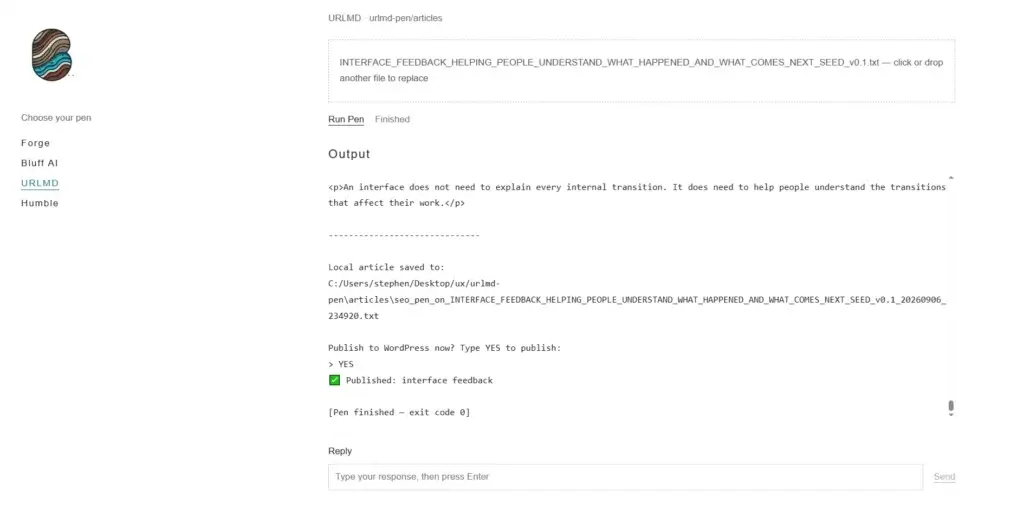
During prepared production runs, I have sometimes produced complete long-form drafts at a rate of approximately one every two minutes. These are not merely title lists or skeletal outlines. They can arrive as substantial documents with meaningful sections, headings, lists, navigation, and other HTML structures already present.
That observed rate is evidence of production capacity, not a universal promise. Different subjects require different amounts of research, preparation, differentiation, and review. A coordinated collection of related pages presents a different production problem from a set of unrelated technical articles. A consequential subject may require more investigation and a slower editorial pass.
The governing principle is that speed should follow understanding. It should not substitute for it.
This reflects a broader principle of workflow architecture: repeated work becomes faster when settled decisions can be preserved and reused appropriately. Human attention can then remain focused on differences, uncertainties, and choices that genuinely require judgment.
Content engineering during production
The finished material is treated as more than generated copy. Each page is constructed as a document that must remain understandable, maintainable, and capable of participating in a larger website.
Document engineering considers how a document’s meaning, structure, relationships, accessibility, and history can remain understandable as it moves between people, formats, workflows, and systems. Content production applies that thinking during composition instead of treating structure as a repair to be added afterward.
For web publishing, the output can begin as semantic HTML. Depending on the information, that structure may include:
- a meaningful heading hierarchy;
- sections corresponding to real changes in subject;
- ordered or unordered lists when information has list relationships;
- tables when the information is genuinely tabular;
- descriptive links whose purpose can be understood in context;
- page navigation when a longer document benefits from it; and
- accessible labels where additional identification is needed.
This does not mean making every document technically elaborate. Structure should follow the information. A short definition may require very little markup. A long reference page, procedural guide, or curated content neighborhood may need more explicit organization.
Accessibility is considered as part of the document’s construction. Source structure alone cannot guarantee an accessible experience, but meaningful HTML gives browsers, publishing systems, assistive technologies, and future editors clearer material to work with. URLMD’s accessibility neighborhood provides paths into the standards, practices, and human responsibilities surrounding that work.
Content engineering also considers the document’s place within the website. A page should not exist merely because it can be generated. Its purpose, terminology, parent relationships, internal links, and supporting material affect whether it becomes a useful part of the information architecture or remains an isolated URL.
Human review and website integration
Every completed draft remains subject to human review before publication.
I inspect the document’s language, organization, and HTML, then consider how it belongs within the existing website. The review may include refining headings, correcting unnecessary structures, checking important distinctions, adding internal links, and selecting appropriate categories, metadata, schema, titles, and URLs.
This is not simply proofreading. It is the point where a completed document becomes situated within a larger information environment.
A well-written page may still need a clearer relationship to existing material. A heading may be accurate but inconsistent with the vocabulary used elsewhere. A claim may need qualification. A possible internal link may reveal that the website lacks a necessary definition or supporting article. A technically valid element may be redundant within the content management system that will publish it.
Editorial review and responsibility remain human activities even when automated systems contribute substantially to composition. Generative tools can assist with language, structure, repetition, and transformation. They do not assume responsibility for the website’s claims or determine what a particular organization should publish.
Internal linking is added according to the relationships actually present in the material rather than according to a predetermined quota. Some links help a reader understand a foundational term. Others lead toward a deeper treatment, a related workflow, a broader neighborhood, or an important boundary.
The result is intended to be more than a collection of individually acceptable pages. The goal is a body of content whose parts remain useful on their own while becoming more valuable through their relationships.
Different projects require different forms
Human-guided content production is not restricted to one article format, subject type, or word count.
A project may need substantial evergreen articles, concise definitions, service explanations, regional introductions, technical references, supporting blurbs, or neighborhood pages that organize existing information. An older article may become the foundation for a new version that preserves useful history while correcting obsolete language, assumptions, and structure.
Some collections have a legitimate repeating form. A geographic project, for example, may require a foundational page for each state and several related articles beneath it. Once the shared editorial structure has been established, appropriate characteristics can carry across the collection while the location, conditions, title, and article-specific reasoning change.
Other collections should not be produced that way. A set of distinct technical concepts may require separate orientation for every document. A sensitive or consequential subject may need additional research and review. A missing glossary definition may be more useful than another long-form article. A singular edge case may deserve its own page even though it cannot be reproduced as a series.
The form should follow the information need. High production capacity creates possibilities; it does not make every possible page necessary.
Large collections can also reveal their own future work. Repeated references may identify a missing foundational article. Several pages may depend on the same undefined concept. Unresolved relationships may cluster around a subject that deserves a new content neighborhood.
In this way, production can contribute to content gap analysis through observation of the growing website. Gaps are not inferred only from external keyword lists. They can also become visible through the work of creating, reviewing, connecting, and using the content itself.
Appropriate uses and boundaries
This service is useful when a website needs more than disconnected text files. It is especially appropriate when the material must be substantial, structurally coherent, adaptable to an existing publishing system, and capable of joining a larger body of information.
Human-guided content production may support:
- new knowledge bases and information-rich websites;
- large editorial launches with established subject maps;
- reconstruction of aging or structurally weak website content;
- article families that share a legitimate editorial framework;
- technical, educational, or service-related reference material;
- semantic HTML production for integration by development teams; and
- continued expansion of an established information architecture.
It is not an offer to publish arbitrary quantities simply because the production capacity exists. New content should remain connected to a real audience, information need, organizational purpose, or architectural role.
It is also not a promise that every project will proceed at the fastest observed rate. Composition may take minutes when editorial direction and working context have already been established. Research, planning, review, and integration remain part of the work, even when they occur at different stages.
My role is not limited to operating a writing tool. I design and maintain the production environment, guide its use, evaluate the resulting documents, and integrate them into real websites. The method has been refined through the production and review of hundreds of substantial pages across different subjects and publishing needs.
The governing distinction is straightforward: automation reduces mechanical friction and increases useful production capacity. Human judgment continues to determine direction, meaning, relationships, quality, and publication.
That combination makes it possible to produce content at a rate that would be difficult to reach through conventional composition alone while still treating every finished page as part of a real information environment—not as one more unit of automatic output.