

Reciprocal Rank Fusion (RRF) combines multiple ranked result lists into one ordering. Instead of adding the original retrieval scores, it gives each candidate a contribution based on its position in each list, then adds those contributions together.
This makes RRF useful when retrieval methods measure relevance differently. A lexical search score and a vector similarity score do not need to share a numerical scale for their ranked results to participate in the same calculation.
The exchange is straightforward: RRF preserves ranking positions and repeated appearances, but discards the original score magnitudes. Understanding that exchange helps explain both its usefulness and its limits.
Why combine ranks instead of raw scores?
Different retrieval methods can produce useful results without producing comparable measurements.
A lexical method such as BM25 scores documents using term-based signals, including term frequency, rarity, and document length. A vector retrieval method orders candidates using a similarity or distance calculation over numerical representations. Their scores describe different relationships.
Adding those raw values can give one method more influence simply because its numbers are larger. Even when two systems return scores between zero and one, their values do not necessarily have the same interpretation.
RRF avoids that direct comparison. It asks where a candidate appears in each ranked list, rather than how large its original score was.
This is one way to combine results in hybrid retrieval. It is not limited to lexical and vector search: ranked lists can also come from different query formulations, indexes, or other retrieval paths.
The lists need not be statistically independent. They do, however, need consistent item identities and a clear ordering for the calculation to be meaningful.
How Reciprocal Rank Fusion works
In ordinary, unweighted RRF, each appearance of a candidate contributes:
Contribution =
The candidate’s fused score is the sum of its contributions across the input lists:
RRF(candidate) =
The sum includes each input list containing that candidate, using its rank in that list.
- Rank is the candidate’s position in an input list, starting at 1.
- k is a smoothing constant that moderates differences between rank positions.
- An absent candidate contributes zero from that list.
The system then sorts candidates by their fused scores, highest first.
A common starting value for the constant is k = 60, though it is not a universal optimum. Here, k means the RRF constant—not the number of candidates requested from a retrieval method. Product documentation may use different parameter names for these settings.
Microsoft’s RRF scoring explanation describes the calculation and distinguishes the RRF constant from nearest-neighbor candidate counts. Elastic’s RRF reference documents its separate ranking-constant and input-window controls. These are implementation references, not evidence that one setting is best for every task.
RRF rewards two things: appearing higher in a list and appearing in more than one list. Neither property establishes that the candidate is correct.
A worked example
Suppose a search system retrieves documents about a diagnostic code through two paths. Lexical retrieval notices exact terminology; vector retrieval notices related descriptions.
Each path returns three candidates. Assume that matching document labels refer to the same document across both lists, use equal weights, and set k = 60.
| Candidate | Lexical rank | Vector rank | RRF calculation | Approximate score |
|---|---|---|---|---|
| Diagnostic code reference | 1 | 2 | 1/61 + 1/62 |
0.03252 |
| Troubleshooting guide | Not returned | 1 | 0 + 1/61 |
0.01639 |
| Service bulletin | 2 | Not returned | 1/62 + 0 |
0.01613 |
| Parts catalog entry | 3 | Not returned | 1/63 + 0 |
0.01587 |
| Related case study | Not returned | 3 | 0 + 1/63 |
0.01587 |
The diagnostic reference leads because it receives contributions from both lists. The troubleshooting guide comes next because its single appearance is at rank 1.
The parts catalog entry and case study tie. RRF alone does not distinguish them in this example; an implementation needs a defined tie-handling policy, such as a stable secondary ordering.
The reference’s score of approximately 0.03252 is not a 3.252% probability of relevance or correctness. It is the result of this fusion calculation under these inputs and settings.
Likewise, “not returned” does not necessarily mean irrelevant. A candidate might sit just below a retrieval cutoff, be excluded by a filter, or be missing from an index. RRF receives the list, not an explanation for every absence.
What the smoothing constant changes
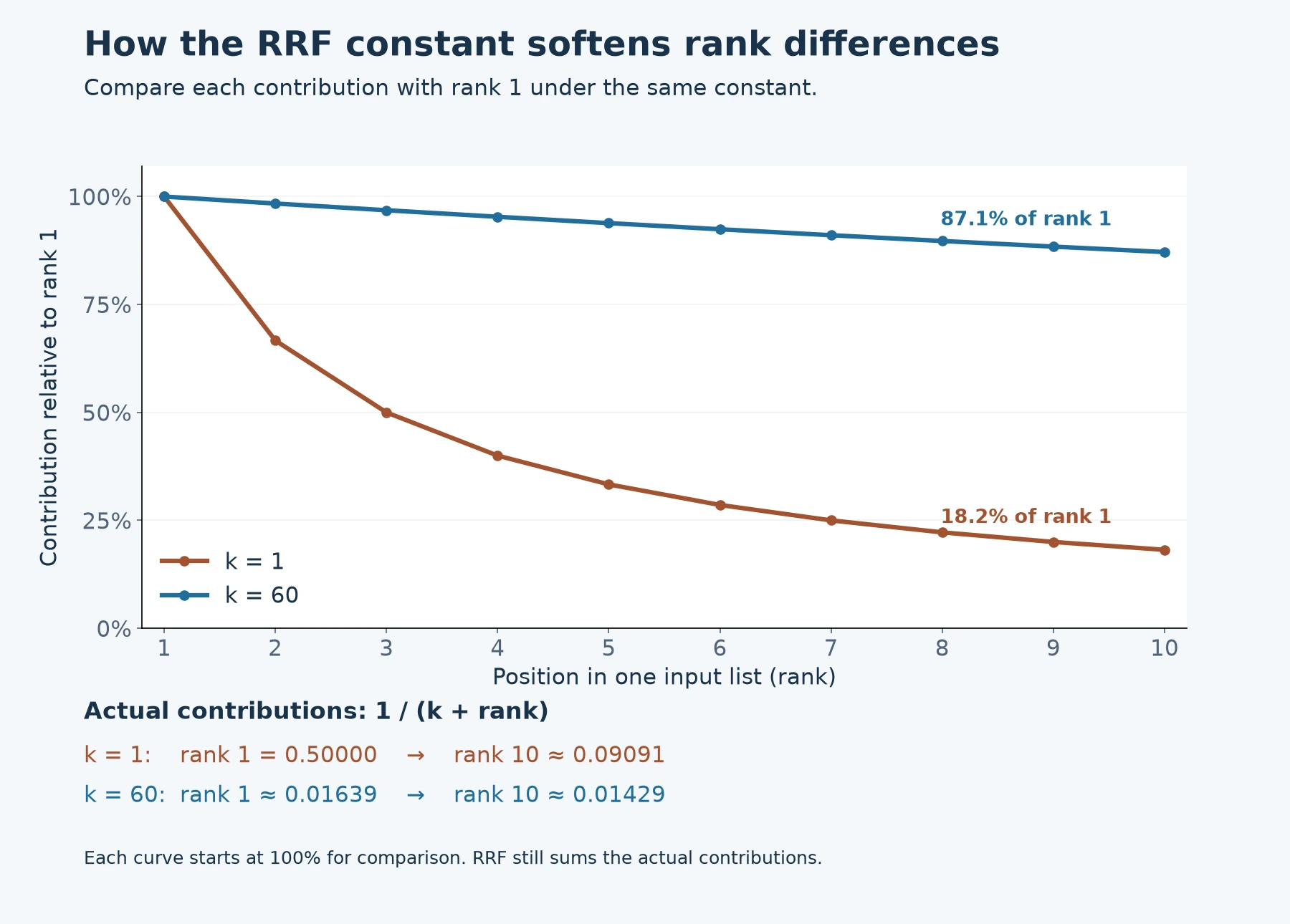
The constant controls how sharply contributions decline as rank increases.
With k = 60, rank 1 contributes approximately 0.01639, while rank 10 contributes approximately 0.01429. The higher position contributes more, but the difference is modest.
With k = 1, those contributions become 0.5 and approximately 0.09091. The advantage of the higher position is much stronger.
- A smaller constant makes high positions more influential relative to lower positions.
- A larger constant makes contributions from different included positions more similar, giving repeated appearances more influence relative to position.
For fixed, finite lists, a sufficiently large constant makes the number of lists containing a candidate the leading influence. Position can still distinguish candidates with the same number of appearances at finite constant values.
That behavior applies only to appearances actually included in the input. Increasing the constant cannot give a contribution to a document below a cutoff or absent from every list.
The constant therefore needs to be considered alongside candidate depth. It changes how admitted appearances are valued, not which appearances exist.
What RRF preserves and discards
Replacing scores with positions is a deliberate reduction of information.
RRF preserves ordering and recurrence
RRF retains whether a candidate ranked first, second, or lower, and whether the same candidate appeared in other lists.
If a transformation changes a method’s score values without changing its ordering, the RRF result remains unchanged, provided list membership and tie handling also remain the same. This reduces dependence on the original score scale.
RRF discards score gaps
Consider two retrieval lists. In one, the first candidate barely outranks the second. In another, the first candidate has a much larger score than everything below it. Once those scores become ranks, both lists present RRF with positions 1 and 2.
RRF does not retain the distinction between a near tie and a large numerical separation.
That is a limitation when score gaps carry useful, validated information. It can also be a useful simplification when those gaps are unstable or lack a reliable interpretation. A large raw-score difference is not automatically a meaningful confidence difference.
The fused ordering need not match any input list
A candidate appearing moderately high in several lists can outrank a candidate placed first by only one method. The resulting order reflects the aggregation rule, rather than simply selecting one method’s ranking.
This can reward useful complementarity. It can also disadvantage a uniquely valuable result found by a specialized retrieval path. Whether that tradeoff helps depends on the task.
Candidate depth, identity, and weighting
The formula is small, but decisions made around it can materially change the result.
Candidate depth determines what fusion can see
If a method returns only its first 20 candidates, a document at position 21 contributes nothing from that path. Increasing the depth can introduce new candidates and give existing candidates additional contributions.
Unequal depths also matter. A path contributing 100 results has more opportunities to contribute than one returning 10, although deeper appearances receive smaller individual contributions.
Record the depth of each input list separately from the number of fused results ultimately displayed or passed downstream. RRF cannot recover a candidate omitted from every input list.
Identity determines which contributions can be added
Before combining two appearances, the system must establish that they refer to the same candidate.
A candidate might be a document, passage, product record, or specific revision. Two passages from one document are not necessarily the same item. Two revisions sharing a title may contain different instructions.
Stable identifiers should preserve the distinctions the task requires. Matching titles or similar wording alone may not be sufficient.
Weights change the influence of each list
A weighted variation multiplies each list’s contribution by an assigned weight:
Weighted contribution =
This can give a particular retrieval path more influence, but it adds another choice to justify and evaluate. A weight expresses a preference in the ranking calculation; it is not automatically a calibrated measure of trust.
Weighting also does not enforce a hard requirement. If a result must match a particular version, jurisdiction, or access permission, that condition needs explicit handling rather than merely a ranking boost.
Overlapping lists can amplify the same signal
Two retrieval paths can use the same corpus, closely related models, or shared metadata. Their agreement may therefore reflect overlapping signals rather than separate support.
Adding a duplicate list gives its candidates another contribution. In effect, it increases that list’s influence without introducing a new source.
Correlation does not make fusion useless. It means repeated appearance should be interpreted as recurrence across the supplied rankings—not as independent corroboration of a claim.
Evaluation and important boundaries
RRF provides a reproducible way to combine rankings. Whether it improves retrieval requires testing.
Compare the fused system with its individual retrieval paths using consistent queries, source snapshots, and relevance judgments. Include exact identifiers, paraphrases, specialized questions, version-sensitive requests, and questions for which the corpus has no satisfactory answer.
A useful evaluation examines:
- whether relevant candidates enter the combined candidate set;
- whether useful results move into the positions people actually inspect;
- which relevant results appear through only one path;
- how constants, weights, and input depths affect the outcome;
- what changes when a retrieval path is removed;
- whether improvements justify the latency and processing cost.
The guide to evaluating retrieval quality develops the broader question of measuring usefulness rather than judging a ranking by appearance alone.
Fusion is not the entire retrieval workflow
RRF combines the supplied rankings. A later reranking stage may evaluate the surviving candidates again using additional query–candidate evidence.
For AI-assisted workflows, context assembly may then select and organize material for a particular task. A high fused rank does not, by itself, establish that a passage belongs in that context.
Access restrictions must hold before protected material reaches an unauthorized recipient. Applicability, currentness, provenance, and factual support also require checks appropriate to the task. Fusion scores do not replace those checks.
A useful mental model
Reciprocal Rank Fusion turns positions from several lists into a shared calculation. It avoids requiring unrelated raw scores to mean the same thing, while accepting the information loss that comes with using ranks.
Its result says, in effect, “this candidate accumulated more rank-based contributions under these settings.” It does not say, “this candidate is true, current, authorized, or sufficient.”
RRF can help organize attention. The quality of that organization still depends on the retrieval paths, the candidates admitted, the identities being combined, and evidence that the resulting order helps people complete their task.