

Reranking is a retrieval stage that reevaluates an initial set of candidate results before presenting, synthesizing, or otherwise using them. The first retrieval pass finds potentially relevant material efficiently. A reranker reconsiders those candidates using another scoring or ordering process, often a more detailed comparison with the query and supplied context.
This layered process appears in search engines, site search, recommendation systems, and retrieval-augmented generation. Its purpose is not to search the entire collection again. It is to make a more careful decision among results that have already been retrieved.
What reranking means
Reranking means reconsidering the order and usefulness of a limited candidate set after initial retrieval. A system may first retrieve 50, 100, or several hundred potentially relevant documents or passages. It can then use a slower or more context-sensitive method to score those candidates again.
The distinction matters because searching an entire index and closely evaluating every result are different computational problems. Initial retrieval generally favors speed and broad coverage. Reranking can spend more processing time on a much smaller collection.
A simple retrieval pipeline may look like this:
- A person submits a query.
- The system interprets or reformulates the query.
- An initial retriever finds a candidate set.
- A reranker compares those candidates more closely with the query.
- The system selects or groups results for display or use, checking whether the set supplies what the task needs.
- The final results are displayed or supplied to another system.
Not every retrieval system uses this exact sequence. Large search and AI systems may contain several retrieval and ranking stages, each using different signals. “Reranking” is therefore best understood as a functional category rather than one universal algorithm.
How reranking works
Initial retrieval often uses methods designed to search large collections efficiently. These may include lexical matching, vector similarity, database filters, graph relationships, or a combination of approaches. The result is a candidate set: a manageable group of items that might answer the query.
The reranker then asks a narrower question:
Among these available candidates, which ones are most useful for this query in this context?
What a reranker can evaluate depends on its inputs and method. A query and passage alone do not necessarily expose the full source document, its version, or the wider task state. If text is shortened or truncated before scoring, a qualification outside that supplied text is not being evaluated. Provide applicable metadata and needed context explicitly, and check what actually reaches the reranking stage.
A reranker may evaluate:
- how directly a passage addresses the query;
- whether the important entities and relationships align;
- whether the result matches the likely task or intent;
- how much supporting context the result contains;
- whether supplied dates or versions fit the question;
- whether several results are redundant;
- whether available source and scope information aligns with the task;
- how well the candidate fits the wider conversation or application state.
The resulting scores can inform reordering and selection. Required applicability and access conditions need explicit enforcement rather than a favorable score. A ranking preference for a version is not equivalent to requiring that version, and protected material must not reach an unauthorized recipient while waiting for a later relevance check.
A small example
Suppose someone searches for “browser caching after a site update.” An initial retriever may find material about browser caching, server caching, content delivery networks, cache invalidation, and general website performance.
A reranker can examine the query and recognize that the central issue is what happens to cached resources after content changes. It may elevate passages about cache-control headers, validators, versioned asset URLs, and revalidation while moving broad performance discussions lower.
The initial retrieval was not necessarily wrong. It established a potentially useful neighborhood. In this hypothetical example, reranking favors material more responsive to the question; the ordering would still need evaluation on actual queries and sources.
Retrieval, ranking, and reranking are related but distinct
The terms retrieval, ranking, and reranking are sometimes used interchangeably, but they describe different responsibilities within an information system.
| Stage | Primary task | Typical scope | Common priority |
|---|---|---|---|
| Retrieval | Find potentially relevant items | A large index or collection | Coverage and efficiency |
| Initial ranking | Assign an initial order or score | The retrieved candidate set | Useful ordering at scale |
| Reranking | Reevaluate and refine the candidates | A smaller subset of results | Contextual relevance and precision |
In practice, the boundaries can overlap. Some retrieval methods produce ranked results immediately, and some systems perform multiple rounds of ranking. The useful distinction is that a reranker operates after an earlier candidate-selection decision.
Reranking should also not be confused with reindexing. Reindexing changes or refreshes the searchable representation of a collection. Reranking changes how already retrieved candidates are evaluated for a particular query.
Common reranking methods
Reranking may be performed with rules, statistical models, neural models, language models, or combinations of these methods. The appropriate method depends on the size of the candidate set, latency requirements, available computing resources, and the consequences of retrieval errors.
Rule-based reranking
A rule-based reranker adjusts results according to explicit conditions. It might prefer material from a particular source or apply an explicit ordering rule. Keep preferences separate from required eligibility conditions, and distinguish reordering from duplicate removal or filtering even when one component performs several of those operations.
Rules are understandable and controllable, but they can become brittle if they attempt to represent every form of relevance.
Learning-to-rank models
Learning-to-rank systems combine multiple signals to estimate an effective result order. Signals may include textual relevance, freshness, source characteristics, interaction data, document structure, and query classification.
The model learns from examples or judgments rather than relying only on manually defined weighting. Its quality still depends on the training data, evaluation criteria, and assumptions built into the system.
Cross-encoder reranking
A cross-encoder evaluates the query and a candidate passage together. This joint examination can capture detailed relationships between the query and document that are difficult to preserve when each is encoded separately.
Cross-encoders are commonly contrasted with bi-encoder or embedding-based retrieval. In vector retrieval, the query and documents are usually represented independently so that similarity can be calculated efficiently across a large index. A cross-encoder can perform a closer comparison, but it must generally process each query-candidate pair. In a retrieve-and-rerank design, the separately encoded document representations can be prepared ahead of the query. The cross-encoder instead scores the query and candidate jointly at query time, commonly in batches of pairs. This often makes it more suitable for a restricted candidate set than for scoring an entire large corpus. The Sentence Transformers retrieve-and-rerank example illustrates that architecture; its configuration and results are not universal guarantees.
For more context on the initial retrieval layer, see Understanding Vector Search and Hybrid Retrieval.
Language-model reranking
A language model can be asked to compare results, estimate relevance, identify missing support, or choose passages that best answer a question. This can provide flexible contextual evaluation, especially when relevance depends on instructions or conversational history.
Language-model reranking also introduces uncertainty. Results can vary with prompt design, model behavior, context length, candidate ordering, and incomplete evidence. For higher-consequence uses, model judgments should not be treated as inherently authoritative.
Diversity-aware reranking
The highest-scoring results are not always the most useful set if they repeat the same information. A diversity-aware reranker may reduce redundancy and preserve candidates that contribute distinct perspectives, subtopics, or evidence.
This is particularly useful when a broad or ambiguous query has several reasonable interpretations. Diversity should not be confused with random variation; the retained results still need to be relevant.
Reranking in RAG and AI search
In a retrieval-augmented generation system, retrieved material is assembled as context for a language model. Because the model has a limited context window, not every retrieved passage can or should be included.
Reranking helps decide which passages deserve that limited space. A typical RAG sequence may include:
- splitting source material into retrievable passages;
- representing those passages in a lexical, vector, or hybrid index;
- retrieving a broad candidate set;
- reranking candidates against the current question;
- removing duplicates or low-value passages;
- assembling selected context;
- generating an answer grounded, as far as possible, in that context.
Reranking can improve the relevance of supplied context, but it does not guarantee a correct answer. A well-ranked passage may be inaccurate, outdated, incomplete, or misinterpreted during generation. Retrieval quality and answer quality are connected, but they are not identical.
A better order is not yet a sufficient context
Reranking scores candidates; context selection decides what the next stage receives. The highest-ranked passages can all repeat one fact while omitting evidence needed for another part of the question. Selection should check combined coverage, necessary qualifications, source identity, applicable versions, and the available token budget.
When a small matched passage needs its parent section or another qualification, recover that context and check the expanded evidence. The Chunking example distinguishes a searchable match from the evidence delivered downstream. Additional text introduced after reranking has not automatically received the same evaluation as the original candidate.
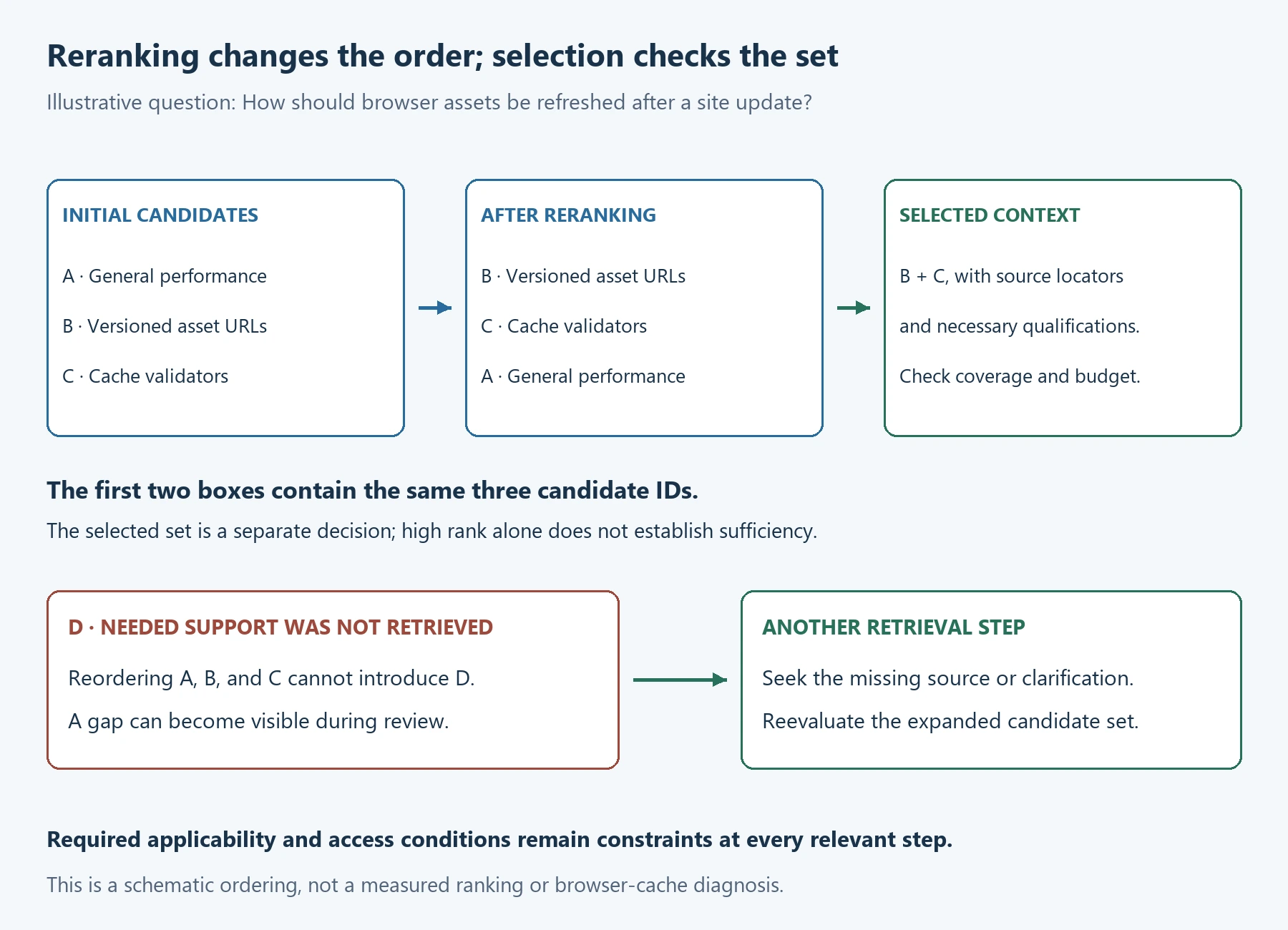
This is one reason context prioritization matters. A system must consider not only whether a passage is relevant, but also whether it contributes necessary evidence, definitions, distinctions, or constraints.
Passage boundaries also affect reranking. A fragment may contain the right terms while omitting the sentence that qualifies their meaning. Thoughtful chunking for retrieval and semantic segmentation give the reranker more coherent units to evaluate.
Limitations of reranking
Reranking can refine a candidate set, but it cannot fully repair every problem created earlier in the retrieval pipeline.
The correct result must enter the candidate set
A reranking stage cannot elevate a candidate absent from its input set. If initial retrieval misses the best source, later evaluation is constrained by that omission. This is sometimes described as a candidate-recall problem.
For example, if the correct passage uses different terminology from the query and the initial retriever does not recognize the relationship, a highly capable reranker may still have no opportunity to assess it. A broader workflow can retrieve again, consult another source, or ask for clarification. That is a new evidence-gathering step, not a recovery performed by reordering the original list.
Reranking adds computational cost
Closer query-document comparison requires time and processing resources. Larger candidate sets may improve the chance of including useful material, but they also increase reranking cost. Systems must balance coverage, latency, and depth of evaluation.
Relevance is contextual
A result can be relevant in one sense and unsuitable in another. It may discuss the correct subject but address the wrong audience, jurisdiction, time period, product version, or level of technical depth.
Rerankers can account for some of these distinctions when the relevant context is available. They cannot reliably infer constraints that were never supplied or represented.
Scores are model-dependent
A reranking score is not an objective measure of truth. It expresses the output of a particular method under particular conditions. Different models may produce different orders, and small score differences may not represent meaningful differences in usefulness. A score is not automatically a calibrated probability of relevance or correctness; its interpretation depends on the model and evaluation.
Bias can move through the pipeline
Reranking may preserve or amplify biases found in training data, relevance judgments, source selection, interaction data, or system rules. A polished final order can conceal the assumptions that produced it.
Compare the same candidates before and after reranking
To isolate reranking’s contribution, keep the query, candidate IDs, source versions, and supplied text fixed. Compare the initial and reranked orders against the same relevance judgments at the same final result count. Record added latency and processing cost. If retrieval depth or candidate content also changes, report that as a separate pipeline change rather than attributing the entire difference to reranking.
Then evaluate the selected context and downstream task separately. Did useful evidence move upward? Did the final selection retain complementary evidence and qualifications? Were important sources missing from the candidate set altogether? Evaluating retrieval coverage helps distinguish an ordering improvement from a complete answer basis.
Evaluation should therefore consider more than average relevance. Depending on the application, it may also need to examine source coverage, failure patterns, accessibility, freshness, representation, and the consequences of excluding a result.
What reranking means for publishers and content structure
Publishers cannot control how an external retrieval system reranks results. Search engines and AI systems use changing, partly undisclosed processes, and there is no single format that guarantees selection.
However, clear content gives retrieval and reranking systems better material to evaluate. The same practices also make pages easier for people to read and verify.
State the subject and scope clearly
A passage should make clear what it is about, which entities are involved, and what conditions apply. Specific wording is especially important when a term has several meanings.
For example, a heading such as “Reranking in retrieval-augmented generation” establishes more context than “How it works.” Both may be readable within the page, but the specific heading remains more understandable when the passage is encountered independently.
Keep important qualifications near the claim
Retrieval systems may isolate passages from their original pages. If a qualification appears several sections away, the retrieved passage may lose an important boundary.
This does not mean every paragraph must repeat every caveat. It means that a central condition, exception, or limitation should remain close enough to the statement it governs.
Use coherent headings and semantic sections
Descriptive headings help readers navigate and provide structural cues about the relationship among passages. Native HTML elements can reinforce those relationships without requiring excessive markup.
URLMD’s guides to semantic HTML foundations and heading hierarchy explain how page structure supports human understanding, accessibility, and retrieval.
Answer specific questions without stripping away context
A concise definition can help a reranker identify direct relevance. Supporting explanation gives the passage enough substance to remain useful after retrieval.
The goal is not to manufacture isolated “answer blocks.” It is to create passages that answer clearly while preserving the context needed to interpret the answer responsibly. See Passage Clarity for a closer examination of this balance.
Maintain entity and terminology continuity
Consistent naming helps a system connect references across a page. Introduce abbreviations, distinguish related concepts, and avoid switching terms when the terms are not truly interchangeable.
This is particularly important for technical subjects where retrieval, ranking, reranking, filtering, and recommendation may overlap without meaning the same thing. Entity clarity in AI search provides additional context.
Support important claims with accessible evidence
Reranking can identify a passage as relevant, but relevance alone does not establish reliability. Clear citations, dates, source context, and visible editorial responsibility help people assess what a retrieved passage supports.
Reranking is a refinement layer, not a substitute for retrieval quality
Reranking allows a retrieval system to begin broadly and then examine a smaller set more carefully. This division of labor makes it possible to combine efficient candidate discovery with deeper contextual comparison.
Its usefulness remains bounded by the candidate set, the information available to the reranker, the quality of its evaluation method, and the decisions made elsewhere in the pipeline. It can improve ordering and inform selection, but it cannot automatically establish truth or add evidence absent from its input candidates. Seeking missing material requires another retrieval or clarification step.
For readers and publishers, the durable lesson is straightforward: clear definitions, coherent passages, descriptive structure, and nearby qualifications make information easier to evaluate—whether that evaluation is performed by a person, a search system, or an AI-assisted retrieval workflow.
Frequently asked questions about reranking
What is reranking in information retrieval?
Reranking is the reevaluation of an initial set of retrieved candidates to determine which results best fit a query and its context. It usually uses a smaller candidate set than the initial retrieval stage, allowing for more detailed comparison.
How is reranking different from vector search?
Vector search is commonly used to retrieve candidates by comparing query and document embeddings. Reranking occurs afterward and may use a more detailed method to reconsider those candidates. Vector similarity can also be one signal within a broader reranking process.
Does reranking guarantee better results?
No. Reranking can improve result ordering when the candidate set contains useful material and the reranker evaluates it well. It cannot reliably recover documents excluded during initial retrieval, and it may introduce errors or bias of its own.
Why is reranking useful in RAG systems?
RAG systems have limited context space. Reranking helps select the passages most likely to support the current question before those passages are supplied to a language model. This can improve context relevance, but it does not guarantee that the generated answer will be complete or correct.