

by Lucent AND Stephen
Candidate depth is the number of results a retrieval path supplies to a later stage. In rank fusion, that cutoff determines which candidates—and which repeated appearances of those candidates—the fusion rule can see.
A document just below one path’s cutoff contributes nothing from that path, even if another path has already found it. Increasing depth can therefore introduce new candidates, change the scores of existing candidates, or both.
This makes depth more than a performance setting. It shapes the information available for ranking before fusion begins.
What candidate depth controls
A retrieval pipeline can have several limits that all sound like “the number of results.” They govern different boundaries:
- Internal search effort: how broadly a retrieval method searches its index or explores possible neighbors.
- Per-path candidate depth: how many ranked results each retrieval path supplies to fusion.
- Fused output size: how many results survive the combined ranking.
- Reranking or presentation size: how many candidates a later model evaluates or a person sees.
For example, lexical retrieval might supply 50 candidates and vector retrieval another 50. Fusion might retain 30 unique candidates, a reranker might reorder those 30, and the interface might display 10.
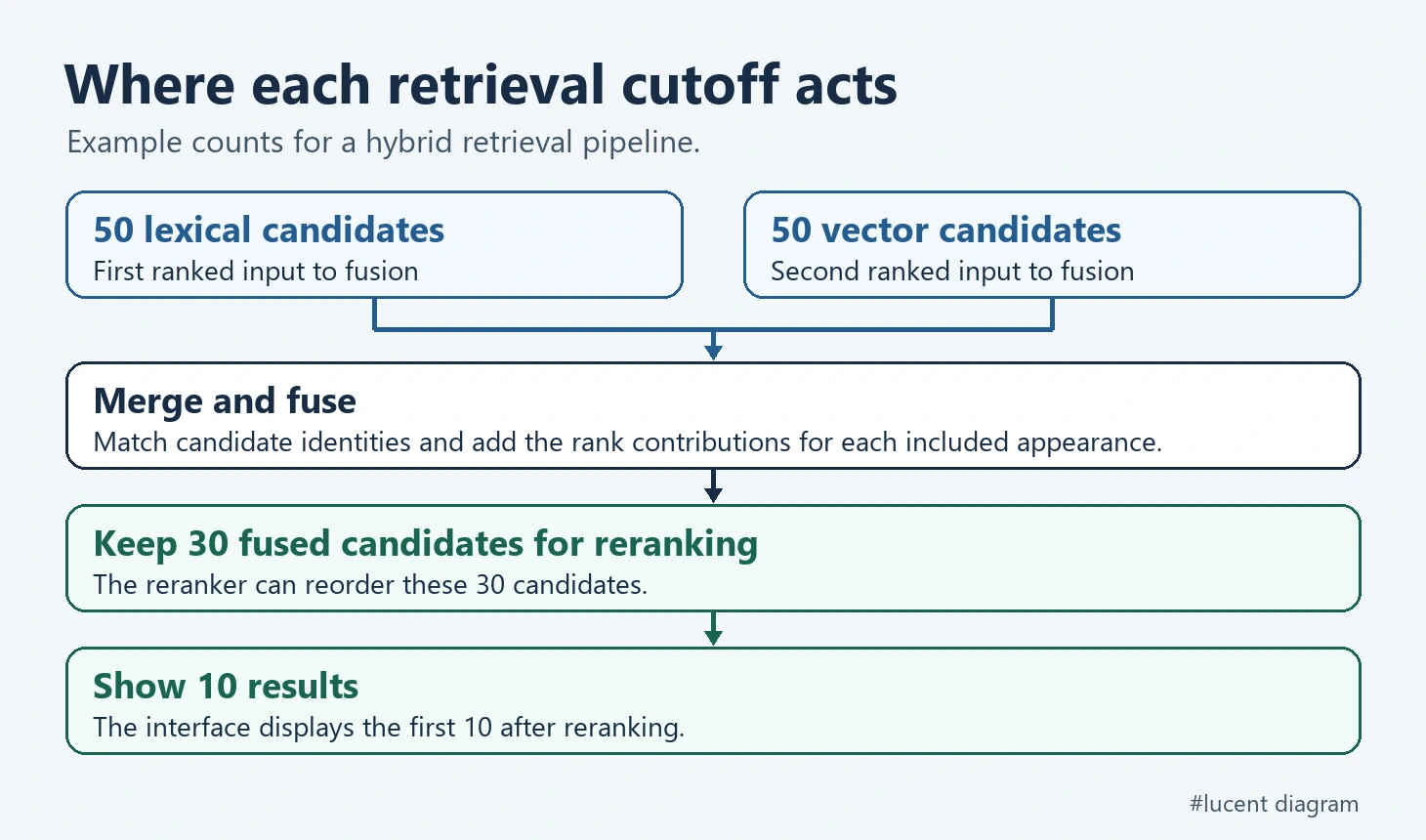
The two input depths of 50 are not the displayed result count of 10. Nor do they tell us exactly how much work either retrieval method performed internally.
Product terminology varies. A setting called a “window,” “limit,” or “top k” may refer to a different stage in another system. The useful question is: which boundary does this setting control?
In hybrid retrieval, depth often needs to be considered separately for each participating path rather than treated as one system-wide number.
How one additional appearance changes fusion
Reciprocal Rank Fusion, or RRF, assigns a contribution to each included appearance:
Contribution = 1 / (k + rank)
Here, ranks begin at 1 and k is a smoothing constant. An appearance outside the supplied list contributes zero.
Consider a diagnostic search using lexical and vector retrieval. Keep the vector depth fixed at three, and increase the lexical depth from two to three. Use ordinary unweighted RRF with k = 60.
The table shows three candidates from illustrative rankings. The diagnostic procedure is third in the lexical ranking, so its lexical appearance is outside the depth-2 input. For this illustration, assume the underlying orderings remain unchanged as the lexical list expands.
| Candidate and ranks | Lexical depth 2 | Lexical depth 3 |
|---|---|---|
| Exact-code reference Lexical 1 · Vector outside list |
1/61 ≈ 0.01639 |
1/61 ≈ 0.01639 |
| Diagnostic procedure Lexical 3 · Vector 2 |
1/62 ≈ 0.01613 |
1/63 + 1/62 ≈ 0.03200 |
| General troubleshooting guide Lexical outside list · Vector 1 |
1/61 ≈ 0.01639 |
1/61 ≈ 0.01639 |
At lexical depth two, the diagnostic procedure receives only its vector contribution. It sits below the other two illustrated candidates.
At lexical depth three, its lexical appearance enters the calculation. It now leads these three candidates, even though neither retrieval method changed its position.
The candidate was already present in the combined candidate set. What changed was the visibility of its recurrence.
This reveals two distinct effects of increasing depth:
- Coverage can expand: a newly admitted appearance may introduce a candidate that no other path returned.
- Existing candidates can gain contributions: a newly admitted appearance may belong to an item already found elsewhere.
The second effect can change the fused ranking without increasing the number of unique candidates. Neither effect, by itself, establishes that the resulting ordering is better.
What an absent result means
Fusion receives the supplied lists, not a complete account of everything the retrieval methods considered.
When a candidate is absent from one list, several explanations are possible:
- It fell below that path’s output cutoff.
- It was excluded by a filter or eligibility rule.
- It was missing from the index or unavailable in the indexed snapshot.
- An approximate search did not discover it within the configured search effort.
- It was removed through deduplication or another processing step.
Those explanations suggest different remedies. Increasing output depth might help with a cutoff. It will not ingest a missing revision, correct faulty metadata, or justify bypassing an access restriction.
RRF treats an absent appearance as a zero contribution. That is a rule of the calculation—not a measured relevance score of zero and not proof that the method rejected the document as irrelevant.
If investigating a cutoff requires running a deeper search, the result should be described accordingly. A production log showing only the first 20 results does not establish that a particular missing document was ranked twenty-first.
The empty-search example shows why a completed search with zero matches, a coverage gap, and a timeout support different conclusions.
Unequal depths and the smoothing constant
Equal input depths are convenient for comparison, but they are not inherently fair or optimal. Retrieval paths can differ in coverage, precision, cost, and the kinds of queries they handle well.
A lexical path supplying 100 candidates and a vector path supplying 20 creates unequal opportunities to contribute. The deeper path can introduce more candidates and reveal more appearances of candidates found elsewhere.
That does not make depth equivalent to a list weight. Increasing depth leaves the existing contributions unchanged when their ranks remain fixed. A weight, by contrast, scales every included contribution from that list.
The constant changes contributions, not membership
With k = 60, rank 1 contributes approximately 0.01639, while rank 20 contributes 0.01250. The twentieth included position still contributes about 76% as much as the first.
With k = 1, the corresponding contributions are 0.5 and approximately 0.04762. Position makes a much larger relative difference.
A larger constant makes contributions from different included positions more similar. For fixed, finite lists, that gives repeated appearances greater influence relative to position. But an appearance outside the input still contributes nothing.
Depth and the constant therefore answer separate questions:
- Depth: which appearances enter the calculation?
- Smoothing constant: how differently are their positions valued?
No choice of constant recovers an appearance that fusion never received. Stephen’s mathematical treatment of RRF develops this interaction through fixed-list examples and limiting behavior.
More appearances are not more independent evidence
A deeper list may reveal that another method also retrieved a document. That is useful information about retrieval behavior. It does not create another source supporting the document’s claims.
As When Retrieval Methods Agree explains, recurrence across rankings and independent corroboration concern different relationships.
Recall, latency, and processing cost
Under fixed, nested input rankings, increasing depth cannot remove candidates from the combined candidate set. It can only preserve or expand that set. Candidate recall—the share of judged-relevant items present in the candidate set—therefore cannot decrease under those assumptions.
Final ranking quality has no equivalent guarantee.
Additional contributions can move candidates into or out of the fused output window. A deeper input might recover a relevant item while also changing the ranking in a way that displaces another useful result. Better coverage before fusion does not automatically mean better results after truncation.
Deeper retrieval can move cost downstream
The arithmetic of RRF is often modest compared with retrieval, document fetching, or model-based reranking. The practical cost of deeper lists may arise elsewhere:
- Retrievers may perform more work or return larger responses.
- More identifiers and metadata may need to be merged and deduplicated.
- More unique candidates may reach an expensive reranker.
- Additional text may need to be fetched or processed.
Overlap matters. Two paths returning 100 candidates each produce at most 200 unique candidates, and fewer when their lists overlap. Raw input depth alone does not describe the downstream workload.
When paths run in parallel, end-to-end latency is not simply the sum of their individual times. A slower path, resource contention, or a downstream bottleneck may dominate. Measure the actual pipeline rather than inferring its cost from list sizes alone.
Requested depth may change the retrieval run itself
The worked example assumed that requesting more results simply extended a fixed ordering. Real implementations do not always behave that way.
In approximate retrieval, changing the requested result count or an associated search setting may alter which candidates are discovered, including positions near the top. Search effort and output depth should therefore be recorded separately wherever the implementation exposes them.
How to test candidate depth
A useful depth is one supported by the task, corpus, and resource budget—not a universal number.
Start with a representative retrieval evaluation set. Include exact identifiers, paraphrases, specialized questions, version-sensitive requests, and queries with no satisfactory answer in the collection.
- Establish a baseline. Record each path’s depth, retrieval settings, fusion constant, weights, and downstream limits.
- Vary depths deliberately. Try several values for each path. A small grid of lexical and vector depths can reveal effects that equal-depth comparisons miss.
- Separate coverage from ranking. Measure relevant candidates entering the union, then evaluate the fused and final lists at the positions that matter.
- Inspect boundary cases. Examine relevant candidates just outside a cutoff and candidates whose additional appearances change the fused order.
- Measure cost. Record actual returned counts, unique candidate counts, latency, reranking volume, and processing expense where applicable.
- Check interactions. After understanding depth effects, test whether reasonable changes to the smoothing constant or downstream window alter the conclusion.
- Validate beyond tuning queries. Check the selected configuration on held-out queries and important query categories.
Two evaluation methods answer different questions. Retrieving deep lists once and truncating them offline isolates the effect of the cutoff on those captured rankings. Running each configuration through the live retrieval system measures actual behavior and cost.
The offline method is useful, but it does not reproduce every effect of requesting a different depth from an approximate search service.
Look beyond the average. A depth increase may help paraphrased questions while harming exact-code searches, or produce little overall change while recovering a small but important class of queries. The broader guide to evaluating retrieval quality provides context for those task-based judgments.
What to preserve for later inspection
A fused score is easier to explain when the input boundaries remain visible. For evaluation and debugging, preserve enough information to identify:
- the query, filters, source snapshot, and retrieval configurations;
- requested depth and actual returned count for each path;
- candidate identities, including passage or revision distinctions where needed;
- per-path ranks and contributions for each fused candidate;
- the fusion constant, weights, and tie-handling policy;
- the limits applied after fusion and reranking;
- known exclusions, timeouts, or partial responses.
Requested depth is not proof of received depth. A path configured to return 100 results may supply fewer because of filtering, limited matches, or an incomplete response. An unavailable path should not silently look like a successful search that found nothing.
Diagnostic records must also respect access and retention boundaries. Inspectability does not require copying protected content into unrestricted logs.
Candidate depth defines part of what fusion is allowed to count. It controls both the opportunity to discover new items and the opportunity to recognize repeated appearances of items already found.
The durable approach is to keep those effects separate: measure coverage, evaluate the resulting order, account for cost, and preserve enough context to explain what changed. A deeper list gives fusion more input. Whether that input produces a more useful result remains an empirical question.