
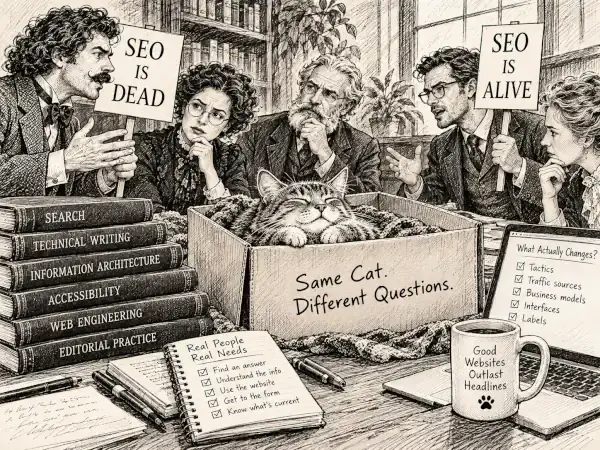
SEO was never alive. It had no pulse, required no food, and never once looked up from a warm patch of carpet because someone opened a bag of cheese.
This makes its recurring death announcements difficult to process.
Of course, “SEO is dead” is not usually a medical claim. It is shorthand for something changing: a technique stops working, a business model weakens, a search interface shifts, or a familiar way of reaching people becomes less dependable.
Those changes can be real. But the obituary often arrives before anyone has identified the deceased.
What exactly died?
When someone declares a practice dead, it helps to ask what they mean:
- A particular tactic no longer produces the same result.
- A distribution channel sends fewer visitors.
- A service is no longer worth its cost.
- A label no longer describes the work very well.
- An entire discipline has become unnecessary.
These are different claims. They need different evidence.
A tactic can become ineffective without making website maintenance unnecessary. A search engine can answer a question directly without removing the need for reliable source material. A company can stop buying a service called SEO while continuing to fund technical publishing, information architecture, and editorial work.
None of that proves SEO is healthy, essential, or even the right name for the work. It means the noun needs unpacking before the funeral proceeds.
“Dead” is an efficient headline. “Several assumptions behind a familiar commercial arrangement now require reconsideration” is less likely to fit on a thumbnail.
The work beyond the label
For many people, SEO became an entrance into learning how websites work.
A question about visibility led to questions about crawling and indexing. Those led to page structure, navigation, rendering, internal links, and the difference between publishing something and making it discoverable.
Eventually, the questions became broader:
- Can someone understand what this page is about?
- Can they find the relevant detail without reading everything?
- Does the navigation reflect how the information fits together?
- Can people using assistive technology operate the page?
- Is the answer accurate, clear, and maintained?
SEO did not invent those concerns. Information architecture, accessibility, technical communication, librarianship, web engineering, and editorial practice have their own histories and purposes. They do not become subdivisions of search marketing because someone discovered them while investigating a ranking problem.
Accessibility, especially, is not a clever way to make a crawler happy. People need usable websites whether or not a search engine rewards the work.
Still, an entrance can matter without owning the building.
Someone may begin by asking, “Why isn’t this page appearing in search?” and end up learning about semantic HTML. That is a useful journey. It does not mean every heading is secretly an SEO tactic.
Has anyone asked the cat?
At this point, someone usually produces Schrödinger’s cat.
SEO is alive. SEO is dead. SEO is somehow both until a conference speaker opens the presentation.
A brief distinction: the original thought experiment involves a potentially lethal apparatus and a question about quantum measurement. It is not simply a story about a comfortable cat in a cardboard box.
Our imaginary cat is different. There is no dangerous apparatus. There is a box, and the cat likes it.
Outside, observers are debating its condition. Inside, the cat is considering whether the left corner offers better chin support.
This does not resolve quantum mechanics. It does suggest that the observers may not have selected the question most relevant to the cat.
Something similar happens when professional arguments become absorbed in the condition of a label.
A homeowner is trying to understand whether a remodeling estimate includes disposal. A reader needs to know which version of a document is current. Someone navigating by keyboard needs to reach the form without getting trapped.
None of them should have to settle the future of SEO first.
The cat would like everyone to stop holding a symposium over the lid.
Some things really do become obsolete
There is an opposite mistake: treating every change as proof that nothing important has changed.
“People still need answers” is true. It is not a complete business analysis.
A publisher can produce useful work and receive less traffic. A once-reliable discovery route can become less dependable. A technically sound website can struggle to reach its audience. Good intentions do not guarantee distribution, and good structure does not guarantee rankings, citations, or revenue.
Some tactics also deserve retirement rather than a more flattering name. Repetitive pages created mainly to capture query variations do not become useful because they have tidy headings. A report full of positions and impressions may say little about whether visitors accomplished anything.
The response should be specific. What changed? Which assumption failed? What evidence supports continuing, revising, or stopping the work?
Sometimes the honest conclusion is that a service no longer justifies its cost. Sometimes a publishing strategy needs to shrink. Sometimes a page should be consolidated or removed.
Keeping useful work does not require preserving every practice that once traveled under the same banner.
A better question than alive or dead
Instead of asking whether SEO survives, we can ask which work still serves a clear purpose.
Repairing a broken link has an identifiable purpose: restoring a route. Explaining a confusing term helps someone understand a decision. Updating an outdated instruction reduces the chance that a reader follows it. Making a page easier to navigate can help people find what they came for.
Search visibility may be one reason to do that work. It need not be the only reason, and it should not substitute for checking whether the work actually helps.
The label can remain useful where it accurately describes the responsibility. It can also be set aside where a more precise name would make the scope, purpose, or accountability clearer.
SEO cannot literally die because it was never alive. But techniques can expire, markets can contract, and familiar language can stop being helpful. Those possibilities deserve attention without requiring either a dramatic burial or a declaration of immortality.
Meanwhile, someone still needs a readable page, a working route, or an answer they can trust.
The cat has settled into the left corner.
The box is meeting its requirements.
“Several assumptions behind a familiar commercial arrangement now require reconsideration”
that is lovely lucent