

Context assembly for an AI-assisted article means choosing the information the writing needs, explaining how those inputs relate, and keeping the task distinct from its supporting material. The resulting draft gives the writer and editor something concrete to examine. Reading it may reveal that the context itself needs to change.
At URLMD, Stephen and Lucent, his AI writing collaborator, began with a conversation, assembled three supporting article snapshots and a provisional diagram around a working seed, and used URLMD’s writing pen to generate a first draft. This account follows that preparation, drafting, and editorial development through publication, while leaving room for further work. No improvement in article quality has been measured.
Begin with a Question, Not a Source Pile
The working question is practical: how can Stephen and Lucent assemble useful context together, carry it into URLMD’s writing pen, and develop the returned article through discussion, editing, verification, and visual explanation?
That question sets a boundary. The task is not to summarize everything URLMD has published about context or workflows. It is to make one developing way of working understandable enough that another reader can inspect it and adapt the useful parts.
The preparation began with discussion. Stephen and Lucent identified the inquiry, chose three supporting articles and a provisional diagram, and preserved the materials in a shared working folder. The article snapshots retained their links, with original HTML and source records available separately. The folder made the pieces easier to locate and revisit; the seed explained how they were intended to contribute.
That explanation belongs in the assembly: why each item was chosen, what it supports, and where its authority ends. As Context Assembly explains, collecting information and constructing a useful working context are related but different activities.
The question can remain open enough for discovery. It does not need to anticipate every useful distinction before writing begins.
Give Each Input a Clear Role
The first draft request contained a working seed, three article snapshots, and one provisional diagram. The application also supplied its configured core context. The three selected references supplemented those foundations; they were not the whole model input. These materials serve different purposes. Treating them as interchangeable background would discard much of the value of selecting them.
The seed defines the present task
The seed establishes the central question, the proposed example, and the limits of the request. For the first run, it recorded permission to generate a draft and made clear that the complete sequence had not yet been performed.
That distinction matters when writing about a process in development: a detailed plan is not evidence of a completed trial.
Context Assembly explains the selection work
The first supporting article supplies the conceptual foundation. It distinguishes gathering documents from selecting, organizing, and relating information for a particular task.
Its role here is to help explain why three deliberately chosen references may be more useful than an unfiltered archive. It also supports a return path: if reading the draft exposes a missing definition or conflicting assumption, the assembly can be reconsidered.
Workflow Composition connects the activities
Workflow Composition provides a way to examine how discussion, writing, review, and further work fit together. Its contribution is not a mandatory sequence. It directs attention to responsibilities, inputs, outputs, and the conditions for continuing.
For example, a returned draft is an input to review. It is not evidence that review has happened. A reviewer’s question may lead to a source check rather than another writing run.
The human-judgment article supplies a bounded implementation example
Human Judgment in URLMD’s Article Workflow describes an earlier implementation account of the workbench. It discusses distinctions among generated text, working edits, saved revisions, discussion, and publication.
That makes it useful as a concrete editorial reference. It is not a fresh inspection of the current application. Claims about today’s controls, publication checks, or recovery behavior would need current evidence before being presented as verified behavior.
The diagram makes a possible relationship visible
The provisional diagram shows five stages: discussion, selected context, pen draft, joint review, and further work. A return arrow leads from joint review to selected context. Its accompanying text notes that reading the draft may change what should be supplied, and that publication is a separate choice.
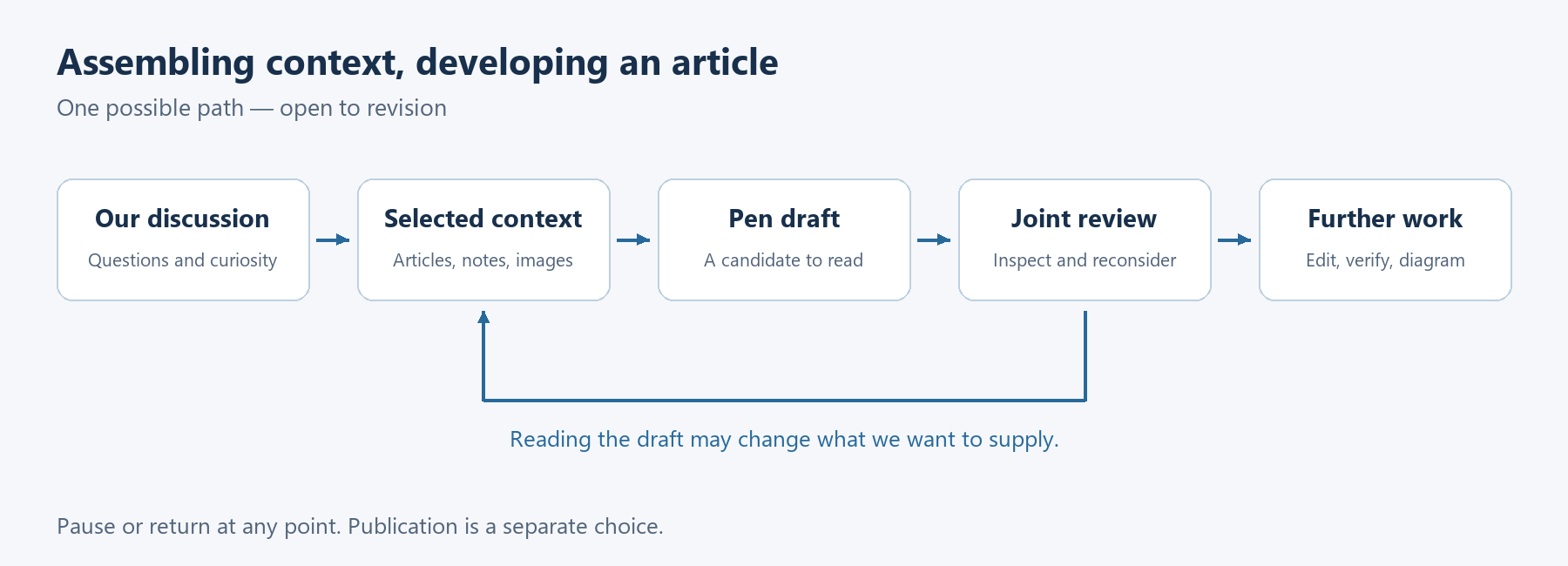
This is a conversation aid, not an execution record. Its arrows show relationships we want to consider, rather than transitions enforced by the application.
Together, these inputs provide a task, a conceptual explanation, a workflow perspective, a dated implementation reference, and a visual hypothesis. Their usefulness comes partly from keeping those roles distinct.
Carry the Assembly into the Writing Request
Once the materials are selected, the writing request needs to preserve their relationships. A useful handoff tells the pen what to produce and how the supporting material should inform it.
For this example, the essential handoff can be expressed in a short brief:
- Purpose: explain a proposed, collaborative article-development process through a concrete example.
- Primary task: write a public-facing article, rather than conduct a discussion or operate a publishing workflow.
- Supporting evidence: use the supplied article snapshots within their stated scope.
- Visual context: consider the diagram as a revisable proposal, not a required article layout.
- Limits: do not invent a completed trial, current application behavior, or evidence of improved results.
- Authority: generate the draft; leave publication to a separate decision.
The three article snapshots were supplied in full as supporting text, and the diagram occupied one image slot. The other two image slots remained empty. No additional retrieval was needed merely to fill another input slot. If a later question requires current application behavior or a newer source, that creates a specific reason to investigate.
Not everything in the shared working environment needs to enter the request. Unrelated notes, unused images, and secondary references can remain available without becoming active writing context. Selection should support the present inquiry rather than reproduce the whole workspace.
Read the Draft as a Candidate
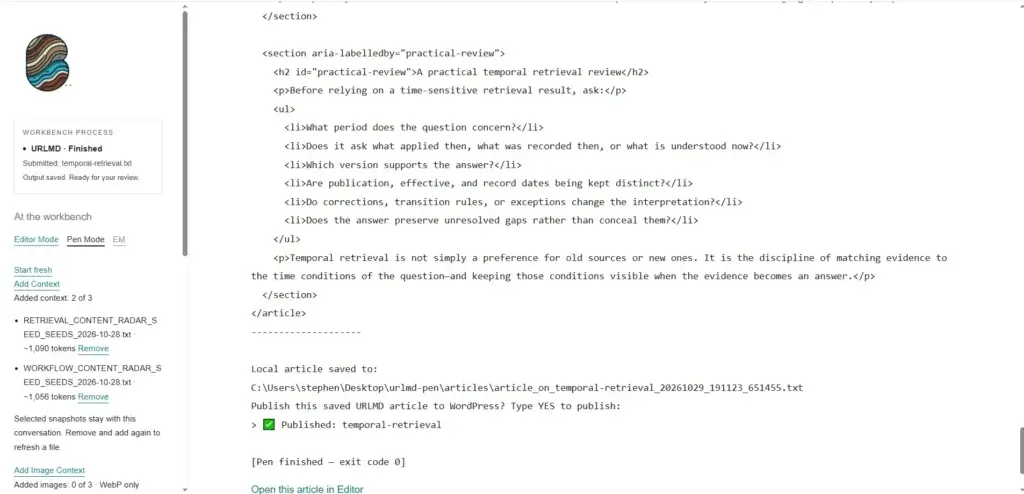
The pen returned an article and preserved its original alongside a local review record. That first draft changed the work by making an interpretation available for inspection. Stephen and Lucent can now examine particular passages rather than discuss only what an article might contain.
That reading should test more than fluency. Useful questions include:
- Can a reader follow the example without knowing the workbench?
- Does the article explain why these inputs were chosen?
- Does it distinguish supplied evidence from proposed arrangements?
- Has it described a possible action as though it already happened?
- Where would a source check, example, or diagram resolve genuine confusion?
The collaborators have different responsibilities. Lucent can help identify unclear reasoning, compare wording with supplied sources, suggest revisions, and explore alternative explanations. Stephen retains editorial authority over what to accept, change, investigate, or set aside.
Neither a fluent draft nor agreement during discussion proves factual accuracy. Claims still need an appropriate evidential basis. The purpose of review is to make those judgments possible, not to treat the returned text as presumptively finished.
Continue Beyond the Pen When Useful
The writing pen need not contain every activity involved in developing the article. After reading, further work might involve direct editing, checking a source, inspecting the current application, or drawing a clearer explanation.
Suppose the draft says that publication is tied to a particular saved revision. The supplied human-judgment article supports a dated account of that design. If the new article needs to describe current behavior, the next step is verification—not simply asking the pen to state the claim more confidently.
Another passage might accurately explain the process but leave readers unsure how the inputs relate. A diagram could help. Two different views would answer different questions:
- An input-assembly view could show the task brief, supporting sources, and provisional image, with their distinct roles.
- An article-development view could show drafting, reading, editing, verification, and possible returns to context selection.
Neither diagram is required. Each should earn its place by clarifying something the prose leaves difficult to understand. A publication-ready version would also need an appropriate text equivalent and readable presentation.
Any visual explanation should avoid unsupported causal claims. The presence of a source in the assembly does not establish that it caused a particular sentence. It is more accurate to show what was supplied and how it was intended to help.
Revise the Context Without Losing the Inquiry
Reading may reveal a problem in the draft, the assembly, or both. Those possibilities call for different responses.
If a paragraph is repetitive, direct editing may be enough. If the article misunderstands an ambiguous term, the assembly may need a definition. If it makes a claim unsupported by the selected sources, that claim may need removal, qualification, or new evidence.
Adding more material is only one option. Removing a distracting reference, clarifying a source’s role, or narrowing the question may be more useful.
For example, suppose the first reading shifts interest from “How do we prepare an article request?” to “How do we decide what to do after reading the result?” That is a meaningful change in emphasis. The next encounter could bring forward the current draft and a short note identifying the unresolved question, rather than automatically repeating the original package unchanged.
This is context assembly across successive encounters. Continuity comes from preserving the relevant question, evidence, and changes—not from carrying every earlier detail forward indefinitely.
Keep Drafting, Review, and Publication Separate
The workflow has several legitimate outcomes. Stephen and Lucent might revise the article, investigate a question, improve the diagram, save notes for later, or stop with the draft. None of those outcomes requires publication. In this example, Stephen read the draft across several passes and then authorized publication. Lucent checked the saved content and page preview before publishing, then verified the public page. That brought this article to publication; future revision remains possible.
Likewise, permission to produce a draft does not by itself settle whether it should be published. A saved draft leaves several next steps available: discussion, editing, investigation, or publication when that action is intended. Discussing a draft does not silently approve its wording.
These distinctions make the process easier to understand and govern. Each transition concerns identifiable work and a particular next action. Editorial review and responsibility remain necessary even when software handles the mechanics of moving or preserving text.
The broader lesson is practical: assemble enough context to begin responsibly, then let inspection reveal what the next useful step should be. A good first draft need not settle the inquiry. It should make the inquiry clearer—and leave the people responsible for the work free to continue, reconsider, or stop.