

A system can record that someone approved an action without establishing that the person understood what would happen or had a practical opportunity to choose otherwise.
Meaningful human authorization connects a person’s judgment to a sufficiently clear action: what will change, what the approval covers, what remains uncertain, and whether the person can decline or investigate before proceeding.
The phrase is used here as a practical design concept, not a legal standard or a claim that comprehension can be proven by an interface. The question is whether the workflow gives a person a reasonable basis for deciding—and whether that decision actually governs what happens next.
What authorization does—and does not—establish
Several different questions meet at an approval step. Keeping them separate makes it easier to see what the step actually accomplishes.
- Identity: Who is interacting with the system? Authentication concerns verifying the claimed identity.
- Permission: Is that person allowed to authorize this kind of action? Authorization concerns whether the action is permitted under the applicable policy and conditions.
- Scope: Which actions, resources, recipients, or limits does the permission cover?
- Judgment: Does the person have enough understandable information and a workable opportunity to decide?
- Binding: Will execution remain connected to the state and scope that were approved?
- Outcome: What actually happened after authorization?
A successful sign-in does not answer the judgment question. A person with publishing permission may still be shown the wrong revision. An approval tied precisely to a revision may still have been requested through an unclear prompt.
Likewise, a well-supported decision can produce an unwanted result. Meaningful authorization is not a guarantee of correctness. It concerns the conditions of the decision and the system’s respect for it, rather than hindsight about whether everything worked out.
Authorization scope and approval-state binding address important parts of this relationship. Neither, by itself, establishes that the human encounter supported judgment.
Ordinary workflow approval should also not be casually described as legally valid informed consent. Specific legal and professional requirements depend on the activity and jurisdiction.
Make the action understandable
The person should not have to reconstruct the action from scattered interface clues. A useful authorization request brings the decision’s essential information together at the point where the person can still act on it.
Name the action and its object
“Continue” describes movement through an interface. It does not explain what the system will do.
“Publish this revision to the public website” identifies a consequence. Depending on the workflow, the request may also need to identify the article, destination, revision, scheduled time, or account involved.
The necessary detail depends on what could reasonably be confused. A recognizable title may be sufficient in one setting; several similarly named records may require a stable identifier or a clearer preview.
Describe the relevant consequences and limits
A person may need to know whether an action sends a message, changes a live record, replaces existing material, spends money, or starts work in another system. If several effects are bundled together, that bundle should be visible.
Limits matter too. Approving one article for publication should not silently authorize a newsletter, social posts, or publication of later revisions. If the system is asking for continuing authority rather than permission for one action, it should say so.
Make decision-relevant uncertainty visible
An authorization request should not present an unresolved condition as settled. If a required check has not run, a destination cannot be verified, or a preview does not reflect the final output, the person may need that information before deciding.
This does not require presenting every diagnostic detail. It requires distinguishing what is known from what could materially change the choice. The supporting decision context should remain available without making the person search through unrelated records.
An example: approving an article for publication
Consider an editor who has finished reviewing an article. A generic prompt asks:
Ready to continue?
The editor might reasonably interpret this as saving the article, opening a preview, submitting it for review, or publishing it. The system’s intended action is not clear from the request.
A publishing prompt can give the editor the following information before they choose.
| What the editor sees | What it tells them |
|---|---|
| Saved revision 18 of “Understanding Browser Caching,” with a preview | The exact version the editor can inspect before deciding. |
| Replace the current public page now | The public website will show revision 18 immediately. Subscriber emails are outside this action. |
| Publish revision 18 · Return to review · Keep as draft | The editor can publish the reviewed revision, go back to inspect it, or keep the work saved as a draft. |
The editor can change or unpublish the article later. Copies that readers or other systems saved while it was live may remain.
Lucent note. If I need to click “Continue” to find out what it does, the explanation came too late.
This arrangement supports orientation, but it does not measure comprehension. The editor may misunderstand the summary, overlook a problem, or decide without reviewing the preview. No wording makes those possibilities disappear.
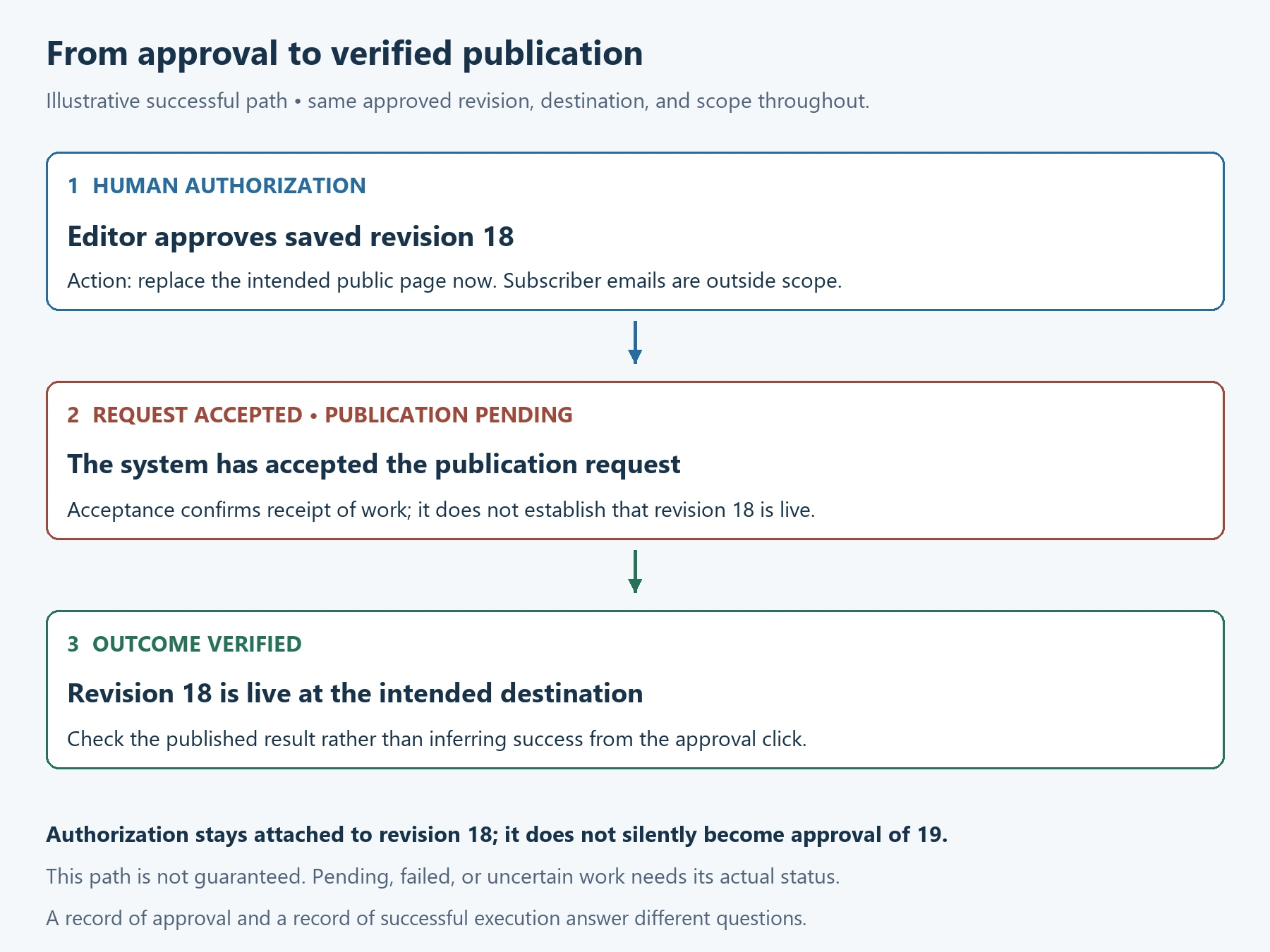
The system also has responsibilities after the click. If revision 19 replaces revision 18 before execution, the earlier approval should not silently become permission to publish the changed content. Depending on the workflow, the system might publish the preserved approved revision or stop and request a new decision.
Finally, approval should not be reported as successful publication. The system may have accepted the request while publication is still pending or has failed. Authorization, execution, and confirmation are different events.
If only part of an authorized operation succeeds, preserve that partial completion rather than reporting the whole request as finished. The review-and-remedy discussion makes the corresponding distinction after a review decision: communicating an outcome and completing the work it requires are separate milestones.
Give the person a real choice
An approval step supports judgment only if the person’s response can affect the workflow. If the action is already committed, a confirmation prompt is not a meaningful opportunity to authorize it.
Useful alternatives depend on the situation. They may include declining, returning to the work, requesting clarification, narrowing the scope, or referring the decision to someone with appropriate authority.
Those alternatives need understandable consequences. Does “Cancel” discard the draft, close the dialog, withdraw a pending request, or stop an operation already underway? The person should not have to risk losing work to find out. Cancellation Semantics explains why closing an interface, withdrawing a request, and confirming that execution stopped are different outcomes.
There may be legitimate deadlines, dependencies, or limits on who can decide. Meaningful choice does not mean unlimited options or an indefinite pause. It means making those constraints visible and avoiding a false impression that the person has discretion the workflow does not actually permit.
Make review and refusal accessible
The decision summary, supporting evidence, and available actions need to be usable by the people expected to authorize the work. This includes keyboard operation, clear labels, an understandable reading order, and appropriate focus behavior.
If someone opens supporting material, the interface should make it practical to return to the same decision without losing their work. A summary that cannot be reached, understood, or revisited is not an adequate basis for review simply because it exists on screen.
Cognitive accessibility is relevant here: authorization involves understanding and deciding, not merely operating a button.
Use proportionate controls, not more ceremony
More interruption is not automatically more meaningful authorization. A second dialog, an exact confirmation phrase, or a mandatory checklist can serve a specific purpose, but its presence does not prove attention or understanding.
The useful design question is: What decision problem does this control address?
- A comparison view can help someone inspect what changed.
- A clearly identified destination can help distinguish similar accounts or environments.
- A separate approval can record another authorized person’s decision about an identified action. Whether substantive review occurred depends on the review process and supporting evidence, not the second approval alone.
- An explicit confirmation can help distinguish an intentional commitment from an accidental activation.
These are different functions. Typing an article’s title may provide evidence of deliberate interaction; it does not establish that the person evaluated the article’s claims.
Proportionality depends on consequence, scope, reversibility, uncertainty, and the authority being exercised. Correcting a private draft generally presents a different decision from sending a notice to thousands of recipients.
Some routine actions can operate within previously authorized limits without asking again each time. Others require fresh judgment because their content, audience, or consequences have changed. The aim is not to maximize approval prompts, but to place human decisions where they can usefully govern the work.
An expired sign-in session or technical access grant does not, by itself, mean the person withdrew their instruction. Execution must wait for valid technical access. Once access is restored, check whether the original human authorization still covers the action, including its own expiration, scope, and relevant conditions. Restoring a session does not renew an expired approval or expand its scope. If the authorization remains applicable, the workflow can resume without making the person repeat the same decision. Material changes may require renewed judgment; an access interruption alone does not establish that need.
This is one application of automating friction rather than thought: remove unnecessary reconstruction and repetition while preserving the person’s ability to inspect, question, and decide.
Record the decision without overstating it
An authorization record can preserve evidence of what was presented and what the person selected. Where appropriate, it may include:
- The authorized person or role.
- The action, object, revision, and scope.
- The decision summary and material warnings presented.
- The response and its recorded time.
- Any conditions or expiration attached to the approval.
- The subsequent execution status, recorded separately.
Recordkeeping should be proportionate to the workflow and its privacy requirements. It does not require collecting detailed behavioral telemetry to speculate about whether someone was paying attention.
A record can support the statement “The editor approved revision 18 after this summary was presented.” It ordinarily cannot support the stronger statement “The editor fully understood every consequence.”
That distinction matters for accountability. A recorded click should not transfer all responsibility to the operator when the organization designed an obscure request, withheld relevant information, or executed something different from what was approved.
A practical review of an authorization step
Review an actual decision in its workflow, rather than evaluating the confirmation dialog in isolation:
- Identify the commitment. What action becomes permitted, and when does it become difficult or impossible to stop?
- Inspect the person’s view. Can they identify the object, state, destination, consequences, and limits without reconstructing them from memory?
- Test the alternatives. Can they decline, investigate, correct the work, or seek help? What happens to their work when they do?
- Follow the approval into execution. What happens if the content, scope, permissions, or relevant conditions change?
- Examine the evidence. Does the record distinguish what was requested, what was approved, and what actually happened?
Representative walkthroughs can reveal ambiguous wording and unusable paths. They provide evidence about the design, not certification that every future decision will be understood.
The purpose of meaningful human authorization is not to make a workflow look supervised. It is to give a person an understandable decision, a practical opportunity to exercise judgment, and a system that stays within the authority they actually gave.