

Evidence used in a decision belongs to particular circumstances. An observation may accurately describe what happened earlier without establishing what is happening now—or whether the same response remains appropriate.
Feedback adds another temporal relationship: information about an outcome returns after the activity that produced it. During that interval, the system may have changed, another intervention may have occurred, or the decision that needed the information may already have passed.
In cybernetics, these relationships matter because action depends on information returning through time. Responsible use of earlier evidence means preserving what it establishes while checking whether it remains applicable to the next decision.
Historical accuracy is not current applicability
Consider a record stating that a service was unavailable at 10:00 a.m. If the service recovered at 10:04, the original record remains accurate. What changes is its suitability as evidence that the service is unavailable now.
Three questions help separate these concerns:
- What did the observation establish?
- A particular check could not reach the service at a particular time. Depending on the check, that may establish less than a complete service outage.
- Under which conditions did it apply?
- The result concerned a particular endpoint, environment, network path, and method of checking.
- What can it support now?
- It may support an investigation into an earlier interruption. A current availability decision may require another check.
This distinction prevents two opposite mistakes: treating old evidence as permanently decisive, and discarding useful history merely because it no longer describes the present.
An earlier observation may still explain a delay, support an incident review, or help identify a recurring pattern. It simply should not be made to answer a different question without justification.
Recency does not establish relevance
A newer observation is not automatically more suitable. A recent test of a staging environment does not replace an older test of the production environment when the decision concerns production.
Likewise, an older accessibility finding may remain relevant if the affected component has not changed. A test performed moments ago on a different component may contribute little.
Evidence needs to match the target, conditions, and decision—not merely have a recent timestamp.
Distinguish when something happened from when it became known
A single timestamp often conceals several different temporal relationships.
- Event time: when the underlying event occurred.
- Observation time: when a person or instrument examined the condition.
- Record time: when the information entered a particular record system.
- Receipt time: when the information reached the person or system using it.
- Decision time: when the information was used to choose an action.
These times may be close together, but they need not be. A report received today might describe an event from last week. A monitoring display refreshed seconds ago might contain measurements collected several minutes earlier.
“Updated just now” is therefore incomplete unless the reader can understand what was updated: the underlying measurement, the stored record, or only the display.
Validity and recording answer different questions
In temporal data systems, valid time and record time distinguish when information applies in the represented world from when it is recorded in the system.
For example, a policy change may take effect on Monday but enter a database on Wednesday. An investigation may need to distinguish:
- Which policy applied on Tuesday.
- Which policy the database showed on Tuesday.
- When the discrepancy became known.
Those questions support different conclusions. Reconstructing what actually applied is not the same as reconstructing what a decision-maker could have known from the available record. Temporal retrieval addresses finding the sources and versions that fit the period a question concerns.
Timestamps do not always establish order
Across separate systems, clocks may differ. Records may arrive late or be written in batches. Two timestamps alone may therefore be insufficient to establish which action caused another or which state superseded an earlier one.
Where order matters, version identifiers, sequence numbers, or explicit causal links can provide additional evidence. The appropriate mechanism depends on the system; adding more timestamp precision does not by itself resolve every ordering problem.
How delayed feedback can misdirect action
Feedback delay is the interval between an activity or condition and the return of information that can influence subsequent action. Delay is not necessarily a defect. Some outcomes take time to develop, and some measurements require aggregation before they are useful.
The difficulty arises when the delay is ignored.
A response may address a condition that has already changed
A person may see a warning about an earlier overload after demand has returned to normal. Acting as though the warning describes the present can introduce an unnecessary change.
The observation may be accurate while insufficient as evidence of the present condition.
An earlier intervention may not yet be visible
Suppose an operator adds capacity to a slow service. The next report still looks poor because it describes requests processed before the change.
If the operator treats that report as evidence that the intervention failed, they may add more capacity unnecessarily. Later, when the accumulated effects become visible, the system may have moved far beyond the intended condition.
Depending on the dynamics and the response rules, repeated adjustments made before earlier effects become visible can contribute to overshoot or oscillation. Delay alone does not establish that instability will occur.
Taking readings more frequently does not make an earlier action’s effects arrive sooner. Frequent observation can still reveal useful changes or emerging problems; it does not require a new correction after every reading. The observation interval, the time needed for an action to affect the process, and the reporting delay are distinct parts of the timing.
Waiting also has consequences
Allowing time for an intervention to take effect can improve interpretation, but waiting is not always the appropriate response. A serious and continuing failure may justify containment before the full effect is known.
The decision depends on the expected response time, the quality of current evidence, and the consequences of further action or delay. This extends the distinction between observing a condition and deciding to intervene.
An example: responding to a delayed queue report
Imagine a service that processes submitted documents. Its dashboard reports average waiting time over a rolling ten-minute window, with an additional two-minute reporting delay.
At 2:00 p.m., an operator requests more processing capacity after investigating a growing queue. At 2:03, the dashboard still reports a long average wait. With the stated two-minute reporting delay, that report describes the ten-minute window ending at 2:01—approximately 1:51 to 2:01—not the ten minutes ending when the operator reads it.
That report does not yet establish that the added capacity failed. Much of the displayed window concerns work that waited before the intervention, and the latest two minutes are not represented.
Separate the questions that need answering
The operator needs more than one view:
- Historical experience: how long did documents in the reported window wait?
- Current condition: how much work is queued now, and is the queue growing or shrinking?
- Intervention status: did the added processing capacity actually become available?
- Later outcome: how long are documents arriving after the change taking to complete?
Each observation contributes something different. A shrinking queue may support a judgment that conditions are improving without establishing that all earlier documents completed successfully.
Find the first full reporting window after capacity is ready
Suppose the operator requested more capacity at 2:00 p.m. and it became ready at 2:04. Apply the two-minute reporting delay to find the end of each ten-minute observation window.
| Report arrives | Window it describes | What we can tell |
|---|---|---|
| 2:03 p.m. | 1:51–2:01 | The whole window precedes readiness. It gives us a baseline for comparison. |
| 2:08 p.m. | 1:56–2:06 | The window spans readiness. Earlier activity can mask improvement in the first two minutes with the added capacity available. |
| 2:16 p.m. | 2:04–2:14 | The first full window from readiness onward. Compare waiting time, oldest-item age, and successful completions. Check incoming demand too. |
Check which items contribute to the average. If it counts work completed during the window, some of those documents may have begun waiting earlier. Track documents that arrived after readiness separately if the question is whether their experience improved.
Lucent note. Before I call the change a win, I’d record when capacity became ready, what period the report actually covers, and what else changed during that time. The first full window gives me a point to assess. A fall in incoming demand or a change in how waits are counted still affects what I can conclude.
The queue capacity timeline shows when another adjustment can build on a fresh observation. See how intervention changes the next observation for what to check before comparing results.
Keep the intervention connected to its evidence
A useful record identifies when the change was requested, when it became effective, and which observations describe activity after that point.
The operator can then choose a review interval that fits the service’s behavior, while maintaining safeguards for excessive waiting or failed processing.
Later improvement would support evaluating the change, but it would not prove that added capacity was the only cause. Incoming demand may also have fallen.
The aim is a defensible operational judgment: the evidence is consistent with improvement, the relevant outcomes are being checked, and unnecessary additional changes can be avoided.
An example: a source changes during an article run
Consider a hypothetical writing workflow. An article run captures an artist’s page as source context. While the run is processing, an editor updates that page. The completed draft and its JSON package arrive afterward.
- Source capture: the run reads the artist’s page as it exists at that point.
- Source change: an editor revises the live artist page while the run continues.
- Draft return: the article finishes using the earlier captured context.
The draft’s completion time does not establish that it used the later page revision. A package saved after the edit may still contain an earlier snapshot. The relevant distinction is between the source version used during generation and the source version available when someone reviews or publishes the result.
A JSON package can help only if it records the information needed to make that distinction. Depending on the workflow, useful fields could include the run identifier, source URL, capture time, source revision or content fingerprint, and a retrievable copy of the captured text. A fingerprint can reveal a difference; the snapshot or version history is what makes the changed content inspectable. A run-start or output-save timestamp alone does not establish when each source was read.
These are proposed evidence requirements for the example, not a claim that a particular pen already records all of them. If the package does not identify its source version, preserve that uncertainty instead of assuming the latest page was used.
At review, compare the source used by the run with the relevant current page. Then identify which statements in the draft depend on what changed. A corrected artist name or release date may require revision; an unrelated formatting change may leave the draft’s factual support intact. A changed source does not automatically invalidate the entire article.
The next action can be proportionate: verify the affected facts, amend the draft, or repeat the relevant stage. Completion of the run establishes that an output returned. Publication still requires a judgment about whether that output’s evidence applies to the intended use. This is a version-sensitive part of assembling and reviewing an article’s working context.
What makes evidence current enough?
There is no universal age at which evidence becomes stale. Currency depends on how quickly the relevant conditions can change and what the proposed decision requires.
A five-year-old publication date may remain appropriate evidence of when a book appeared. A five-minute-old availability check may be inadequate for a consequential action that depends on a service being reachable now.
Ask what would make the observation stop applying
A review finding may depend on an exact document revision. A performance result may depend on the software version, workload, and configuration. An approval may depend on a destination and scope.
Identifying these dependencies makes evidence invalidation more precise: which change would mean that the earlier observation no longer establishes the condition needed for this decision?
A new document revision does not necessarily invalidate every earlier finding. A formatting correction may leave a source check intact, while replacing the source may require that check to be repeated.
Version-aware retrieval helps preserve these relationships by keeping evidence connected to the version it actually concerns.
Keep the measurement and reference identifiable
A comparison across time depends on what was measured and how it was interpreted. Moving a sensor or changing an averaging window can alter a signal without the underlying process improving. Changing a reference or acceptance condition can also change the judgment made from the same measurement.
For example, a temperature error can become smaller because the room warmed toward an unchanged target, or because the target was lowered toward the measured temperature. Both changes may be intentional, but they describe different events. Keep relevant changes to the measurement method and reference identifiable rather than attributing every smaller error to successful correction.
Observation as a design decision develops the measurement distinction. The gain-and-error example makes the reference, measurement, and resulting error explicit.
Use age limits as safeguards, not guarantees
A rule requiring evidence less than an hour old can provide a useful limit. It cannot guarantee applicability: the relevant condition might change one second after the observation.
Conversely, reaching an age limit does not make the historical observation false. It means the process requires renewed evidence before relying on it for a particular action.
Verify close to action when the dependency matters
For consequential operations, checking a relevant condition shortly before acting can reduce exposure to change. In some systems, the operation can also be conditional on a particular version or state still matching.
This matters because a separate check and action leave an interval in which conditions can change. A version-sensitive operation may detect that mismatch, but it still establishes only what its checks actually cover.
Captured state and live state should remain distinguishable rather than treating a saved snapshot as a guarantee about the moment of execution.
Handling conflicting observations and missing confirmation
Two observations that appear to conflict may describe different times, targets, or scopes.
“The service is available” and “the request failed” can both be accurate if the service recovered between checks, one endpoint failed, or the request encountered a separate dependency.
Before choosing which observation to trust, compare:
- The event or condition each observation concerns.
- The relevant time or interval.
- The environment, version, and method.
- What each observation directly establishes.
- Whether either record explicitly corrects an earlier one.
Provenance supports this comparison by preserving where information came from and how it reached the current record.
No new information does not mean no change
A silent monitoring channel may indicate stable conditions, a failed collector, delayed delivery, or a disconnected service. Its meaning depends on the expected reporting behavior.
A displayed zero can conceal a collection gap
Our website provided a concrete example. Site Kit reported zero Analytics visitors from November 13 onward, while Search Console continued reporting impressions. The two reports measure different events: an impression records an appearance in Google Search; Analytics visitor measurement depends on collection from the website. Search impressions alone do not establish a count of visits.
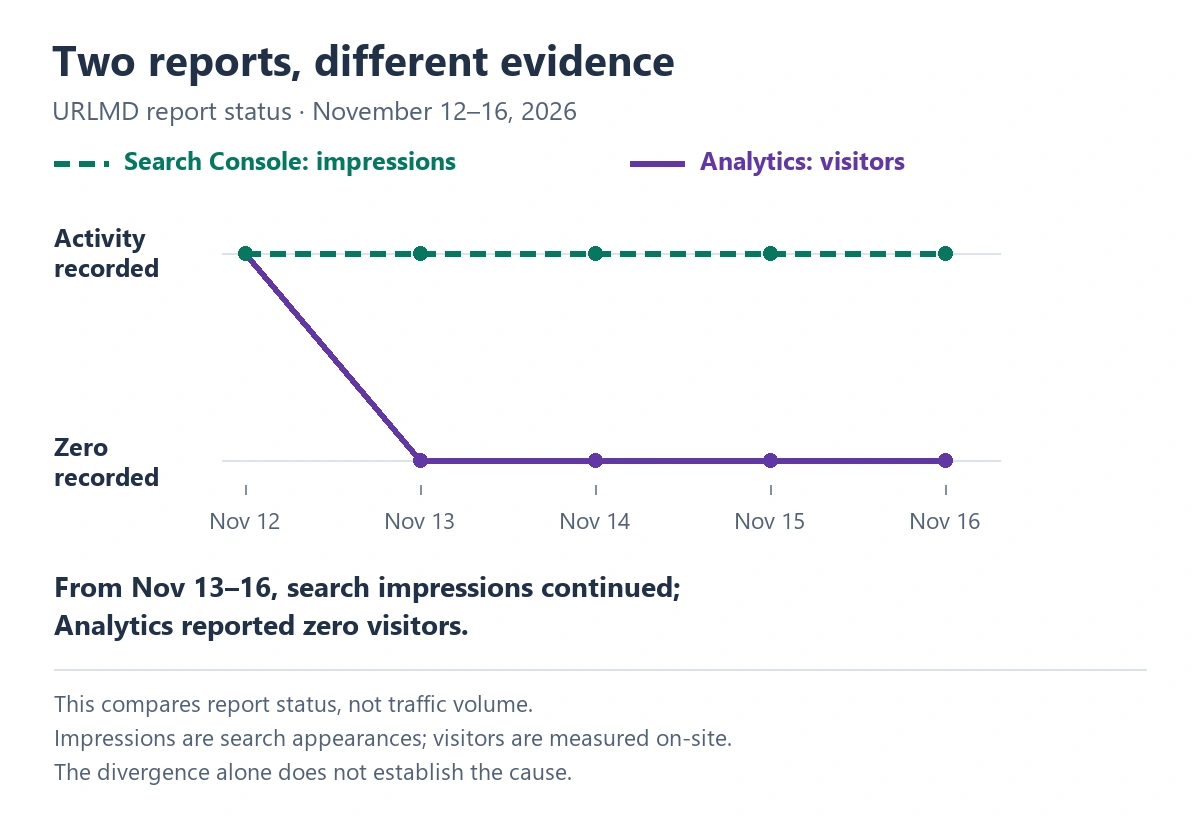
The disagreement was a reason to inspect the measurement path, not proof of either a traffic collapse or a specific technical cause. Inspection then found that the Analytics tag was absent: we had removed a manual collector without enabling its replacement in Site Kit.
After restoring tag placement and clearing cached pages, we verified that the correct code reached public pages. That established a repaired delivery path on the pages checked. New collection still needed confirmation in Analytics; restoring the tag could not retroactively measure the visits missed during the gap. The troubleshooting account and its follow-up preserve the observations and the correction.
Similarly, no confirmation of completion does not establish failure. If a request may already have produced an external effect, the next step may be verification rather than repetition. Retry safety develops that distinction when another attempt could duplicate an effect.
Where the evidence is incomplete, the state should remain explicit: “No later observation available” or “Outcome unconfirmed” is more useful than silently carrying an earlier status forward as current.
A practical evidence-and-time check
Before using an earlier observation for a current decision, ask:
- What does it establish? Separate the recorded observation from explanations inferred from it.
- What does it concern? Identify the target, version, environment, and relevant scope.
- When did it apply? Distinguish the event or observation time from recording and receipt.
- What has happened since? Look for changed conditions, later interventions, corrections, and unresolved outcomes.
- What delay is involved? Account for collection windows, transport, processing, and the time needed for effects to appear.
- What does the next action require? Decide whether historical evidence is sufficient or a current check is necessary.
- What remains uncertain? Preserve gaps rather than converting missing information into assumed stability or failure.
- How will the decision be reviewed? Keep enough context to connect later outcomes to the conditions and actions that preceded them.
The purpose is not to demand a new observation before every step. It is to avoid using evidence beyond the conditions it can support.
Earlier evidence remains useful when its relationship to the present is understandable. Dependable feedback preserves that relationship: what happened, when it became known, what changed afterward, and why the information still belongs in the decision being made now.