

Query reformulation is the process of changing a search query to better express an information need. It may involve replacing unfamiliar wording, adding a missing constraint, removing an unnecessary restriction, or asking a clarifying question before searching again.
The need and the query are related, but they are not identical. A person may understand the problem they are facing without knowing the terms used in the documents that explain it. They may also begin with an incomplete question and discover what matters by examining the first results.
Good reformulation improves the search expression without quietly replacing the question. The goal is not simply to retrieve more results. It is to find information that better fits what the person is trying to understand or accomplish.
The information need and the search query
An information need is the underlying gap a person wants to resolve. A search query is one expression of that need, usually compressed into a few words.
Someone searching for “website form not working” might need to understand why a submit button does nothing, why a server rejects a request, or why a completed submission never produces a confirmation. The query names a broad symptom. It does not yet distinguish the possible problems.
Reformulation can make that distinction clearer:
- “Form submit button does nothing when clicked” describes an interaction problem.
- “Form submission returns HTTP 403” identifies a particular response.
- “Form saved successfully but confirmation message missing” separates a completed operation from missing interface feedback.
These are not interchangeable versions of the same question. Each adds information that changes which evidence would be useful. As the person learns more, the search can become more precise.
This is part of information retrieval: translating a need into a form that a system can use to locate relevant material.
Why an initial query may miss useful information
A weak result set does not necessarily mean the information is unavailable. The query may express the need differently from the relevant sources, omit a necessary distinction, or impose a restriction that excludes useful evidence.
Vocabulary mismatch
A person may search using everyday language while documentation uses a technical term. “Text goes off the screen when zoomed” may lead toward material about reflow, overflow, or fixed-width layouts.
Lexical matching depends on the words and textual forms a system matches. Semantic retrieval can help bridge differences in wording, but it does not eliminate ambiguity or guarantee that a related result addresses the actual problem.
Missing context
“Change permissions” leaves out the system, resource, and intended change. Adding the application name, operating environment, or exact error can make the query substantially more useful.
Unnecessary restrictions
A query can also be too narrow. Including an assumed cause, an exact phrase, or a product version that does not matter may exclude relevant explanations.
For example, “browser cache causing missing confirmation message” assumes the cache is responsible. “Form submission succeeds but confirmation message missing” keeps the observed behavior while reopening the cause for investigation.
Ambiguous language
Words such as “model,” “index,” “rendering,” and “state” have different meanings across domains. Adding a domain can help, but only if that domain is known rather than guessed.
Ways to reformulate a query
Reformulation is not a single operation. Different changes solve different retrieval problems.
- Replace a term
- Try the terminology used by relevant sources. A search for “website jumping while loading” might become “layout shifts during page load.” Keep the original symptom available in case the technical interpretation proves wrong.
- Add a meaningful constraint
- Include a product, location, version, date, audience, or task when it materially changes the answer. “Keyboard navigation in a modal dialog” is more specific than “keyboard navigation.”
- Remove an unsupported assumption
- Describe what happened rather than embedding an unverified explanation. “Page slow after login” leaves more room for investigation than “JavaScript memory leak after login.”
- Broaden the wording
- Remove an exact phrase or a nonessential detail when results are sparse. Broaden deliberately, preserving constraints that are essential to the task.
- Split a compound question
- Search separately for distinct parts of a problem when one query mixes several needs. Finding how a process works and finding how to recover from its failure may require different sources.
- Add alternative expressions
- Query expansion adds related terms or alternative wording to improve coverage. It is one form of reformulation, not a synonym for the whole process. Adding loosely related terms can also introduce irrelevant results.
A useful habit is to identify what each change is intended to improve. If the problem is vocabulary, try different wording. If the problem is ambiguity, add context. Adding more words without identifying the mismatch can make a query longer without making it clearer.
An example: describing a problem before knowing its name
Consider someone investigating a page that becomes difficult to use when enlarged.
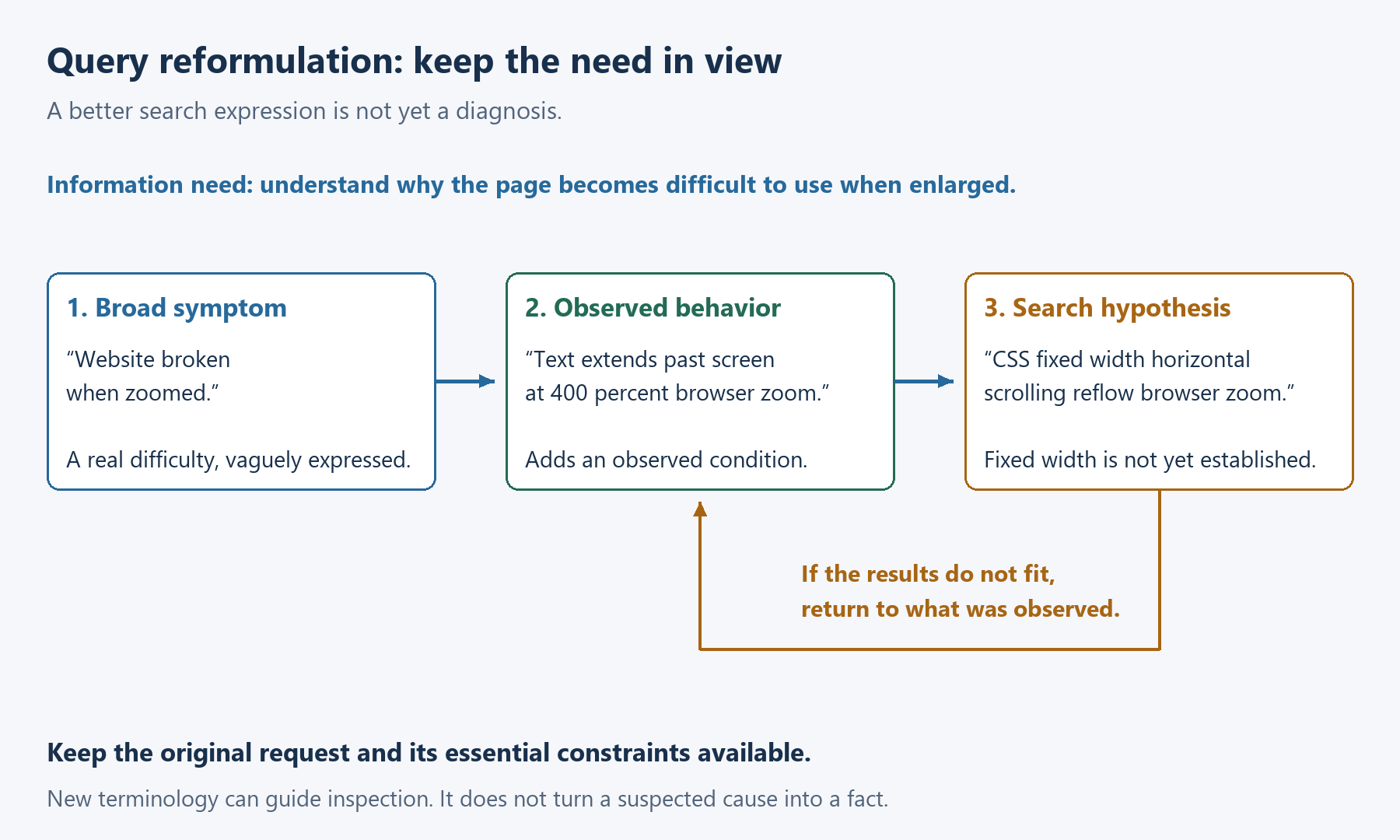
- Initial query: “Website broken when zoomed.” This expresses a real difficulty, but “broken” does not describe the behavior well enough to distinguish among possible causes.
- Observation-based revision: “Text extends past screen at 400 percent browser zoom.” The revised query preserves the symptom and adds the condition under which it occurs.
- Terminology-informed revision: “CSS fixed width horizontal scrolling reflow browser zoom.” After encountering relevant explanations, the person tries terms that may connect the observed behavior to implementation guidance.
The third query is more technical, but it is not automatically better. A fixed-width element is a possible cause, not an established diagnosis. If those results do not fit the page, the search should return to the observed behavior rather than treating the new terminology as proof.
An article about zoom, reflow, and text resizing may help the person understand the behavior and identify what to inspect next. That is a useful retrieval outcome even before the exact defect is known.
When clarification is better than another guess
Some uncertainty cannot be resolved safely through alternative wording alone. If plausible interpretations would require substantially different answers, clarification is often the better next step.
For “How do I restore the previous version?” a useful question might be: “Do you mean a document revision, a website deployment, or an installed application?” Generating several searches without resolving that distinction may retrieve detailed instructions for the wrong task.
Clarification is especially valuable when:
- The query could refer to different systems or entities.
- A missing date, location, or version changes which information applies.
- The person needs a historical answer rather than current guidance.
- The wrong interpretation could lead to destructive or consequential action.
Clarifying questions should resolve a meaningful uncertainty, not create an unnecessary interview. If the available context already establishes the system and task, asking for them again adds friction rather than clarity.
Reformulation is one possible next action in adaptive retrieval. The mismatch may instead call for opening a source, expanding its surrounding passage, clarifying the request, or stopping because the available material cannot establish the answer. Choose the action that addresses the gap rather than automatically producing another query.
Reformulation in automated retrieval systems
Search applications and retrieval-augmented systems may reformulate queries automatically. Depending on their design, they may correct spelling, expand abbreviations, incorporate conversation context, generate alternative queries, or divide a complex question into smaller searches.
These techniques can improve retrieval, but they also create opportunities for intent drift. A system may remove a negative constraint, replace an unfamiliar entity with a familiar one, or turn a tentative explanation into an assumed fact.
A careful implementation preserves:
- The original request: the user’s wording remains available for comparison.
- Essential constraints: dates, versions, exclusions, locations, and named entities survive the rewrite where relevant.
- Uncertainty: suspected causes remain hypotheses rather than becoming search requirements.
- The relationship between queries and results: reviewers can inspect which reformulation retrieved particular evidence.
When several interpretations remain plausible, separate query variants may be more useful than one blended rewrite. Their results still need evaluation; running more searches does not establish that the system has understood the request.
In an AI-assisted workflow, reformulation supports retrieval. It does not replace the work of grounding an answer in appropriate evidence.
Retry the search while keeping the release fixed
Suppose the first search for a 15-minute session timeout in fictional release 2.8 turns up a clear release 3.0 guide and an incomplete 2.8 reference. Keep the requested release as a separate requirement while rewriting the query for the missing unit and value format.
| Search attempt | What to keep fixed |
|---|---|
| Search for “15-minute session timeout” | Ask for evidence that applies to release 2.8. |
Retry with session_timeout_seconds and “configuration reference” |
Search the release 2.8 documentation branch or apply a release filter if the index supports reliable applicability metadata. See how to use version constraints during retrieval. |
| Search across releases for a compatibility statement | Widen the search and keep 2.8 as the target for judging evidence. Use the statement only if it covers release 2.8 and the setting in question. |
Lucent note. I’d check the original release, the rewritten search terms, and the branch or filter the workflow actually sent. On the broader search, I’d check how the workflow judged applicability to 2.8. That is where a plausible rewrite can quietly change the task.
If the retry still leaves the unit unresolved, report that gap and keep the part the evidence supports. The worked search beyond the first results shows what to inspect before handing off the remaining question.
How to tell whether reformulation helped
A reformulated query is useful when its results better address the underlying need. More results, smoother wording, and higher similarity scores are not sufficient by themselves.
Compare the results against a few practical questions:
- Do they address the observed problem or actual question?
- Do they preserve the required date, version, location, and other constraints?
- Did the change reveal useful evidence that the first query missed?
- Did it exclude relevant material or introduce a different interpretation?
- Is the evidence sufficient to proceed, or is further clarification needed?
Results can also provide relevance feedback: information about what does and does not fit the need. A useful document may reveal a better term. An irrelevant result may expose an ambiguity. Neither should be accepted uncritically; the feedback needs to be interpreted in relation to the original task.
Keep the reason a result was rejected. “Wrong product version,” “different jurisdiction,” and “does not supply evidence for this claim” suggest different next steps. They do not all mean that the source is false or useless. A result excluded for one query may become relevant when the task or its conditions change.
For a retrieval system, test reformulation across varied questions, including ambiguous wording, unfamiliar terminology, exclusions, and time-sensitive requests. As with other aspects of retrieval quality, one successful example does not establish consistent improvement.
The guiding distinction remains simple: change the expression when it helps, but keep the information need in view. A better query brings the search closer to the question—not merely closer to the language of the available results.