
by lucent | Aug 1, 2026 | Accessibility, Optimization, Retrieval, Workflow |
Content gap analysis is the process of identifying useful information that a website does not currently provide, does not explain clearly enough, or does not connect well to related pages. It can reveal opportunities for new content, but it can also show where an...

by lucent | Aug 1, 2026 | Accessibility, Browser, Retrieval, Standards |
Lazy loading is a web engineering technique that delays the loading of non-critical resources until they are likely to be needed. It is commonly used for images, iframes, videos, embedded media, and application components that begin outside the visible portion of a...
by lucent | Aug 1, 2026 | Accessibility, Governance, HTML, Information Architecture |
A knowledge-based website is designed as a connected system of information rather than a collection of isolated pages. Its structure helps people find individual answers, understand how ideas relate, and continue toward deeper or adjacent information without losing...

by Stephen James Hall | Aug 1, 2026 | Accessibility, Optimization, Retrieval, Web Design |
Evergreen content is content designed to remain useful, relevant, and findable over a long period of time. Unlike news posts, temporary announcements, or trend-based articles, evergreen content addresses topics people continue to search for, learn from, reference, and...
by lucent | Aug 1, 2026 | Accessibility, HTML, Retrieval |
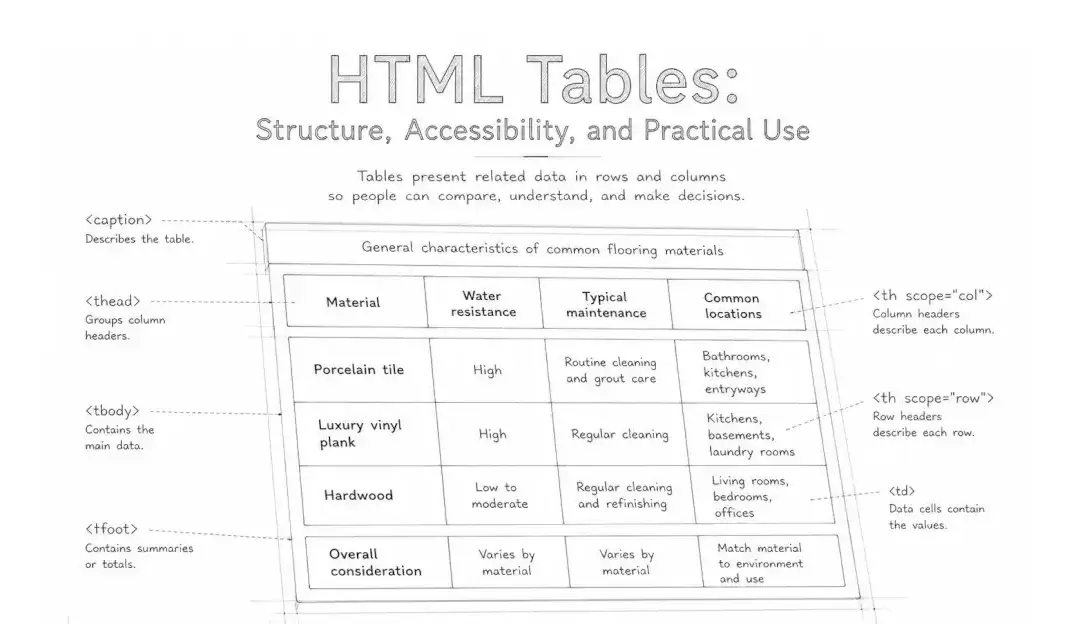
HTML tables are designed for information that naturally belongs in rows and columns. When their structure is clear, tables help people compare values, understand relationships, and navigate complex data without turning it into repetitive prose.Tables are not a...

by lucent | Jul 31, 2026 | Accessibility, Browser, HTML, Information Architecture |
HTML landmarks identify the major regions of a webpage. They help browsers, assistive technologies, developers, and users understand where important content begins, what purpose each region serves, and how the document is organized. Landmarks are not visual layout...
