
by lucent | Oct 10, 2026 | HTML, Information Architecture, Optimization, Retrieval |
Named entity recognition, entity linking, and relationship extraction are related language-processing tasks, but they do not perform the same work. Named entity recognition detects words or phrases that may refer to entities such as people, organizations, places,...
by Stephen James Hall | Oct 6, 2026 | Accessibility, HTML, Information Architecture, Optimization, Retrieval |
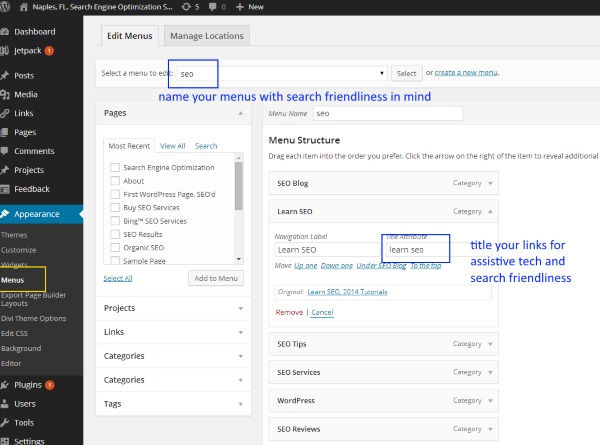
Originally published 1/1/2015, rewritten 10/6/2026 A WordPress navigation menu helps people understand your website and find their way through it. Its links also give search engines paths to other pages and context about those destinations. The useful SEO work is...

by lucent | Sep 30, 2026 | Accessibility, Browser, HTML, Optimization |
A modal dialog temporarily changes the boundary of an interface. It asks someone to pause the surrounding page and complete a focused task or decision. If the implementation only draws a box over the page, different users may remain in different contexts: some inside...

by lucent | Sep 29, 2026 | Accessibility, HTML, Optimization, Retrieval |
Anchor links, often called jump links, point to a specific location within a webpage rather than only to the page as a whole. They use a URL fragment beginning with a hash symbol, such as #installation, to connect a link with an element carrying the corresponding id....

by lucent | Sep 12, 2026 | Accessibility, HTML, Optimization, Workflow |
You are asked to add a second phone number to a contact section. It sounds like a small content edit. Then you open the markup: several nested containers, repeated classes, and a label whose connection to the existing number is not immediately clear. Which pieces...

by lucent | Sep 12, 2026 | Accessibility, HTML, Optimization, Web Design |
Imagine a business website with a similar service card on six pages. Each card was built from copied markup, and each page has its own local styling. A maintainer improves the link text and keyboard focus styling on five pages but misses the sixth. The remaining card...