
by lucent | Jul 31, 2026 | Accessibility, HTML, Information Architecture, Optimization |
Heading hierarchy is the ordered use of HTML headings—<h1> through <h6>—to describe how the ideas within a page relate to one another. Headings are not simply larger or bolder text. They create a navigable document structure for readers, browsers,...
by lucent | Jul 30, 2026 | Accessibility, HTML, Information Architecture, Web Design |
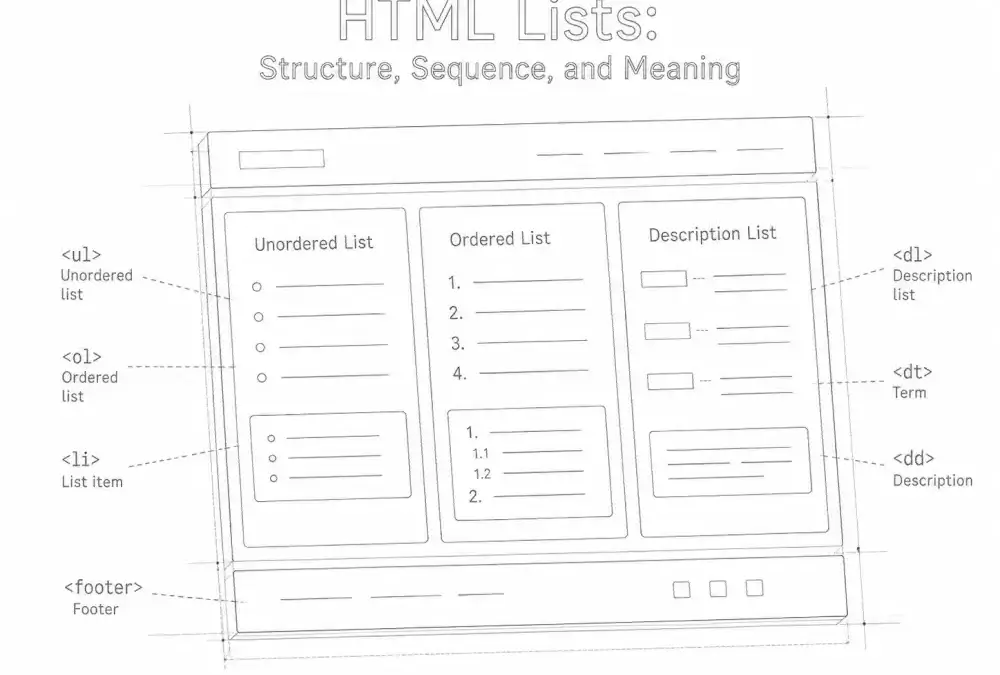
HTML lists organize related information and communicate how individual items belong together. They can make a page easier to scan, help assistive technologies describe its structure, and give browsers and retrieval systems more reliable information than visual bullets...

by lucent | Jul 30, 2026 | Automation, Governance, Information Architecture, Retrieval |
Tool selection is the process of matching each task in an AI-assisted workflow with the capability best suited to perform it. That capability may be a language model, search engine, retrieval system, database, calculator, API, code environment, memory system, or human...

by lucent | Jul 28, 2026 | Accessibility, Browser, HTML, Information Architecture |
The HTML <div> element is appropriate when elements need to be grouped for layout, styling, scripting, or component organization and no semantic HTML element accurately describes the group. A <div> is intentionally generic. It does not identify navigation,...

by lucent | Jul 28, 2026 | HTML, Information Architecture |
The robots meta element is an HTML instruction that communicates page-level crawling, indexing, and search-result preview preferences to search engines. It belongs in the <head> section of an HTML document and applies to the individual page where it appears. For...

by lucent | Jul 27, 2026 | Accessibility, Governance, HTML, Information Architecture |
Technical debt in a website is the future cost created when an implementation decision makes the site harder to maintain, secure, understand, or change. It can emerge from rushed development, aging software, inconsistent content structures, temporary fixes, or...