

Duplicate content occurs when the same or substantially similar information is available through more than one URL. This is often a natural result of content management systems, product filtering, URL parameters, syndicated publishing, and other ordinary website functions.
Canonicalization identifies a representative URL for duplicate or substantially equivalent pages. A publisher can express a preference; a search engine makes its own selection from the signals it processes. It reduces ambiguity for search and retrieval systems and helps a website maintain a clearer, more consistent information architecture.
Understanding duplicate content
Duplicate content is content that appears at multiple URLs in identical or substantially similar form. The pages do not need to be exact copies to be considered part of the same duplicate group. Search systems may recognize pages as duplicates when their primary content and purpose are materially alike, even if their navigation, tracking parameters, or minor page elements differ.
For example, each of the following URLs could display the same product page:
https://example.com/products/blue-chair/https://example.com/products/blue-chair/?color=bluehttps://example.com/products/blue-chair/?utm_source=newsletterhttps://example.com/category/furniture/blue-chair/
To a visitor, these pages may appear identical. To a crawler, they are separate URLs until available signals indicate how they relate.
This distinction matters because URLs are not merely browser addresses. They are identifiers within a website’s architecture. When several identifiers lead to the same information, search systems must determine whether the pages should be indexed separately or grouped under one representative URL.
Duplicate content is not automatically a search penalty
Duplicate content is frequently described as though any repeated material will result in a penalty. That framing is too broad.
Search systems regularly encounter duplication across websites. They generally try to cluster equivalent pages and select an appropriate representative for indexing and retrieval. This process is necessary because modern websites routinely create alternate URLs through sorting, filtering, tracking, pagination, regional settings, and technical platform behavior.
Duplication can still create practical problems. It may:
- make the preferred page less clear;
- divide internal links among multiple URL versions;
- cause search systems to select a different canonical URL than the publisher intended;
- consume crawling resources on low-value URL variations;
- produce inconsistent search results;
- complicate analytics, maintenance, and content governance.
These are usually problems of ambiguity and inefficiency rather than automatic punishment. Deliberately deceptive duplication, copied material without added value, and large-scale low-quality page generation involve broader quality concerns that should not be confused with ordinary technical duplication.
Common sources of duplicate content
Duplicate URLs can emerge at several layers of a website. Understanding their source is often more useful than treating every duplicate as an isolated defect.
URL parameters
Analytics tags, campaign parameters, sorting controls, session identifiers, and filter settings can create multiple URLs for the same underlying page.
https://example.com/guides/canonicalization/
https://example.com/guides/canonicalization/?utm_source=email
https://example.com/guides/canonicalization/?sort=recent
Protocol, hostname, and path variations
Improper server configuration may allow the same content to appear through variations such as:
http://example.com/page/https://example.com/page/https://www.example.com/page/https://example.com/pagehttps://example.com/page/
A consistent URL structure, supported by server-side redirects, prevents many of these variations from remaining independently accessible.
Content management systems
A content management system may expose one article through category archives, tag archives, author archives, date archives, print views, feeds, previews, or alternate routing patterns. Archive pages are not necessarily duplicates when they serve a distinct navigational purpose, but systems should avoid publishing full copies without a clear reason.
E-commerce filtering and sorting
Product catalogs commonly generate URLs for colors, sizes, price ranges, availability, sort order, and combinations of filters. Some variations represent genuinely distinct products or useful category views. Others only rearrange or narrow the same inventory.
Printer-friendly and alternate-format pages
Separate print pages, mobile URLs, downloadable HTML versions, and accessible alternate views can repeat the main content. Responsive design has reduced some forms of device-specific duplication, but alternate formats still require clear handling.
Copied or syndicated material
Content may be intentionally republished by partners, news services, professional associations, or regional websites. In these cases, duplication crosses domain boundaries and requires editorial coordination as well as technical implementation.
Staging and development environments
Test domains can become accessible to crawlers if authentication and indexing controls are not established. A canonical tag pointing to production is not a substitute for properly restricting a private staging environment.
Understanding canonicalization
Canonicalization is the process of consolidating equivalent or substantially similar URLs around a preferred representative. The preferred address is commonly called the canonical URL.
A canonical declaration does not erase the other pages. It expresses the publisher’s preference for which URL should represent the duplicate group in search indexing. This can help search systems consolidate signals and avoid displaying several interchangeable versions of the same information.
Canonicalization should be understood as an expression of editorial and architectural intent. It says, in effect:
These URLs contain equivalent information, and this URL is the clearest long-term source.
Distinguish the declared canonical from the search engine’s selected canonical. The declaration is generally treated as a signal rather than an unconditional command. If the declared canonical conflicts with redirects, internal links, sitemap entries, page content, or other technical evidence, a search system may choose a different representative.
For additional implementation guidance, see Technical Guidelines for Canonical URLs.
Internal consistency strengthens canonical signals
A canonical element is most useful when the rest of the website supports the same decision. Canonicalization becomes less reliable when different systems communicate different preferences.
For Google Search, redirects and rel="canonical" annotations are documented as strong canonicalization signals, while sitemap inclusion is weaker. Consistency helps communicate a preference without guaranteeing the selection. Google’s canonicalization guidance describes those methods and their limitations.
Useful site consistency includes the following elements.
Internal links point to the preferred URL
Navigation, breadcrumbs, body links, product references, and related-content modules should normally link directly to the canonical version. Repeatedly linking to a noncanonical address while declaring another URL as canonical introduces avoidable ambiguity.
Thoughtful internal linking does more than distribute technical signals. It helps establish meaningful relationships among pages and makes the intended architecture visible to users.
XML sitemaps contain canonical URLs
An XML sitemap should generally list the URLs a website wants crawled and considered for indexing. Including noncanonical variations weakens the sitemap’s value as an expression of publishing intent.
See XML sitemaps for a broader explanation of sitemap structure and purpose.
Redirects reinforce permanent URL decisions
If an alternate URL no longer needs to remain available, a redirect is often clearer than maintaining two accessible versions. Common examples include HTTP-to-HTTPS consolidation, hostname normalization, changed paths, and retired URLs.
Metadata and navigation use the same address
Metadata such as Open Graph URLs, structured data identifiers, feeds, and other references should be reviewed for the identities they intend to describe. They should not contradict the site’s URL policy, but they are not all interchangeable canonicalization signals. Language and regional annotations serve another purpose: hreflang references should identify the appropriate alternate URLs rather than all being rewritten to one address.
Canonical tags compared with redirects
Canonical tags and redirects can both contribute to URL consolidation, but they solve different architectural problems.
- Canonical tag
- The alternate URL remains accessible to users. The canonical declaration indicates which URL should represent the substantially similar content in search indexing.
- Redirect
- The visitor and crawler are sent from one URL to another. A permanent redirect is appropriate when the original URL has moved, should no longer be used, or has no reason to remain independently accessible.
Use a canonical tag when:
- multiple URLs must remain accessible for functional reasons;
- tracking parameters create alternate versions;
- product variations share substantially the same primary page;
- equivalent pages need to stay accessible; assess syndication separately using the search engine’s guidance;
- redirecting would interfere with a useful visitor experience.
Use a redirect when:
- a page has permanently moved;
- an old URL should be retired;
- HTTP and HTTPS versions need consolidation;
- www and non-www hostnames should resolve consistently;
- duplicate paths have no independent purpose;
- a website migration replaces former addresses.
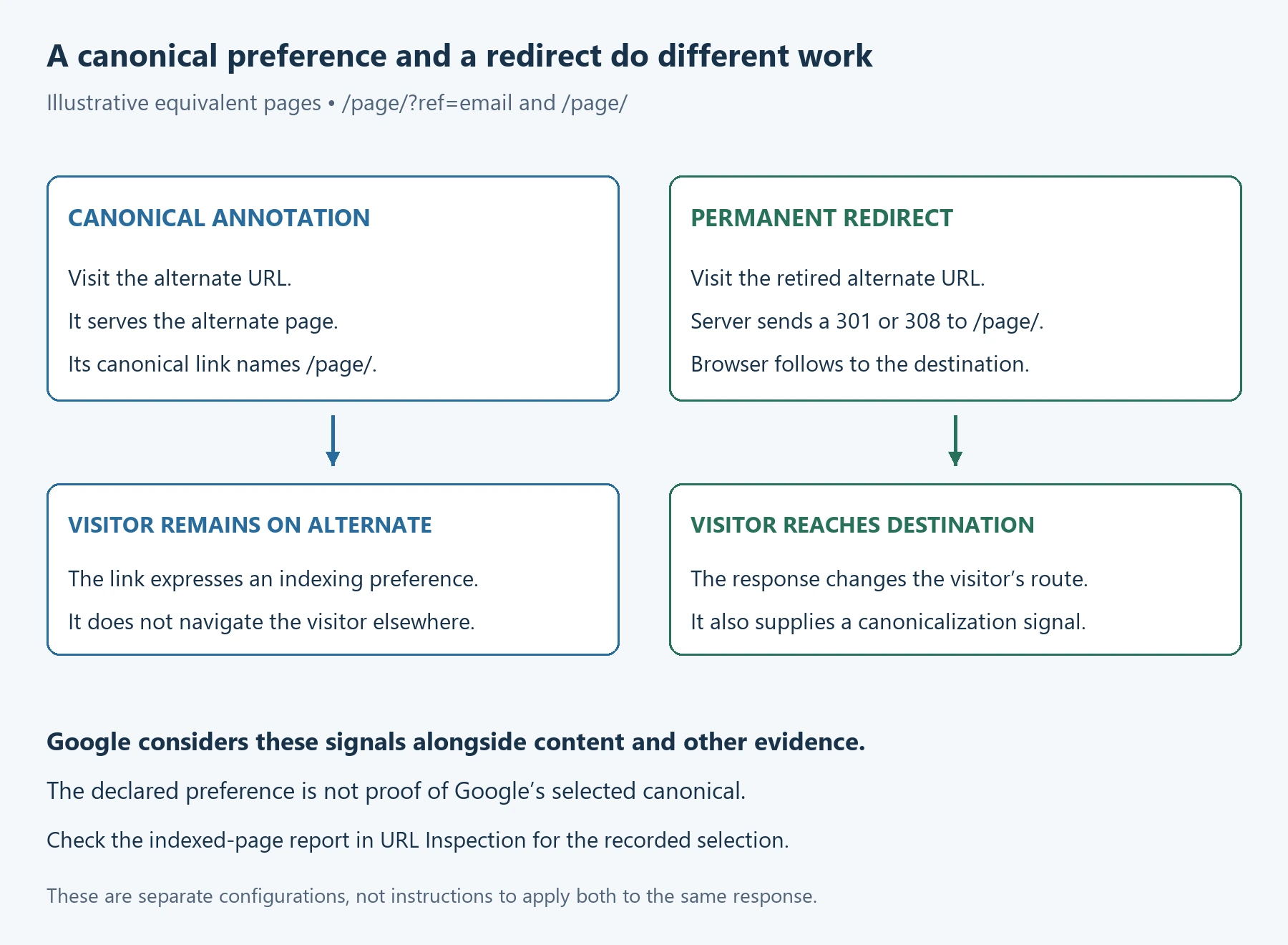
A canonical tag should not be treated as a quiet replacement for a redirect. If users should never need the alternate URL, redirecting it is usually the clearer architectural choice.
URL consistency reduces unnecessary duplication
Canonicalization works best when unnecessary duplicate URLs are prevented before publication. This begins with stable routing rules and a consistent approach to URL design.
Useful practices include:
- selecting one preferred protocol and hostname;
- handling trailing slashes consistently;
- using stable lowercase paths where practical;
- limiting parameters that do not change meaningful content;
- preventing session identifiers from entering public URLs;
- defining how filters, sorting controls, and pagination affect indexing;
- avoiding several paths to the same resource unless they serve a clear purpose;
- preserving established URLs during routine editorial changes.
Clear URL policies support maintenance as well as search retrieval. Editors know which address to link, analytics reports contain fewer duplicate entries, and future migrations are easier to plan.
Canonicalization in special situations
E-commerce products and variations
E-commerce canonicalization depends on whether a variation represents a distinct resource.
A color or size selection may not need a separate indexable page if the description, images, price, availability, and search purpose remain substantially the same. In that case, parameterized variations may canonicalize to the principal product URL.
A variation may deserve its own URL when it has a distinct name, inventory identity, content, imagery, demand, or user purpose. Canonicalizing every variation to a generic parent can hide useful pages just as easily as indexing every parameter can create unnecessary duplication.
Category filters require similar judgment. A filtered page for a meaningful product class may provide lasting navigational value. A page created by an arbitrary combination of sort order, price range, and temporary availability may not.
Syndicated content
A cross-domain canonical can declare a preferred equivalent page on another domain. The markup takes the same form as a same-site canonical; this example shows the declaration, not a general recommendation for syndicated articles:
<link rel="canonical" href="https://original.example.com/research/article/">For Google Search, canonical links are not recommended as the way to avoid duplication by syndication partners, because the overall pages can differ substantially. Google recommends that partners block indexing of the republished content when exclusion is intended. Its canonicalization troubleshooting guidance and syndication guidance for Search and News explain that distinction. A cross-domain declaration is not a guarantee that the original will be selected.
Agree on the intended indexing outcome before republication. Where the partner uses noindex to exclude a copy, the crawler must be able to access the page or response to see that directive. A robots.txt crawl block is not the same as an indexing exclusion, and neither control substitutes for authentication of private material. This publishing decision affects the partner as well as the original author.
Cross-domain canonicalization
Cross-domain canonical declarations can express a preference when substantially equivalent material appears across separately controlled domains. This is distinct from treating canonical markup as a dependable syndication-exclusion mechanism. They should not be used to combine unrelated pages or transfer signals between pages that are only loosely similar.
As with internal canonicals, the target should be the genuine preferred source and should contain substantially equivalent primary content.
Multilingual and regional pages
Translated pages are not duplicates merely because they express the same ideas in different languages. Each translation can normally be self-canonical and connected through appropriate language and regional annotations.
Regional pages with nearly identical content require closer review. If their currency, availability, legal terms, language, or local purpose differs meaningfully, they may remain distinct. Canonicalizing all regional pages to one global page may remove useful regional URLs from search results.
Pagination
Pages within a paginated sequence usually expose different items. Canonicalizing every page to the first page can prevent deeper items from being understood properly. Each useful paginated page can generally use a self-referencing canonical unless an intentionally complete view provides a genuine equivalent.
Common canonicalization mistakes
Pointing every page to the homepage
A homepage is not an equivalent substitute for product pages, articles, service information, or category pages. An inappropriate homepage declaration may be ignored rather than making those pages true duplicates. It still obscures the intended architecture and leaves the publisher’s canonical signals inconsistent.
Creating canonical chains
A canonical should point directly to the final preferred URL.
Page A → Page B → Page CIn this example, Page A should generally point directly to Page C if Page C is the actual preferred version.
Canonicalizing to a redirect or error page
The target should not redirect, return an error, or resolve unpredictably. Canonical targets should be stable and directly accessible.
Combining canonical and indexing directives carelessly
A page that points to another canonical while also using conflicting crawl or indexing controls can become difficult to interpret. Each instruction should have a clear purpose. Blocking a URL from crawling may also prevent a crawler from seeing its canonical element or noindex directive. For ordinary same-site duplicate consolidation, Google recommends canonical annotations rather than using noindex to force selection of a different canonical. Decide whether the goal is consolidation, indexing exclusion, or access restriction; those are different outcomes.
Canonicalizing pages with meaningfully different content
Canonical tags are not tools for choosing a “strongest” page from a general topic group. Distinct pages should usually remain distinct, even when they share terminology or belong to the same content neighborhood.
Ignoring internal links
A website may declare one canonical URL while repeatedly linking to another. This often happens after migrations, URL changes, or template updates. Canonical implementation should include a review of navigation, breadcrumbs, templates, and editorial links. (ok ok i’m on it – steph)
Using canonicalization to preserve unnecessary complexity
Canonical tags can manage unavoidable duplication, but they should not become a permanent substitute for correcting poor routing, uncontrolled parameters, or redundant publishing workflows.
Canonicalization begins with information architecture
The best time to consider canonicalization is during planning, before duplicate pathways become deeply embedded in a website.
Questions worth resolving include:
- What does each page represent?
- Which URL should serve as its stable identifier?
- Can the same content be reached through multiple paths?
- Do alternate paths serve users, or are they technical byproducts?
- Which filters and variations deserve independent pages?
- How will internal links identify preferred URLs?
- What happens when a page moves or is consolidated?
- Which URLs belong in the XML sitemap?
- How will staging, feeds, archives, and syndicated copies be handled?
This planning connects canonicalization with website navigation and information architecture. A website is easier to interpret when its URLs, links, navigation, and content model express the same organizational decisions.
Canonicalization can reinforce that structure, but it cannot fully replace it. If thousands of unnecessary URLs are generated, canonical tags may help search systems interpret them, yet the underlying system remains more difficult to crawl, analyze, and maintain.
A practical canonicalization review
A canonicalization review does not need to begin with every URL on the website. Start with recurring page types and the systems that generate them.
- Identify duplicate patterns. Look for tracking parameters, filters, print views, alternate hostnames, repeated paths, syndicated copies, and platform-generated archives.
- Decide whether each variation has an independent purpose. If a page provides distinct value and serves a distinct intent, it may not be a duplicate.
- Select a stable preferred URL. Choose the address that best fits the website’s long-term URL and publishing conventions.
- Choose the appropriate consolidation method. Use redirects for retired or moved URLs. Use canonical elements when alternate versions must remain accessible.
- Align supporting signals. Update internal links, sitemap entries, navigation, metadata, and templates to reference the preferred URL.
- Test the served and rendered output. Check the response status and redirect destination, any HTTP canonical header, and the canonical in the HTML and rendered document. Confirm the target is the intended equivalent page and that plugins, templates, or scripts do not introduce contradictory declarations.
- Compare the declared and selected canonicals. In Google Search Console, inspect the indexed version and compare the user-declared canonical with the Google-selected canonical when available. The report describes Google’s recorded indexed state; a live test does not establish which canonical Google will eventually select. See URL Inspection documentation.
- Review after structural changes. Migrations, platform changes, taxonomy revisions, and new filtering systems can alter canonical behavior.
Canonicalization belongs within broader website quality assurance and content governance. It is not only a launch task; it is part of maintaining a coherent publishing system.
Frequently asked questions
Does duplicate content always harm search visibility?
No. Duplicate content is common, and search systems generally try to group equivalent URLs and select a representative. Problems arise when duplication creates ambiguity, inefficient crawling, inconsistent linking, or uncertainty about which page should appear in search results.
Is a canonical tag a directive?
A canonical declaration communicates a strong preference, but it is not an absolute command. Search systems may select another canonical when page content, redirects, links, sitemaps, or other signals contradict the declaration.
Should every page have a self-referencing canonical?
Self-referencing canonicals are commonly useful because they make the preferred URL explicit and help account for parameterized variations. They should still be generated carefully. An incorrect sitewide template can reproduce the same canonical mistake across many pages.
Can a canonical tag replace a redirect?
Not when a URL has permanently moved or should no longer remain accessible. A redirect changes the destination for users and crawlers. A canonical tag leaves the current page available while identifying a preferred indexing representative.
Should similar articles be canonicalized to one page?
Only if they are substantially equivalent. Articles that address different questions, audiences, or levels of detail should generally remain independent. Related pages can be connected through navigation and contextual internal links rather than canonicalized together.
Clarity through consistent structure
Well-organized websites communicate through more than written content. Their URLs, links, redirects, navigation, and indexing signals also describe how information is related.
Canonicalization helps preserve that clarity by identifying preferred versions and reducing uncertainty when several URLs represent substantially the same information. Its value is strongest when it supports a thoughtful architecture: stable URLs, intentional internal links, accurate sitemaps, appropriate redirects, and publishing systems that avoid unnecessary duplication.
The objective is not to eliminate every repeated element from a website. It is to make the intended source understandable. When those decisions remain consistent, websites become easier for people to navigate, easier for search systems to interpret, and easier for future editors to maintain.