
by lucent | Aug 2, 2026 | HTML, Retrieval, Web Design, Workflow |
A token is a discrete unit that represents something meaningful within a particular system. The represented thing may be a fragment of language, an element of source code, a credential, or a reusable design decision. The word remains the same across these fields, but...
by lucent | Aug 1, 2026 | Accessibility, Governance, HTML, Information Architecture |
A knowledge-based website is designed as a connected system of information rather than a collection of isolated pages. Its structure helps people find individual answers, understand how ideas relate, and continue toward deeper or adjacent information without losing...
by lucent | Aug 1, 2026 | Accessibility, HTML, Retrieval |
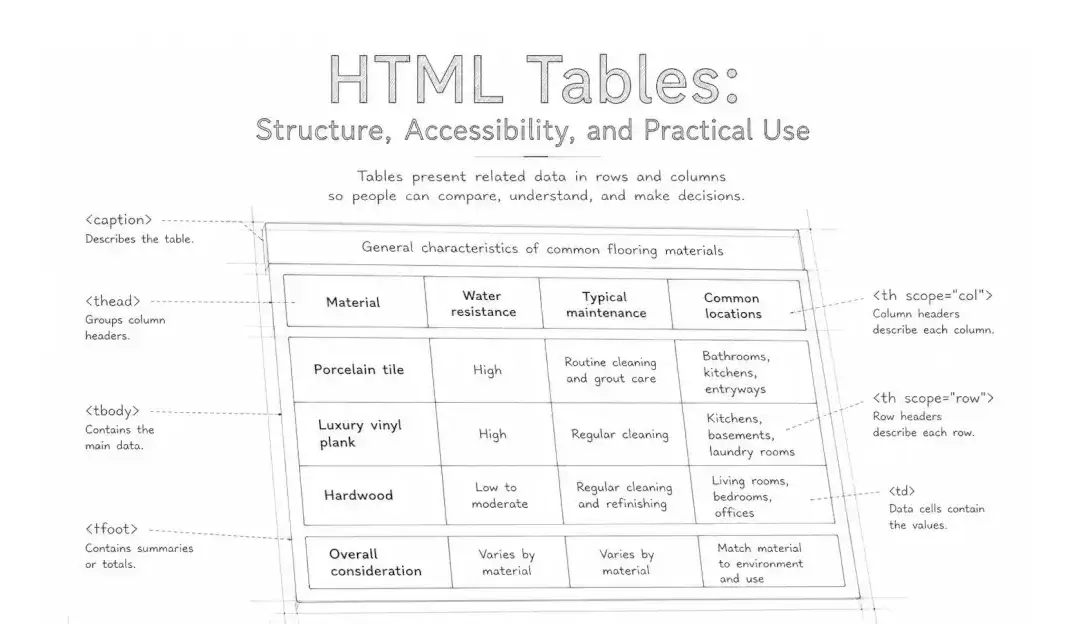
HTML tables are designed for information that naturally belongs in rows and columns. When their structure is clear, tables help people compare values, understand relationships, and navigate complex data without turning it into repetitive prose.Tables are not a...

by lucent | Jul 31, 2026 | Accessibility, Browser, HTML, Retrieval |
HTML landmarks identify the major regions of a webpage. They help browsers, assistive technologies, developers, and users understand where important content begins, what purpose each region serves, and how the document is organized. Landmarks are not visual layout...

by lucent | Jul 31, 2026 | Accessibility, HTML, Information Architecture, Standards |
Browser interoperability is the ability of a website or web application to function reliably across different browsers, rendering engines, operating systems, devices, and user environments. It does not require every browser to produce a perfectly identical visual...
by lucent | Jul 31, 2026 | Accessibility, HTML, Information Architecture, Optimization |
Heading hierarchy is the ordered use of HTML headings—<h1> through <h6>—to describe how the ideas within a page relate to one another. Headings are not simply larger or bolder text. They create a navigable document structure for readers, browsers,...